
Penny Dreadfuls, 1849 · page 89 of 394
The Mysteries of the Court of London — page 89: what you’re looking at
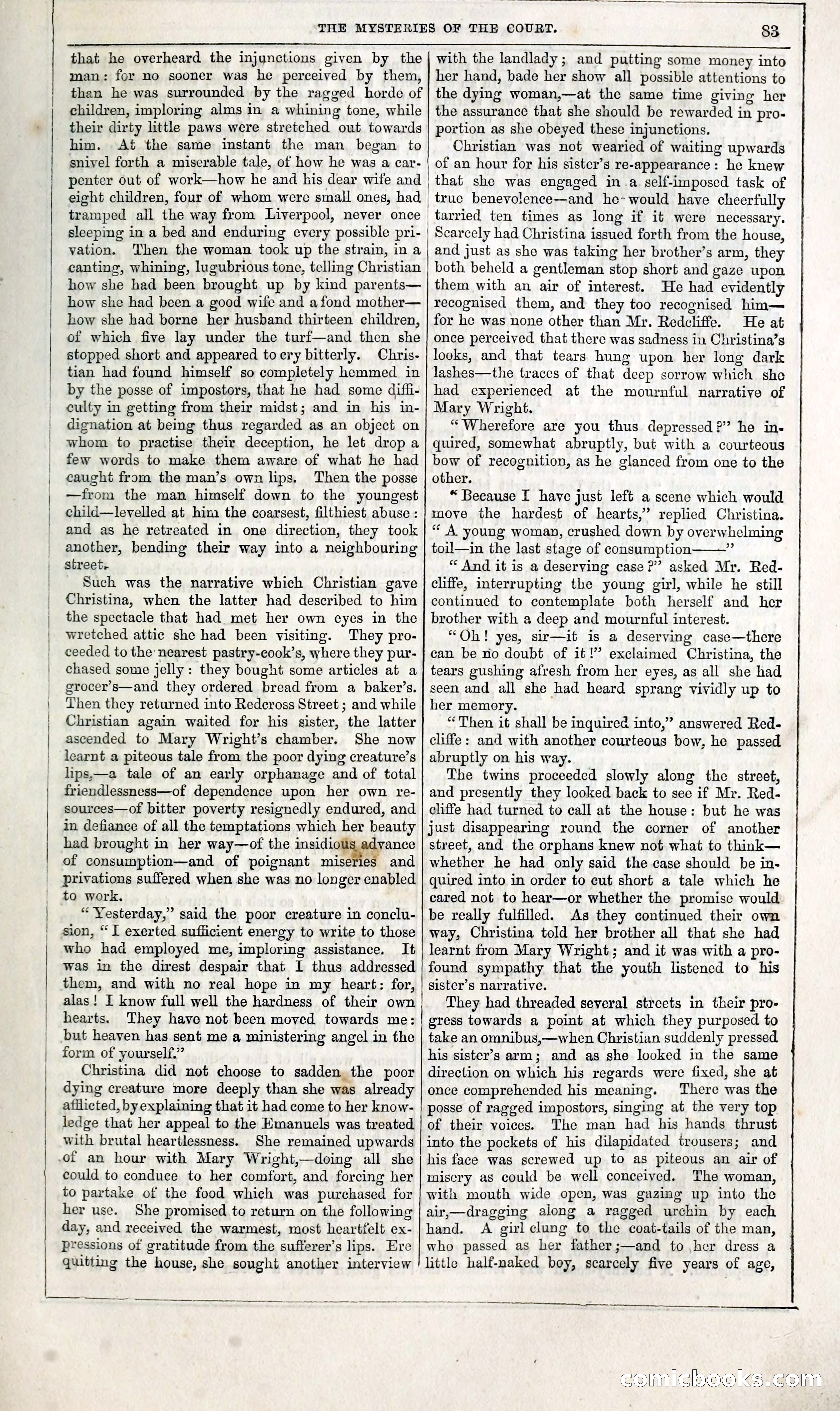
A restored page from Penny Dreadfuls, 1849. Page through the whole issue in the reader above.
📄 Transcribed text from this page (OCR, searchable)
Machine-transcribed from the original scan — historical spelling and the odd misread are preserved.
ce THE MYSTERIES OF THE COURT. 83 that he overheard the injunctions given by the man: for no sooner was he perceived by them, than he was surrounded by the ragged horde of children, imploring alms in a whining tone, while their dirty little paws were stretched out towards him. At the same mstant the man began to sniyel forth a miserable tale, of how he was a car- penter out of work—how he and his dear wife and eight children, four of whom were small ones, had tramped all the way from Liverpool, never once sleeping in a bed and enduring every possible pri- vation. Then the woman took up the strain, in a canting, whining, lugubrious tone, telling Christian how she had been brought up by kind parents— how she had been a good wife and afond mother— how she had borne her husband thirteen children, of which five lay under the turf—and then she stopped short and appeared toecry bitterly. Chris- tian had found himself so completely hemmed in by the posse of impostors, that he had some diffi- culty in getting from their midst; and in his in- dignation at being thus regarded as an object on whom to practise their deception, he let drop a few words to make them aware of what he had caught from the man’s own lips. Then the posse —from the man himself down to the youngest child—levelled at him the coarsest, filthiest abuse : and as he retreated in one direction, they took another, bending their way into a neighbouring street, Such was the narrative which Christian gave Christina, when the latter had described to him the spectacle that had met her own eyes in the wretched attic she had been visiting. They pro- ceeded to the nearest pastry-cook’s, where they pur- chased some jelly: they bought some articles at a grocer’s—and they ordered bread from a baker’s. Then they returned into Redcross Street ; and while Christian again waited for his sister, the latter ascended to Mary Wright’s chamber. She now learnt a piteous tale from the poor dying creature’s lips,—a tale of an early orphanage and of total friendlessness—of dependence upon her own re- sources—of bitter poverty resignedly endured, and in defiance of all the temptations which her beauty had brought in her way—of the insidiows advance of consumption—and of poignant miseries and privations suffered when she was no longer enabled to work. “Yesterday,” said the poor creature in conclu- sion, “I exerted sufficient energy to write to those who had employed me, imploring assistance. It was in the direst despair that I thus addressed them, and with no real hope in my heart: for, alas! I know full well the hardness of their own hearts. They have not been moved towards me: but heaven has sent me a ministering angel in the form of yourself,” Christina did not choose to sadden the poor dying creature more deeply than she was already atilicted, by explaining that it had come to her know- ledge that her appeal to the Emanuels was treated with brutal heartlessness. She remained upwards of an hour with Mary Wright,—doing all she could to conduce to her comfort, and forcing her to partake of the food which was purchased for her use. She promised to return on the following day, and received the warmest, most heartfelt ex- pressions of gratitude from the sufferer’s lips. Ere quitting the house, she sought another interview —————— ee ee with the landlady; and putting some money into her hand, bade her show all possible attentions to the dying woman,—at the same time giving her the assurance that she should be rewarded in pro- portion as she obeyed these injunctions. Christian was not wearied of waiting upwards of an hour for his sister’s re-appearance: he knew that she was engaged in a self-imposed task of true benevolence—and he-would have cheerfully tarried ten times as long if it were necessary. Scarcely had Christina issued forth from the house, and just as she was taking her brother’s arm, they both beheld a gentleman stop short and gaze upon them with an air of interest. He had evidently recognised them, and they too recognised him— for he was none other than Mr. Redcliffe. He at once perceived that there was sadness in Christina’s looks, and that tears hung upon her long dark lashes—the traces of that deep sorrow which she had experienced at the mournful narrative of Mary Wright. “Wherefore are you thus depressed 2” he in- quired, somewhat abruptly, but with a courteous bow of recognition, as he glanced from one to the other. “ Because I have just left a scene which would move the hardest of hearts,” replied Christina. “ A young woman, crushed down by overwhelming toil—in the last stage of consumption 44 “ And it is a deserving case?’ asked Mr. Red- cliffe, interrupting the young girl, while he still continued to contemplate both herself and her brother with a deep and mournful interest. “Oh! yes, sir—it is a deserving case—there can be no doubt of it!” exclaimed Christina, the tears gushing afresh from her eyes, as all she had seen and all she had heard sprang vividly up to her memory. “Then it shall be inquired into,” answered Red- cliffe: and with another courteous bow, he passed abruptly on his way. The twins proceeded slowly alone the street, and presently they looked back to see if Mr. Red- cliffe had turned to call at the house: but he was just disappearing round the corner of another street, and the orphans knew not what to think— whether he had only said the case should be in- quired into in order to cut short a tale which he cared not to hear—or whether the promise would be really fulfilled. As they continued their own way, Christina told her brother all that she had learnt from Mary Wright; and it was with a pro- found sympathy that the youth listened to his sister’s narrative. They had threaded several streets in their pro- gress towards a point at which they purposed to take an omnibus,—when Christian suddenly pressed his sister’s arm; and as she looked in the same direction on which his regards were fixed, she at once comprehended his meaning. There was the posse of ragged impostors, singing at the very top of their voices. The man had his hands thrust into the pockets of his dilapidated trousers; and his face was screwed up to as piteous an air of misery as could be well conceived. The woman, with mouth wide open, was gazing up into the air,—dragging along a ragged urchin by each hand. A girl clung to the coat-tails of the man, who passed as her father;—and to her dress a little half-naked boy, scarcely five years of age, pia 95 .| COMIICMOOOKS (E©)