
Penny Dreadfuls, 1849 · page 86 of 394
The Mysteries of the Court of London — page 86: what you’re looking at
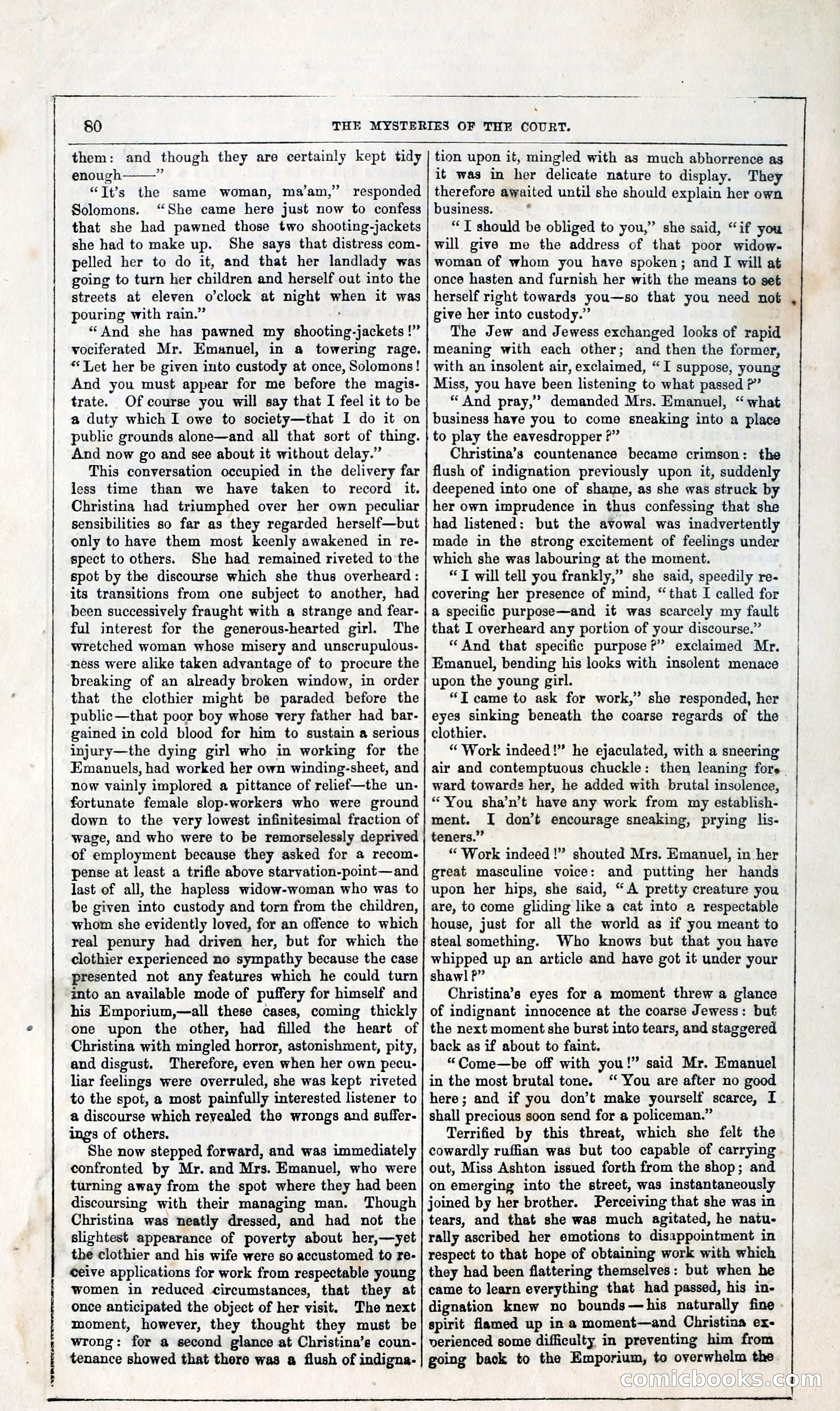
A restored page from Penny Dreadfuls, 1849. Page through the whole issue in the reader above.
📄 Transcribed text from this page (OCR, searchable)
Machine-transcribed from the original scan — historical spelling and the odd misread are preserved.
80 THE MYSTERIES OF THE COURT. them: and though they are certainly kept tidy enough 4 “Tt?s the same woman, ma’am,” responded Solomons. “She came here just now to confess that she had pawned those two shooting-jackets she had to make up. She says that distress com- pelled her to do it, and that her landlady was going to turn her children and herself out into the streets at eleven o’clock at night when it was pouring with rain.” “And she has pawned my shooting-jackets vociferated Mr. Emanuel, in a towering rage. “Let her be given into custody at once, Solomons! And you must appear for me before the magis- trate. Of course you will say that I feel it to be a duty which I owe to society—that I do it on public grounds alone—and all that sort of thing. And now go and see about it without delay.” This conversation occupied in the delivery far less time than we have taken to record it. Christina had triumphed over her own peculiar sensibilities so far as they regarded herself—but only to have them most keenly awakened in re- spect to others. She had remained riveted to the spot by the discourse which she thus overheard: its transitions from one subject to another, had been successively fraught with a strange and fear- ful interest for the generous-hearted girl. The wretched woman whose misery and unscrupulous- ness were alike taken advantage of to procure the breaking of an already broken window, in order that the clothier might be paraded before the public—that poor boy whose very father had bar- gained in cold blood for him to sustain a serious injury—the dying girl who in working for the Emanuels, had worked her own winding-sheet, and now vainly implored a pittance of relief—the un- fortunate female slop-workers who were ground down to the very lowest infinitesimal fraction of wage, and who were to be remorselessly deprived of employment because they asked for a recom- pense at least a trifle above starvation-pomt—and last of all, the hapless widow-woman who was to be given into custody and torn from the children, whom she evidently loved, for an offence to which real penury had driven her, but for which the clothier experienced no sympathy because the case presented not any features which he could turn into an available mode of puffery for himself and his Emporium,—all these cases, coming thickly one upon the other, had filled the heart of Christina with mingled horror, astonishment, pity, and disgust. Therefore, even when her own pecu- liar feelings were overruled, she was kept riveted to the spot, a most painfully interested listener to a discourse which reyealed the wrongs and suffer- ings of others. She now stepped forward, and was immediately confronted by Mr. and Mrs. Emanuel, who were turning away from the spot where they had been discoursing with their managing man. Though Christina was neatly dressed, and had not the slightest appearance of poverty about her,—yet the clothier and his wife were so accustomed to re- ceive applications for work from respectable young Women in reduced circumstances, that they at once anticipated the object of her visit. The next moment, however, they thought they must be wrong: for a second glance at Christina’e coun- tenance showed that there was a flush of indigna- >? e tion upon it, mingled with as much abhorrence as it was in her delicate nature to display. They therefore awaited until she should explain her own business. : “YT should be obliged to you,” she said, “if you will give me the address of that poor widow- woman of whom you have spoken; and I will at once hasten and furnish her with the means to set herself right towards you—so that you need not give her into custody.” The Jew and Jewess exchanged looks of rapid meaning with each other; and then the former, with an insolent air, exclaimed, “I suppose, young Miss, you have been listening to what passed P” “And pray,” demanded Mrs. Emanuel, “what business have you to come sneaking into a place to play the eavesdropper ?” Christina’s countenance became crimson: the flush of indignation previously upon it, suddenly deepened into one of shame, as she was struck by her own imprudence in thus confessing that she had listened: but the avowal was inadvertently made in the strong excitement of feelings under which she was labouring at the moment. “T will tell you frankly,” she said, speedily re- covering her presence of mind, “that I called for a specific purpose—and it was scarcely my fault that I overheard any portion of your discourse.” * And that specific purpose?” exclaimed Mr. Emanuel, bending his looks with insolent menace upon the young girl. “T came to ask for work,’ she responded, her eyes sinking beneath the coarse regards of the clothier. “Work indeed!” he ejaculated, with a sneering air and contemptuous chuckle: then leaning fore. ward towards her, he added with brutal insolence, “You sha’n’t have any work from my establish- ment. I don’t encourage sneaking, prying lis- teners.” “ Work indeed!” shouted Mrs. Emanuel, in her great masculine voice: and putting her hands upon her hips, she said, “A pretty creature you are, to come gliding like a cat into a respectable house, just for all the world as if you meant to steal something. Who knows but that you have whipped up an article and have got it under your shawl P” Christina’s eyes for a moment threw a glance of indignant innocence at the coarse Jewess: but the next moment she burst into tears, and staggered back as if about to faint. “Come—be off with you!” said Mr. Emanuel in the most brutal tone. “ You are after no good here; and if you don’t make yourself scarce, I shall precious soon send for a policeman.” Terrified by this threat, which she felt the cowardly ruffian was but too capable of carrying out, Miss Ashton issued forth from the shop; and on emerging into the street, was instantaneously joined by her brother. Perceiving that she was in tears, and that she was much agitated, he natu- rally ascribed her emotions to disappointment in respect to that hope of obtaining work with which they had been flattering themselves: but when he came to learn everything that had passed, his in- dignation knew no bounds—his naturally fine spirit flamed up in a moment—and Christina ex- verienced some difficulty in preventing him from going back to the Emporium, to overwhelm the Comicwvooks (C@)