
Penny Dreadfuls, 1849 · page 83 of 394
The Mysteries of the Court of London — page 83: what you’re looking at
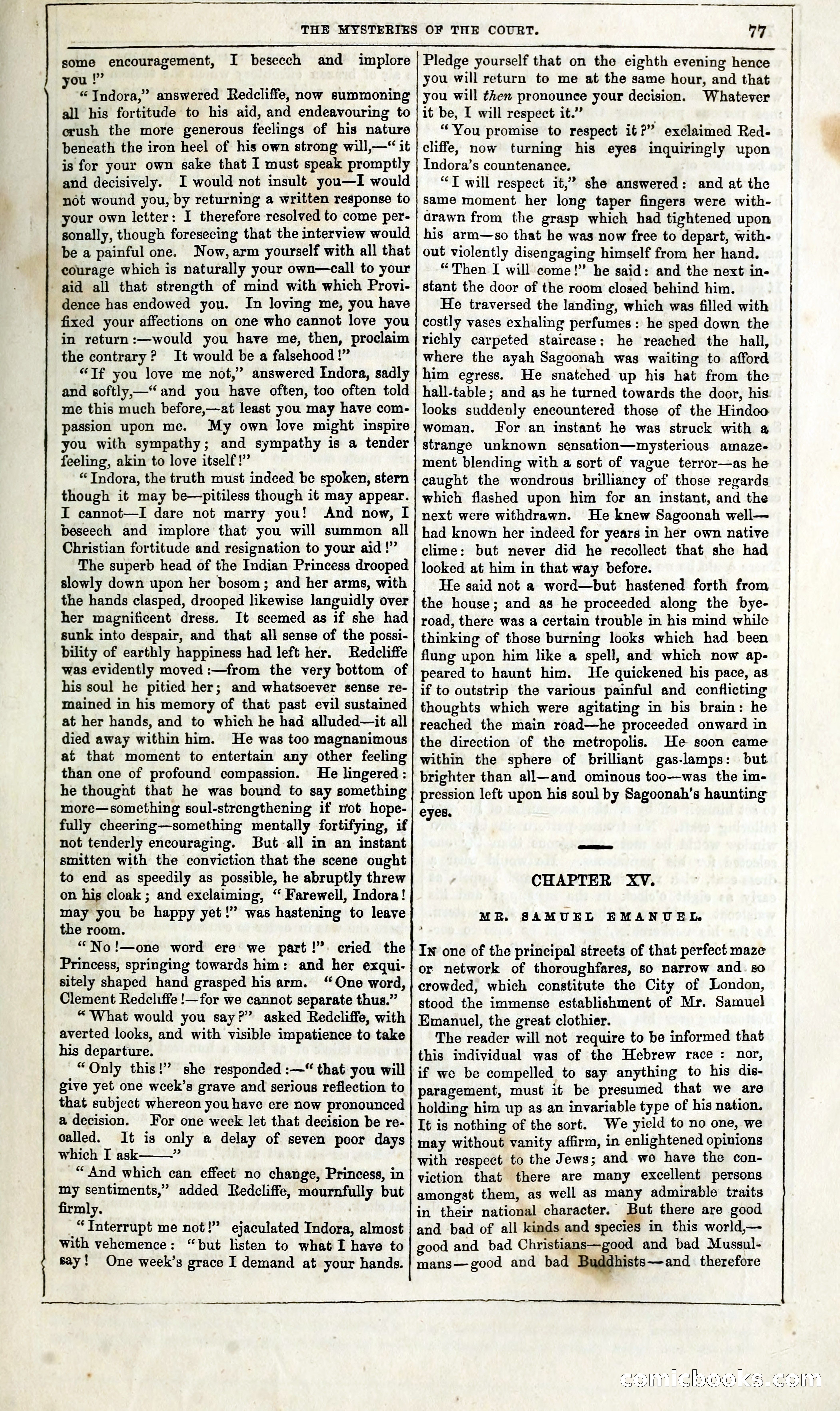
A restored page from Penny Dreadfuls, 1849. Page through the whole issue in the reader above.
📄 Transcribed text from this page (OCR, searchable)
Machine-transcribed from the original scan — historical spelling and the odd misread are preserved.
THE MYSTERIES OF THE COURT. some encouragement, I beseech and implore our’ a Indora,” answered Redcliffe, now summoning all his fortitude to his aid, and endeavouring to crush the more generous feelings of his nature beneath the iron heel of his own strong will,—“ it is for your own sake that I must speak promptly and decisively. I would not insult you—I would not wound you, by returning a written response to your own letter: I therefore resolved to come per- sonally, though foreseeing that the interview would be a painful one. Now, arm yourself with all that courage which is naturally your own—call to your aid all that strength of mind with which Provi- dence has endowed you. In loving me, you have fixed your affections on one who cannot love you in return:—would you have me, then, proclaim the contrary? It would be a falsehood !” “Tf you love me not,” answered Indora, sadly and softly,—“ and you have often, too often told me this much before,—at least you may have com- passion upon me. My own love might inspire you with sympathy; and sympathy is a tender feeling, akin to love itself!” “‘Tndora, the truth must indeed be spoken, stern though it may be—pitiless though it may appear. I cannot—I dare not marry you! And now, I beseech and implore that you will summon all Christian fortitude and resignation to your aid !” The superb head of the Indian Princess drooped slowly down upon her bosom; and her arms, with the hands clasped, drooped likewise languidly over her magnificent dress. It seemed as if she had sunk into despair, and that all sense of the possi- bility of earthly happiness had left her. Redcliffe was evidently moved :—from the very bottom of his soul he pitied her; and whatsoever sense re- mained in his memory of that past evil sustained at her hands, and to which he had alluded—it all died away within him. He was too magnanimous at that moment to entertain any other feeling than one of profound compassion. He lingered: he thougnt that he was bound to say something more—something soul-strengthening if rot hope- fully cheering—something mentally fortifying, if not tenderly encouraging. But all in an instant smitten with the conviction that the scene ought to end as speedily as possible, he abruptly threw on his cloak ; and exclaiming, “ Farewell, Indora! may you be happy yet!” was hastening to leave the room. ““No!—one word ere we part!”. cried the Princess, springing towards him: and her exqui- sitely shaped hand grasped his arm. “One word, Clement Redcliffe !—for we cannot separate thus.” “What would you say?” asked Redcliffe, with averted looks, and with visible impatience to take his departure. “Only this!” she responded :—“ that you will give yet one week’s grave and serious reflection to that subject whereon you have ere now pronounced a decision. For one week let that decision be re- called. It is only a delay of seven poor days which I ask is “And which can effect no change, Princess, in my sentiments,” added Redcliffe, mournfully but firmly. _“Tnterrupt me not!” ejaculated Indora, almost with vehemence: “but listen to what I have to say! One week’s grace I demand at your hands. 77 Pledge yourself that on the eighth evening hence you will return to me at the same hour, and that you will then pronounce your decision. Whatever it be, I will respect it.” 7 “You promise to respect it?” exclaimed Red- cliffe, now turning his eyes inquiringly upon Indora’s countenance. “T will respect it,” she answered: and at the same moment her long taper fingers were with- drawn from the grasp which had tightened upon his arm—so that he was now free to depart, with- out violently disengaging himself from her hand. “Then I will come!” he said: and the next in- stant the door of the room closed behind him. He traversed the landing, which was filled with costly vases exhaling perfumes: he sped down the richly carpeted staircase: he reached the hall, where the ayah Sagoonah was waiting to afford him egress. He snatched up his hat from the hall-table; and as he turned towards the door, his looks suddenly encountered those of the Hindoo woman. For an instant he was struck with a strange unknown sensation—mysterious amaze- ment blending with a sort of vague terror—as he caught the wondrous brilliancy of those regards which flashed upon him for an instant, and the next were withdrawn. He knew Sagoonah well— had known her indeed for years in her own native clime: but never did he recollect that she had looked at him in that way before. He said not a word—but hastened forth from the house; and as he proceeded along the bye- road, there was a certain trouble in his mind while thinking of those burning looks which had been flung upon him like a spell, and which now ap- peared to haunt him. He quickened his pace, as if to outstrip the various painful and conflicting thoughts which were agitating in bis brain: he reached the main road—he proceeded onward in the direction of the metropolis. He soon came within the sphere of brilliant gas-lamps: but. brighter than all—and ominous too—was the im- pression left upon his soul by Sagoonah’s haunting eyes. CHAPTER XV. ME. SAMUEL EMANUEL In one of the principal streets of that perfect maze or network of thoroughfares, so narrow and. so crowded, which constitute the City of London, stood the immense establishment of Mr. Samuel Emanuel, the great clothier. The reader will not require to be informed that this individual was of the Hebrew race : nor, if we be compelled to say anything to his dis- paragement, must it be presumed that we are holding him up as an invariable type of his nation. It is nothing of the sort. We yield to no one, we may without vanity affirm, in enlightened opinions with respect to the Jews; and we have the con- viction that there are many excellent persons amongst them, as well as many admirable traits in their national character. But there are good and bad of all kinds and species in this world,— good and bad Christians—good and bad Mussul- mans—good and bad Buddhists —and therefore —_---— (C(O) SH 6)(0)(0) (C(O)