
Penny Dreadfuls, 1849 · page 73 of 394
The Mysteries of the Court of London — page 73: what you’re looking at
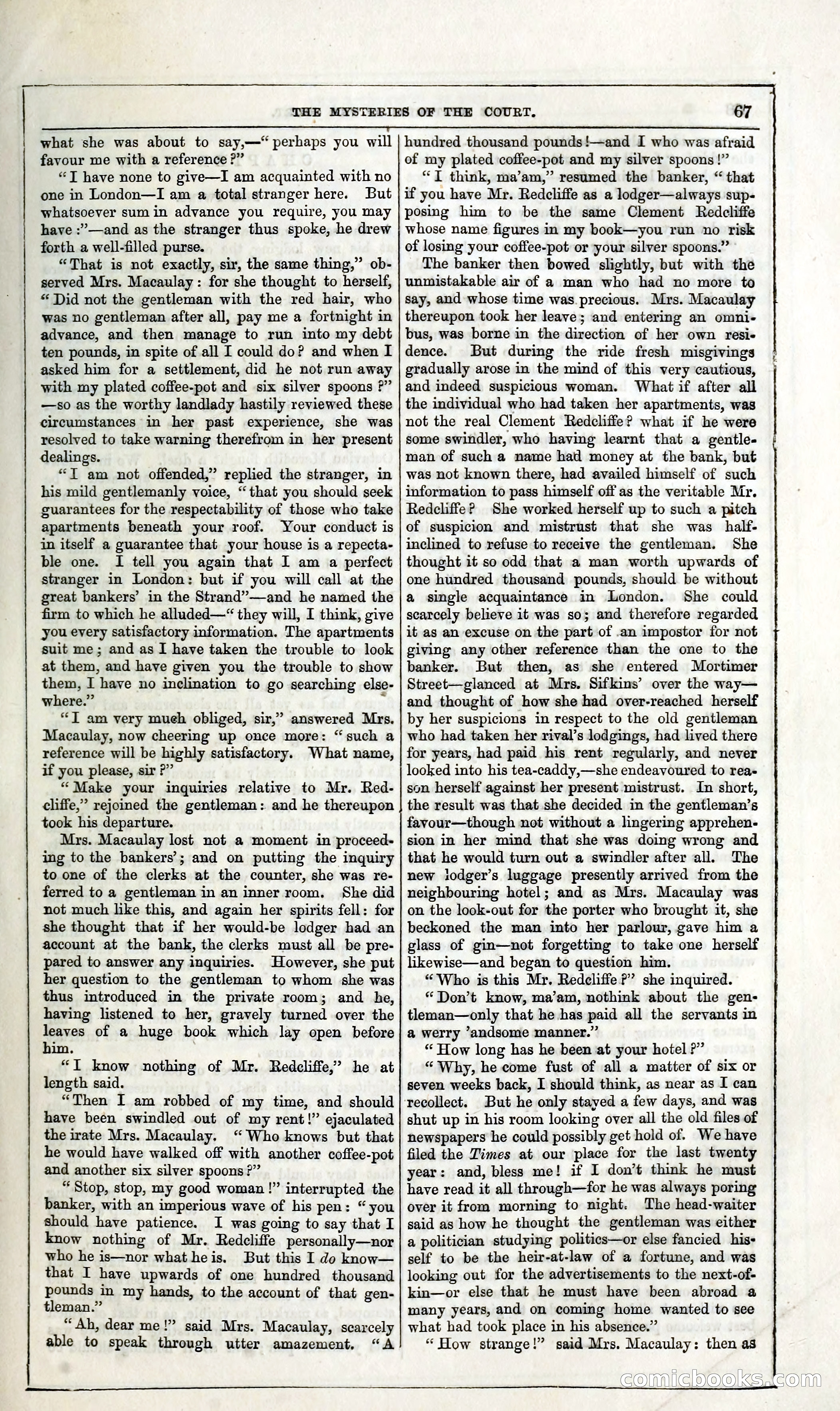
A restored page from Penny Dreadfuls, 1849. Page through the whole issue in the reader above.
📄 Transcribed text from this page (OCR, searchable)
Machine-transcribed from the original scan — historical spelling and the odd misread are preserved.
THE MYSTERIES OF THE COURT. what she was about to say,—“ perhaps you will favour me with a reference ?” “T have none to give—I am acquainted with no one in London—I am a total stranger here. But whatsoever sum in advance you require, you may have :’—and as the stranger thus spoke, he drew forth a well-filled purse. “That is not exactly, sir, the same thing,” ob- served Mrs. Macaulay : for she thought to herself, “Did not the gentleman with the red hair, who was no gentleman after all, pay me a fortnight in advance, and then manage to run into my debt ten pounds, in spite of all I could do? and when I asked him for a settlement, did he not run away with my plated coffee-pot and six silver spoons ?” —so as the worthy landlady hastily reviewed these circumstances in her past experience, she was resolved to take warning therefrom in her present dealings. “T am not offended,’ replied the stranger, in his mild gentlemanly voice, “that you should seek guarantees for the respectability of those who take apartments beneath your roof. Your conduct is in itself a guarantee that your house is a repecta- ble one. I tell you again that I am a perfect stranger in London: but if you will call at the great bankers’ in the Strand”—and he named the firm to which he alluded—“ they will, I think, give you every satisfactory information. The apartments suit me; and as I have taken the trouble to look at them, and have given you the trouble to show them, I have no inclination to go searching else- where.” " “T am very mueh obliged, sir,” answered Mrs. Macaulay, now cheering up once more: “such a reference will be highly satisfactory. What name, if you please, sir P” “Make your inquiries relative to Mr. Red- cliffe,” rejoined the gentleman: and he thereupon took his departure. Mrs. Macaulay lost not a moment in proceed- ing to the bankers’; and on putting the inquiry to one of the clerks at the counter, she was re- ferred to a gentleman in an inner room. She did not much like this, and again her spirits fell: for she thought that if her would-be lodger had an account at the bank, the clerks must all be pre- pared to answer any inquiries. However, she put her question to the gentleman to whom she was thus introduced in the private room; and he, having listened to her, gravely turned over the leaves of a huge book which lay open before “YT know nothing of Mr. Redcliffe,” he at length said. “Then I am robbed of my time, and should have been swindled out of my rent!” ejaculated the irate Mrs. Macaulay. “Who knows but that he would have walked off with another coffee-pot and another six silver spoons ?” “Stop, stop, my good woman!” interrupted the banker, with an imperious wave of his pen: “you should have patience. I was going to say that I know nothing of Mr. Redcliffe personally—nor who he is—nor what heis. But this I do know— that I have upwards of one hundred thousand pounds in my hands, to the account of that gen- tleman.” “Ah, dear me!” said Mrs. Macaulay, scarcely able to speak through utter amazement. “A 67 hundred thousand pounds!—and I who was afraid of my plated coffee-pot and my silver spoons !” “I think, ma’am,” resumed the banker, “ that if you have Mr. Redcliffe as a lodger—always sup- posing him to be the same Clement Redcliffe whose name figures in my book—you run no risk of losing your coffee-pot or your silver spoons.” The banker then bowed slightly, but with the unmistakable air of a man who had no more to say, and whose time was. precious. Mrs. Macaulay thereupon took her leave; and entering an omni- bus, was borne in the direction of her own resie dence. But during the ride fresh misgivings gradually arose in the mind of this very cautious, and indeed suspicious woman. What if after all the individual who had taken her apartments, was not the real Clement Redcliffe? what if he were some swindler, who having learnt that a gentle- man of such a name had money at the bank, but was not known there, had availed himself of such information to pass himself off as the veritable Mr. Redcliffe? She worked herself up to such a pitch of suspicion and mistrust that she was half- inclined to refuse to receive the gentleman. She thought it so odd that a man worth upwards of one hundred thousand pounds, should be without a single acquaintance in London. She could scarcely believe it was so; and therefore regarded it as an excuse on the part of .an impostor for not giving any other reference than the one to the banker. But then, as she entered Mortimer Street—glanced at Mrs. Sifkins’ over the way— and thought of how she had over-reached herself by her suspicions in respect to the old gentleman who had taken her rival’s lodgings, had lived there for years, had paid his rent regularly, and never looked into his tea-caddy,—she endeavoured to reas son herself against her present mistrust. In short, the result was that she decided in the gentleman’s favour—though not without a lingering apprehen- sion in her mind that she was doing wrong and that he would turn out a swindler after all. The new lodger’s luggage presently arrived from the neighbouring hotel; and as Mrs. Macaulay was on the look-out for the porter who brought it, she beckoned the man into her parlour, gave him a glass of gin—not forgetting to take one herself likewise—and began to question him. “Who is this Mr. Redcliffe?” she inquired. * Don’t know, ma’am, nothink about the gen- tleman—only that he has paid all the servants in a werry ’andsome manner.” “ How long has he been at your hotel ?” “ Why, he come fust of all a matter of six or seven weeks back, I should think, as near as I can recollect. But he only stayed a few days, and was shut up in his room looking over all the old files of newspapers he could possibly get hold of. We have filed the Times at our place for the last twenty year: and, bless me! if I don’t think he must have read it all through—for he was always poring over it from morning to night. The head-waiter said as how he thought the gentleman was either a politician studying politics—or else fancied his- self to be the heir-at-law of a fortune, and was looking out for the advertisements to the next-of- kin—or else that he must have been abroad a many years, and on coming home wanted to see what had took place in his absence.” “ How strange!” said Mrs. Macaulay: then as 6)(0)(0) Gol