
Penny Dreadfuls, 1849 · page 56 of 394
The Mysteries of the Court of London — page 56: what you’re looking at
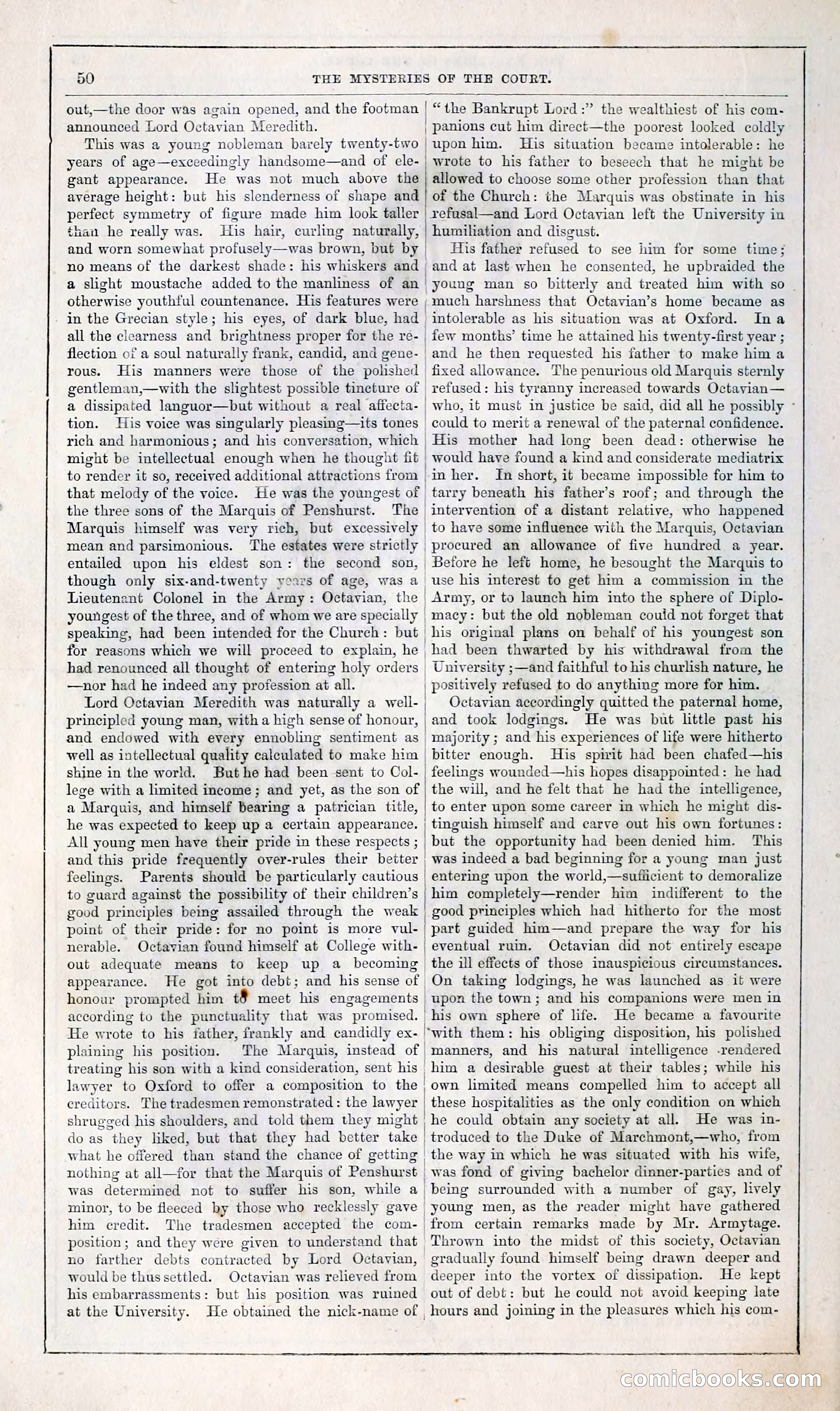
A restored page from Penny Dreadfuls, 1849. Page through the whole issue in the reader above.
📄 Transcribed text from this page (OCR, searchable)
Machine-transcribed from the original scan — historical spelling and the odd misread are preserved.
50 announced Lord Octavian Meredith. This was a young nobleman barely twenty-two | years of age—exceedingly handsome—and of ele- gant appearance. He was not much above the average height: but his slenderness of shape and perfect symmetry of figure made him look taller than he really was. His hair, curling naturally, and worn somewhat profusely—was brown, but by no means of the darkest shade: his whiskers and | a slight moustache added to the manliness of an otherwise youthful countenance. His features were in the Grecian style; his eyes, of dark blue, had all the clearness and brightness proper for the re- flection of a soul naturally frank, candid, and gene- rous. His manners were those of the polished gentleman,—with the slightest possible tincture of a dissipated languor—but without a real affecta-_ tion. His voice was singularly pleasimg—its tones rich and harmonious; and his conversation, which | might be intellectual enough when he thought fit | to render it so, received additional attractions from | that melody of the voice. He was the youngest of the three sons of the Marquis of Penshurst. The Marquis himself was very rich, but excessively | mean and parsimonious. The estates were strictly | entailed upon his eldest son: the second son, | though only six-and-twenty yoars of age, was a_ Lieutenant Colonel in the Army: Octavian, the youngest of the three, and of whom we are specially | speaking, had been intended for the Church: but for reasons which we will proceed to explain, he had renounced all thought of enterimg holy orders | —nor had he indeed any profession at all. Lord Octavian Meredith was naturally a well- principled young man, with a high sense of honour, and endowed with every ennobling sentiment as_ well as intellectual quality calculated to make him shine in the world. But he had been sent to Col- lege with a limited income; and yet, as the son of a Marquis, and himself bearmg a patrician title, he was expected to keep up a certain appearance. All young men have their pride in these respects ; and this pride frequently over-rules their better feelings. Parents should be particularly cautious to guard against the possibility of their children’s 1 good principles being assailed through the weak | point of their pride: for no point is more vul- nerable. Octavian found himself at College with- | out adequate means to keep up a becoming | appearance. He got into debt; and his sense of honour prompted him t8 meet his engagements according to the punctuality that was promised. He wrote to his father, frankly and candidly ex- plaining his position. The Marquis, instead of | treating his son with a kind consideration, sent his lawyer to Oxford to offer a composition to the creditors. The tradesmen remonstrated: the lawyer shrugged his shoulders, and told them they might do as they liked, but that they had better take | what he offered than stand the chance of getting | nothing at all—for that the Marquis of Penshurst was determined not to suffer his son, while a minor, to be fleeced by those who recklessly gave | him credit. The tradesmen accepted the com- position; and they were given to understand that no farther debts contracted by Lord Octavian, would be thus settled. Octavian was relieved from his embarrassments: but his position was ruined at the University. He obtained the nick-name of , * THE MYSTERIES OF THE COURT. out,—the door was again opened, and the footman | “the Bankrupt Lord :” the wealthiest of his com- } | panions cut him direct—the poorest looked coldly upon him. His situation became intolerable: he wrote to his father to beseech that he might be allowed to choose some other profession than that of the Church: the Marquis was obstinate in his refusal—and Lord Octavian left the University in humihation and disgust. His father refused to see him for some time; and at last when he consented, he upbraided the /young man so bitterly and treated him with so ~ ; much harshness that Octavian’s home became as intolerable as his situation was at Oxford. Ina few months’ time he attained his twenty-first year ; and he then requested his father to make him a fixed allowance. The penurious old Marquis sternly refused: his tyranny increased towards Octayian— who, it must in justice be said, did all he possibly - could to merit a renewal of the paternal confidence. His mother had long been dead: otherwise he would have found a kind and considerate mediatrix in her. Im short, it became impossible for him to tarry beneath his father’s roof; and through the intervention of a distant relative, who happened to have some influence with the Marquis, Octavian procured an allowance of five hundred a year. Before he left home, he besought the Marquis to use his interest to get him a commission in the _Army, or to launch him imto the sphere of Diplo- macy: but the old nobleman couid not forget that his original plans on behalf of his youngest son had been thwarted by his withdrawal from the University ;—and faithful to his churlsh nature, he | positively refused to do anything more for him. Octavian accordingly quitted the paternal home, and took lodgings. He was but little past his majority ; and his experiences of life were hitherto bitter enough. His spirit had been chafed—his feelings wounded—his hopes disappointed: he had the will, and he felt that he had the intelligence, to enter upon some career in which he might dis- tinguish himself and carve out his own fortunes: but the opportunity had been denied him. This was indeed a bad beginning for a young man just entering upon the world,—sufiicient to demoralize him completely—render him indifferent to the good principles which had hitherto for the most part guided him—and prepare the way for his eventual rum. Octavian did not entirely escape the ill effects of those inauspicious circumstances. On taking lodgings, he was launched as it were upon the town; and his companions were men in his own sphere of life. He became a favourite with them: his obliging disposition, his polished manners, and his natural intelligence -rendered him a desirable guest at their tables; while his own limited means compelled him to accept all these hospitalities as the only condition on which he could obtain any society at all. He was in- troduced to the Duke of Marchmont,—who, from the way in which he was situated with his wife, was fond of giving bachelor dinner-parties and of 'being surrounded with a number of gay, lively young men, as the reader might have gathered from certain remarks made by Mr. Armytage. Thrown into the midst of this society, Octavian gradually found himself being drawn deeper and deeper into the vortex of dissipation. He kept out of debt: but he could not avoid keeping late hours and joining in the pleasures which his com- CORTICLIOO (E(0)