
Penny Dreadfuls, 1849 · page 53 of 394
The Mysteries of the Court of London — page 53: what you’re looking at
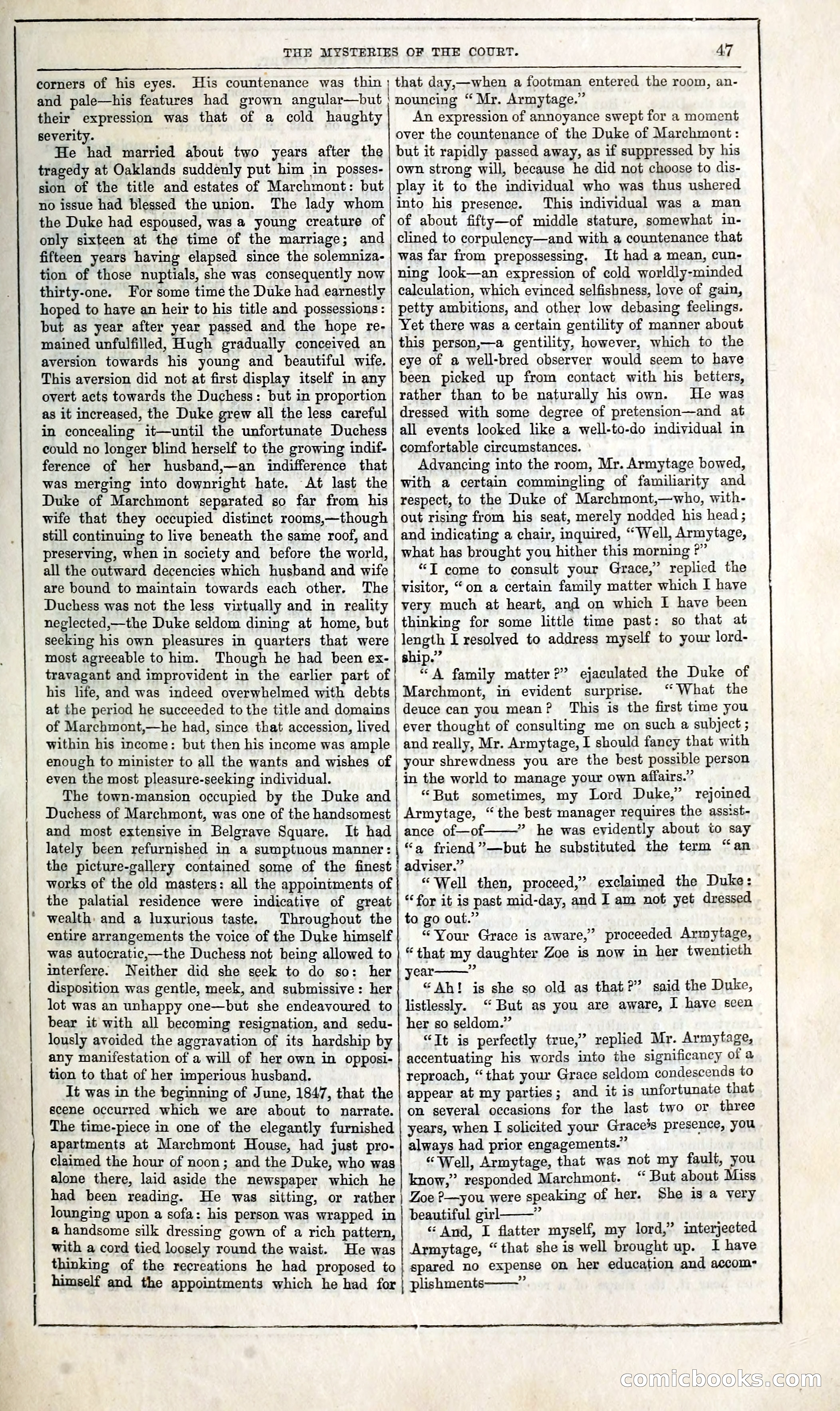
A restored page from Penny Dreadfuls, 1849. Page through the whole issue in the reader above.
📄 Transcribed text from this page (OCR, searchable)
Machine-transcribed from the original scan — historical spelling and the odd misread are preserved.
THE MYSTERIES OF THE COURT. 47 corners of his eyes. His countenance was thin | that day,—when a footman entered the room, an- and pale—his features had grown angular—but | nouncing “Mr. Armytage.” their expression was that of a cold haughty severity. He had married about two years after the tragedy at Oaklands suddenly put him in posses- sion of the title and estates of Marchmont: but no issue had blessed the union. The lady whom the Duke had espoused, was a young creature of only sixteen at the time of the marriage; and fifteen years having elapsed since the solemniza- tion of those nuptials, she was consequently now thirty-one. For some time the Duke had earnestly hoped to haye an heir to his title and possessions : but as year after year passed and the hope re- mained unfulfilled, Hugh gradually conceived an aversion towards his young and beautiful wife. This aversion did not at first display itself in any overt acts towards the Duchess: but in proportion as it increased, the Duke grew all the less careful in concealing it—until the unfortunate Duchess could no longer blind herself to the growing indif- ference of her husband,—an indifference that was merging into downright hate. At last the Duke of Marchmont separated so far from his wife that they occupied distinct rooms,—though still continuing to live beneath the same roof, and preserving, when in society and before the world, all the outward decencies which husband and wife are bound to maintain towards each other. The Duchess was not the less virtually and in reality neglected,—the Duke seldom dining at home, but seeking his own pleasures in quarters that were most agreeable to him. Though he had been ex- travagant and improvident in the earlier part of his life, and was indeed overwhelmed with debts at the period he succeeded to the title and domains of Marchmont,—he had, since that accession, lived within his income: but then his income was ample enough to minister to all the wants and wishes of even the most pleasure-seeking individual. The town-mansion occupied by the Duke and Duchess of Marchmont, was one of the handsomest and most extensive in Belgrave Square. It had lately been refurnished in a sumptuous manner : | the picture-gallery contained some of the finest} works of the old masters: all the appointments of the palatial residence were indicative of great wealth: and a luxurious taste. Throughout the entire arrangements the voice of the Duke himself was autocratic,—the Duchess not being allowed to interfere. Neither did she seek to do so: her disposition was gentle, meek, and submissive: her lot was an unhappy one—but she endeavoured to bear it with all becoming resignation, and sedu- lously avoided the aggravation of its hardship by any manifestation of a will of her own in opposi- tion to that of her imperious husband. Jé was in the beginning of June, 1847, that the scene occurred which we are about to narrate. The time-piece in one of the elegantly furnished apartments at Marchmont House, had just pro- claimed the hour of noon; and the Duke, who was alone there, laid aside the newspaper which he An expression of annoyance swept for a moment over the countenance of the Duke of Marchmont : but it rapidly passed away, as if suppressed by his own strong will, because he did not choose to dis- play it to the individual who was thus ushered into his presence. This individual was a man of about fifty—of middle stature, somewhat in- clined to corpulency—and with a countenance that was far from prepossessing. It had a mean, cun- ning look—an expression of cold worldly-minded calculation, which evinced selfishness, love of gain, petty ambitions, and other low debasing feelings. Yet there was a certain gentility of manner about this person,—a gentility, however, which to the eye of a well-bred observer would seem to have been picked up from contact with his betters, rather than to be naturally his own. He was dressed with some degree of pretension—and at all events looked like a well-to-do individual in comfortable circumstances. Advancing into the room, Mr. Armytage bowed, with a certain commingling of familiarity and respect, to the Duke of Marchmont,—who, with- out rising from his seat, merely nodded his head; and indicating a chair, inquired, “Well, Armytage, what has brought you hither this morning ?” “T come to consult your Grace,” replied the visitor, “on a certain family matter which I haye very much at heart, and on which I have been thinking for some little time past: so that at length I resolyed to address myself to your lord- ship.” 3 A family matter?” ejaculated the Duke of Marchmont, in evident surprise. ‘“ What the deuce can you mean? ‘This is the first time you ever thought of consulting me on such a subject ; and really, Mr. Armytage, I should fancy that with your shrewdness you are the best possible person in the world to manage your own affairs.” “But sometimes, my Lord Duke,’ rejoined Armytage, “the best manager requires the assist- ance of—of. ” he was evidently about to say “a friend”—but he substituted the term “an adviser.” “Well then, proceed,” exclaimed the Duke: “for it is past mid-day, and I am not yet dressed to go out.” “Your Grace is aware,” proceeded Armytage, “that my daughter Zoe is now in her twentieth ear 33 we Ah! is she so old as that?” said the Duke, listlessly. “But as you are aware, I have seen her so seldom.” “Tt is perfectly true,” replied Mr. Armytage, accentuating his words into the significancy of a reproach, “that your Grace seldom condescends to appear at my parties; and it is unfortunate that on several occasions for the last two or three years, when I solicited your Grace’s presence, you always had prior engagements.” “Well, Armytage, that was not my fault, you know,” responded Marchmont. “ But about Miss had been reading. He was sitting, or rather) Zoe?—you were speaking of her. She is a very lounging upon a sofa: his person was wrapped in a handsome silk dressing gown of a rich pattern, with a cord tied loosely round the waist. He was thinking of the recreations he had proposed to himself and the appointments which he had for 2? beautiful girl “ And, I flatter myself, my lord,” interjected Armytage, “that she is well brought up. I have spared no expense on her education and accom- plishments .. 0)(0)(0) (CO) S CO