
Penny Dreadfuls, 1849 · page 45 of 394
The Mysteries of the Court of London — page 45: what you’re looking at
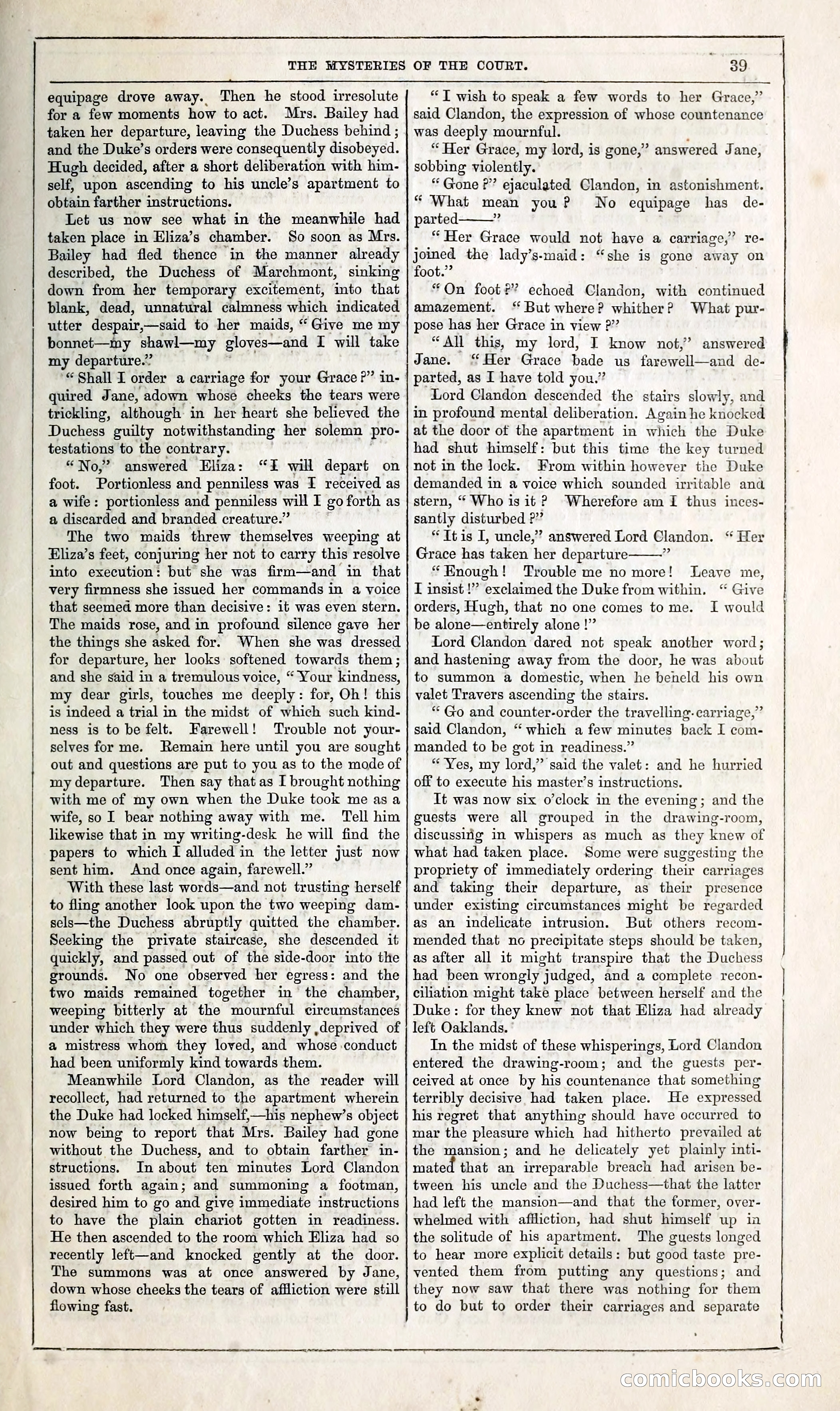
A restored page from Penny Dreadfuls, 1849. Page through the whole issue in the reader above.
📄 Transcribed text from this page (OCR, searchable)
Machine-transcribed from the original scan — historical spelling and the odd misread are preserved.
THE MYSTERIES OF THE COURT. equipage drove away. Then he stood irresolute for a few moments how to act. Mrs. Bailey had taken her departure, leaving the Duchess behind ; and the Duke’s orders were consequently disobeyed. Hugh decided, after a short deliberation with him- self, upon ascending to his uncle’s apartment to obtain farther instructions. Let us now see what in the meanwhile had taken place in Eliza’s chamber. So soon as Mrs. Bailey had fled thence in the manner already described, the Duchess of Marchmont, sinking down from her temporary excitement, into that blank, dead, unnatural calmness which indicated utter despair,—said to her maids, “Give me my bonnet—my shawl—my gloves—and I will take my departure.” “Shall I order a carriage for your Grace?” in- | quired Jane, adown whose cheeks the tears were trickling, although in her heart she believed the Duchess guilty notwithstanding her solemn pro- testations to the contrary. “No,” answered Eliza: “iE will depart on foot. Portionless and penniless was I received as a wife: portionless and penniless will I go forth as a discarded and branded creature.” The two maids threw themselves weeping at Hliza’s feet, conjuring her not to carry this resolve into execution: but she was firm—and in that very firmness she issued her commands in a voice that seemed more than decisive: it was even stern. The maids rose, and in profound silence gave her the things she asked for. "When she was dressed for departure, her looks softened towards them; and she said in a tremulous voice, “ Your kindness, my dear girls, touches me deeply: for, Oh! this is indeed a trial in the midst of which such kind- ness is to be felt. Farewell! Trouble not your- selves for me. Remain here until you are sought out and questions are put to you as to the mode of my departure. Then say thatas I brought nothing with me of my own when the Duke took me asa wife, so I bear nothing away with me. Tell him likewise that in my writing-desk he will find the papers to which I alluded in the letter just now sent him. And once again, farewell.” With these last words—and not trusting herself to fling another look upon the two weeping dam- sels—the Duchess abruptly quitted the chamber. Seeking the private staircase, she descended it quickly, and passed out of the side-door into the grounds. No one observed her egress: and the two maids remained together in the chamber, weeping bitterly at the mournful circumstances under which they were thus suddenly ,deprived of a mistress whom they loved, and whose conduct had been uniformly kind towards them. Meanwhile Lord Clandon, as the reader will recollect, had returned to the apartment wherein the Duke had locked himself,—his nephew’s object now being to report that Mrs. Bailey had gone without the Duchess, and to obtain farther in- structions. In about ten minutes Lord Clandon issued forth again; and summoning a footman, desired him to go and give immediate instructions to have the plain chariot gotten in readiness. He then ascended to the room which Eliza had so recently left—and knocked gently at the door. The summons was at once answered by Jane, down whose cheeks the tears of affliction were still flowing fast. 39 “T wish to speak a few words to her Grace,” said Clandon, the expression of whose countenance was deeply mournful. “Her Grace, my lord, is gone,” sobbing violently. ‘Gone ?” ejaculated Clandon, in astonishment. answered Jane, “What mean you? No equipage has de- parted “Her Grace would not have a carriage,’ re- jomed the lady’s-maid: foot.” “On foot?” echoed Clandon, with continued amazement. ‘“‘ But where? whither? What pur- pose has her Grace in view ?” “All this, my lord, I know not,” answered Jane. “Her Grace bade us farewell—and de- parted, as I have told you.” Lord Clandon descended the stairs slowly, and in profound mental deliberation. Again he knocked at the door of the apartment in which the Duke had shut himself: but this time the key turned not in the lock. From within however the Duke demanded in a voice which sounded irritable and stern, “ Who isit ? Wherefore am I thus inces- santly disturbed ?” *Ttis I, uncle,’ answered Lord Clandon. Grace has taken her departure “Knough! Trouble me no more! Leave me, I insist !” exclaimed the Duke from within. “ Give orders, Hugh, that no one comes tome. I would be alone—entirely alone !” Lord Clandon dared not speak another word; and hastening away from the door, he was about to summon a domestic, when he beneld his own valet Travers ascending the stairs. “Go and counter-order the travelling. carriage,” said Clandon, “ which a few minutes back I com- manded to be got in readiness.” “Yes, my lord,” said the valet: and he hurried off to execute his master’s instructions. It was now six o’clock in the evening; and the guests were all grouped in the drawing-room, discussitig in whispers as much as they knew of what had taken place. Some were suggesting the propriety of immediately ordering their carriages and taking their departure, as their presence under existing circumstances might be regarded as an indelicate intrusion. But others recom- mended that no precipitate steps should be taken, as after all 1t might transpire that the Duchess had been wrongly judged, and a complete recon- cilation might take place between herself and the Duke: for they knew not that Eliza had already left Oaklands. ° In the midst of these whisperings, Lord Clandon entered the drawing-room; and the guests per- ceived at once by his countenance that something terribly decisive had taken place. He expressed his regret that anything should have occurred to mar the pleasure which had hitherto prevailed at the mansion; and he delicately yet plainly inti- mated that an irreparable breach had arisen be- tween his uncle and the Duchess—that the latter had left the mansion—and that the former, over- whelmed with affliction, had shut himself up in the solitude of his apartment. The guests longed to hear more explicit details: but good taste pre- vented them from putting any questions; and they now saw that there was nothing for them to do but to order their carriages and separate “she is gone away on ‘“ Her oes (EO) VOOKS CO)