
Penny Dreadfuls, 1849 · page 395 of 394
The Mysteries of the Court of London — page 395: what you’re looking at
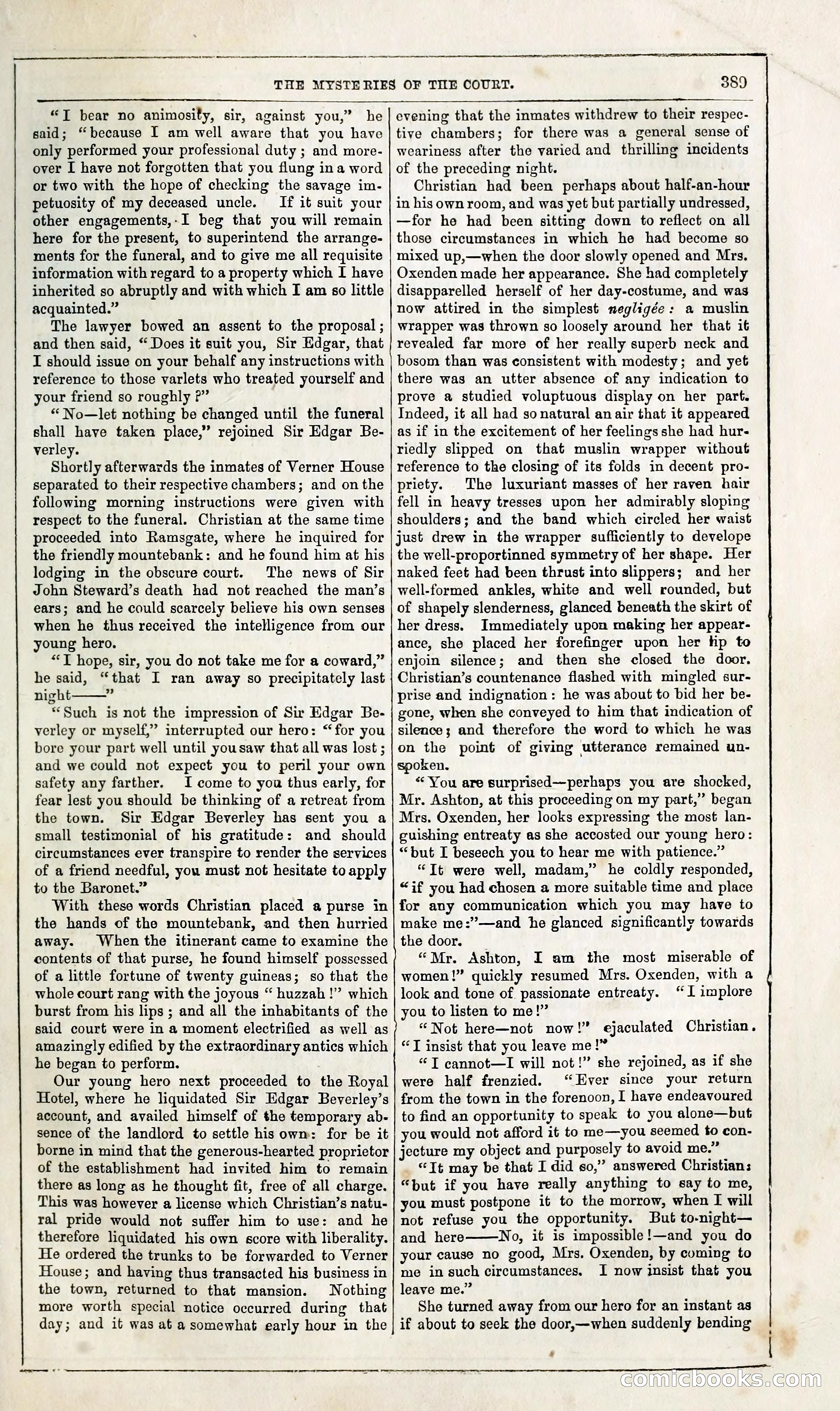
A restored page from Penny Dreadfuls, 1849. Page through the whole issue in the reader above.
📄 Transcribed text from this page (OCR, searchable)
Machine-transcribed from the original scan — historical spelling and the odd misread are preserved.
LL DEL, LS LOL LL LLL LLL LLL LLL LLL LAL, THE MYSTERIES OF THE COURT. “T bear no animosity, sir, against you,” he said; “because I am well aware that you have only performed your professional duty ; and more- over I have not forgotten that you flung ina word or two with the hope of checking the savage im- petuosity of my deceased uncle. If it suit your other engagements,-I beg that you will remain here for the present, to superintend the arrange- ments for the funeral, and to give me all requisite information with regard to a property which I have inherited so abruptly and with which I am so little acquainted.” The lawyer bowed an assent to the proposal ; and then said, “Does it suit you, Sir Edgar, that I should issue on your behalf any instructions with reference to those varlets who treated yourself and your friend so roughly ?”’ ““No—let nothing be changed until the funeral shall have taken place,” rejoined Sir Edgar Be- verley. Shortly afterwards the inmates of Verner House separated to their respective chambers; and on the following morning instructions were given with respect to the funeral. Christian at the same time proceeded into Ramsgate, where he inquired for the friendly mountebank: and he found him at his lodging in the obscure court. The news of Sir John Steward’s death had not reached the man’s ears; and he could scarcely believe his own senses when he thus received the intelligence from our young hero. “IT hope, sir, you do not take me for a coward,” he said, “that I ran away so precipitately last night K “Such is not the impression of Sir Edgar Be- verley or myself,’ interrupted our hero: “for you bore your part well until yousaw that all was lost ; and we could not expect you to peml your own safety any farther. 1 come to you thus early, for fear lest you should be thinking of a retreat from the town. Sir Edgar Beverley has sent you a small testimonial of his gratitude: and should circumstances ever transpire to render the services of a friend needful, you must not hesitate to apply to the Baronet.” With these words Christian placed a purse in the hands of the mountebank, and then hurried away. When the itinerant came to examine the contents of that purse, he found himself possessed of a little fortune of twenty guineas; so that the whole court rang with the joyous “ huzzah!” which burst from his lips; and all the inhabitants of the said court were in a moment electrified as well as amazingly edified by the extraordinary antics which he began to perform. Our young hero next proceeded to the Royal Hotel, where he liquidated Sir Edgar Beverley’s account, and availed himself of the temporary ab- sence of the landlord to settle his owm: for be it borne in mind that the generous-hearted proprietor of the establishment had invited him to remain there as long as he thought fit, free of all charge. This was however a license which Christian’s natu- ral pride would not suffer him to use: and he therefore liquidated his own score with liberality. He ordered the trunks to be forwarded to Verner House; and having thus transacted his business in the town, returned to that mansion. Nothing more worth special notice occurred during that day; and it was at a somewhat early hour in the Se 389 evening that the inmates withdrew to their respec- tive chambers; for there was a general sense of weariness after the varied and thrilling incidents of the preceding night. Christian had been perhaps about half-an-hour in his own room, and was yet but partially undressed, —for he had been sitting down to reflect on all those circumstances in which he had become so mixed up,—when the door slowly opened and Mrs. Oxenden made her appearance. She had completely disapparelled herself of her day-costume, and was now attired in the simplest negligée: a muslin wrapper was thrown so loosely around her that it revealed far more of her really superb neck and bosom than was consistent with modesty; and yet there was an utter absence of any indication to prove a studied voluptuous display on her part. Indeed, it all had so natural an air that it appeared as if in the excitement of her feelings she had hur- riedly slipped on that muslin wrapper without reference to the closing of its folds in decent pro- priety. The luxuriant masses of her raven hair fell in heavy tresses upon her admirably sloping shoulders; and the band which circled her waist just drew in the wrapper sufficiently to develope the well-proportinned symmetry of her shape. Her naked feet had been thrust into slippers; and her well-formed ankles, white and well rounded, but of shapely slenderness, glanced beneath the skirt of her dress. Immediately upon making her appear- ance, she placed her forefinger upon her hp to enjoin silence; and then she closed the door. Christian’s countenance flashed with mingled sur- prise and indignation: he was about to bid her be- gone, when she conveyed to him that indication of silence; and therefore the word to which he was on the point of giving utterance remained un- spoken. “You are surprised—perhaps you are shocked, Mr. Ashton, at this proceeding on my part,” began Mrs. Oxenden, her looks expressing the most lan- gulshing entreaty as she accosted our young hero: “but I beseech you to hear me with patience.” “Tt were well, madam,” he coldly responded, “if you had chosen a more suitable time and place for any communication which you may have to make me:”—and he glanced significantly towards the door. “Mr. Ashton, I am the most miserable of women!” quickly resumed Mrs. Oxenden, with a look and tone of. passionate entreaty. “I implore you to listen to me!” “Not here—not now!” ejaculated Christian. “T insist that you leave me!” “T cannot—I will not!” she rejoined, as if she were half frenzied. “Ever since your return from the town in the forenoon, I have endeavoured to find an opportunity to speak to you alone—but you would not afford it to me—you seemed fo con- jecture my object and purposely to avoid me.” “Tt may be that I did so,” answered Christians “but if you have really anything to say to me, you must postpone it to the morrow, when I will not refuse you the opportunity. But to-night— and here No, it is impossible!—and you do your cause no good, Mrs. Oxenden, by coming to me in such circumstances. I now insist that you leave me.” She turned away from our hero for an instant as if about to seek the door,—when suddenly bending Gon (C O}.O)(O)