
Penny Dreadfuls, 1849 · page 387 of 394
The Mysteries of the Court of London — page 387: what you’re looking at
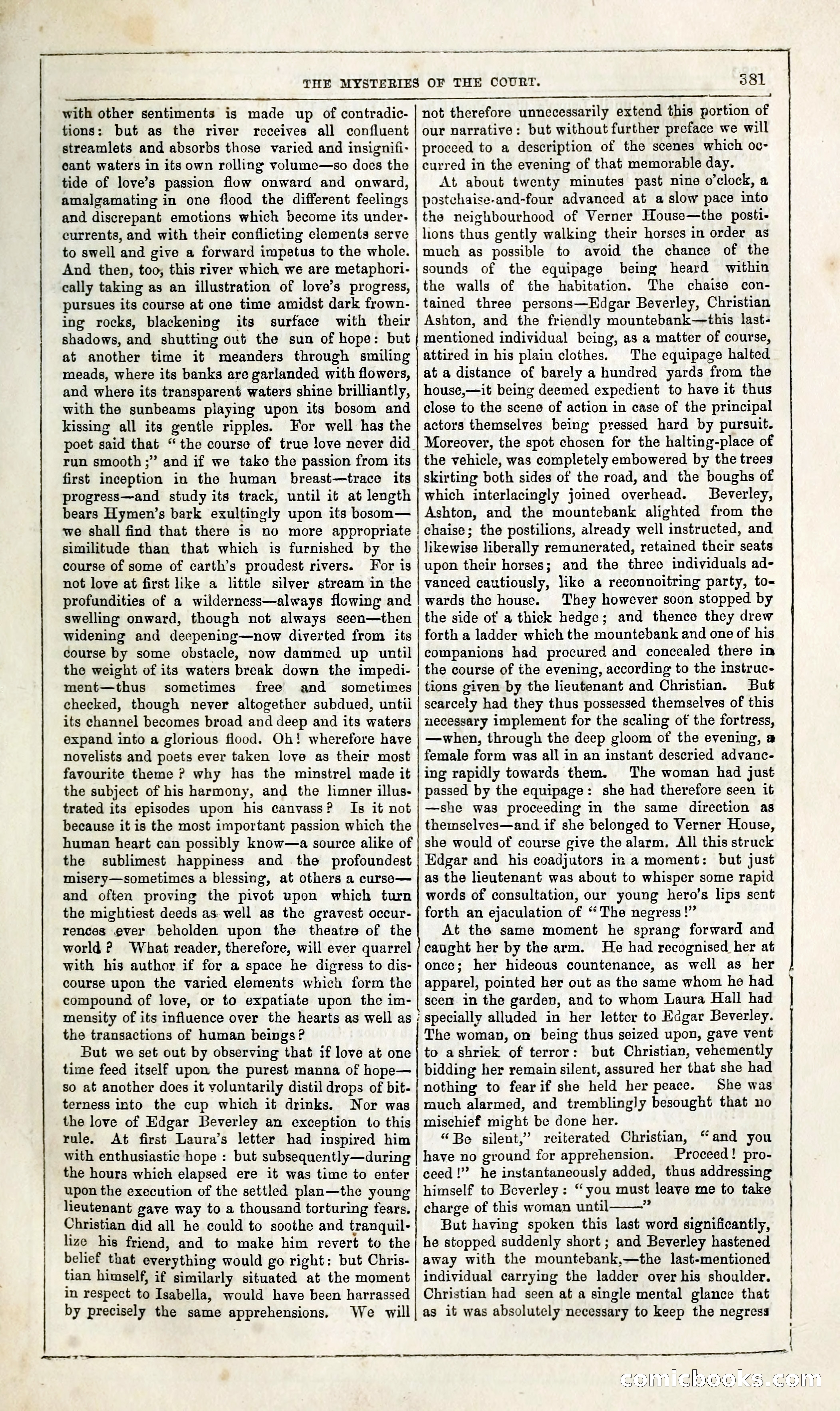
A restored page from Penny Dreadfuls, 1849. Page through the whole issue in the reader above.
📄 Transcribed text from this page (OCR, searchable)
Machine-transcribed from the original scan — historical spelling and the odd misread are preserved.
THE MYSTERIES OF THE COURT. with other sentiments is made up of contradic- tions: but as the river receives all confluent streamlets and absorbs those varied and insignifi- cant waters in its own rolling volume—so does the tide of love’s passion flow onward and onward, amalgamating in one flood the different feelings and discrepant emotions which become its under- currents, and with their conflicting elements serve to swell and give a forward impetus to the whole. And then, too; this river which we are metaphori- cally taking as an illustration of love’s progress, pursues its course at one time amidst dark frown- ing rocks, blackening its surface with their shadows, and shutting out the sun of hope: but at another time it meanders through smiling meads, where its banks are garlanded with flowers, and where its transparent waters shine brilliantly, with the sunbeams playing upon its bosom and kissing all its gentle ripples. For well has the poet said that “ the course of true love never did run smooth ;” and if we take the passion from its first inception in the human breast—trace its progress—and study its track, until it at length bears Hymen’s bark exultingly upon its bosom— we shall find that there is no more appropriate similitude than that which is furnished by the course of some of earth’s proudest rivers. For is not love at first like a little silver stream in the profundities of a wilderness—always flowing and swelling onward, though not always seen—then widening and deepening—now diverted from its course by some obstacle, now dammed up until the weight of its waters break down the impedi- ment—thus sometimes free and sometimes checked, though never altogether subdued, untii its channel becomes broad and deep and its waters expand into a glorious flood. Oh! wherefore have novelists and poets ever taken love as their most favourite theme ? why has the minstrel made it the subject of his harmony, and the limner illus- trated its episodes upon his canvass? Is it not because it is the most important passion which the human heart can possibly know—a source alike of the sublimest happiness and the profoundest misery—sometimes a blessing, at others a curse— and often proving the pivot upon which turn the mightiest deeds as. well as the gravest occur- rences ever beholden upon the theatre of the world? What reader, therefore, will ever quarrel with his author if for a space he digress to dis- course upon the varied elements which form the compound of love, or to expatiate upon the im- mensity of its influence over the hearts as well as ; the transactions of human beings? But we set out by observing that if love at one time feed itself upon the purest manna of hope— so at another does it voluntarily distil drops of bit- terness into the cup which it drinks. Nor was the love of Edgar Beverley an exception to this rule. At first Laura’s letter had inspired him with enthusiastic hope : but subsequently—during the hours which elapsed ere it was time to enter | upon the execution of the settled plan—the young lieutenant gave way to a thousand torturing fears. Christian did all he could to soothe and tranquil- lize his friend, and to make him revert to the belief that everything would go right: but Chris- tian himself, if similarly situated at the moment in respect to Isabella, would have been harrassed by precisely the same apprehensions. We will as es a ae eS eee i ee et S81 not therefore unnecessarily extend this portion of our narrative: but without further preface we will proceed to a description of the scenes which oc- curred in the evening of that memorable day. At about twenty minutes past nine o’clock, a postchaise-and-four advanced at a slow pace into the neighbourhood of Verner House—the posti- lions thus gently walking their horses in order as much as possible to avoid the chance of the sounds of the equipage being heard within the walls of the habitation. The chaise con- tained three persons—Kdgar Beverley, Christian Ashton, and the friendly mountebank—this last- mentioned individual being, as a matter of course, attired in his plain clothes. The equipage halted at a distance of barely a hundred yards from the house,—it being deemed expedient to have it thus close to the scene of action in case of the principal actors themselves being pressed hard by pursuit. Moreover, the spot chosen for the halting-place of the vehicle, was completely embowered by the trees skirting both sides of the road, and the boughs of which interlacingly joined overhead. Beverley, Ashton, and the mountebank alighted from the chaise; the postilions, already well instructed, and likewise liberally remunerated, retained their seats upon their horses; and the three individuals ad- vanced cautiously, like a reconnoitring party, to- wards the house. They however soon stopped by | the side of a thick hedge; and thence they drew forth a ladder which the mountebank and one of his companions had procured and concealed there in the course of the evening, according to the instruc- tions given by the lieutenant and Christian. But scarcely had they thus possessed themselves of this aecessary implement for the scaling of the fortress, —when, through the deep gloom of the evening, @ female form was all in an instant descried advanc- ing rapidly towards them. The woman had just passed by the equipage: she had therefore seen it —she was proceeding in the same direction as themselvyes—and if she belonged to Verner House, she would of course give the alarm. All this struck Edgar and his coadjutors in a moment: but just as the lieutenant was about to whisper some rapid words of consultation, our young hero’s lips sent forth an ejaculation of “The negress !” At the same moment he sprang forward and caught her by the arm. He had recognised her at once; her hideous countenance, as well as her apparel, pointed her out as the same whom he had seer in the garden, and to whom Laura Hall had speciallv alluded in her letter to Eagar Beverley. The woman, on being thus seized upon, gave vent to ashriek of terror: but Christian, vehemently bidding her remain silent, assured her that she had nothing to fearif she held her peace. She was much alarmed, and tremblingly besought that no mischief might be done her. “Be silent,” reiterated Christian, “and you have no ground for apprehension. Proceed! pro- ceed!” he instantaneously added, thus addressing himself to Beverley: “ you must leave me to take charge of this woman until i But having spoken this last word significantly, he stopped suddenly short ; and Beverley hastened away with the mountebank,—the last-mentioned individual carrying the ladder over his shoulder. Christian had seen at a single mental glance that as it was absolutely necessary to keep the negress 0)(0)(0) S