
Penny Dreadfuls, 1849 · page 385 of 394
The Mysteries of the Court of London — page 385: what you’re looking at
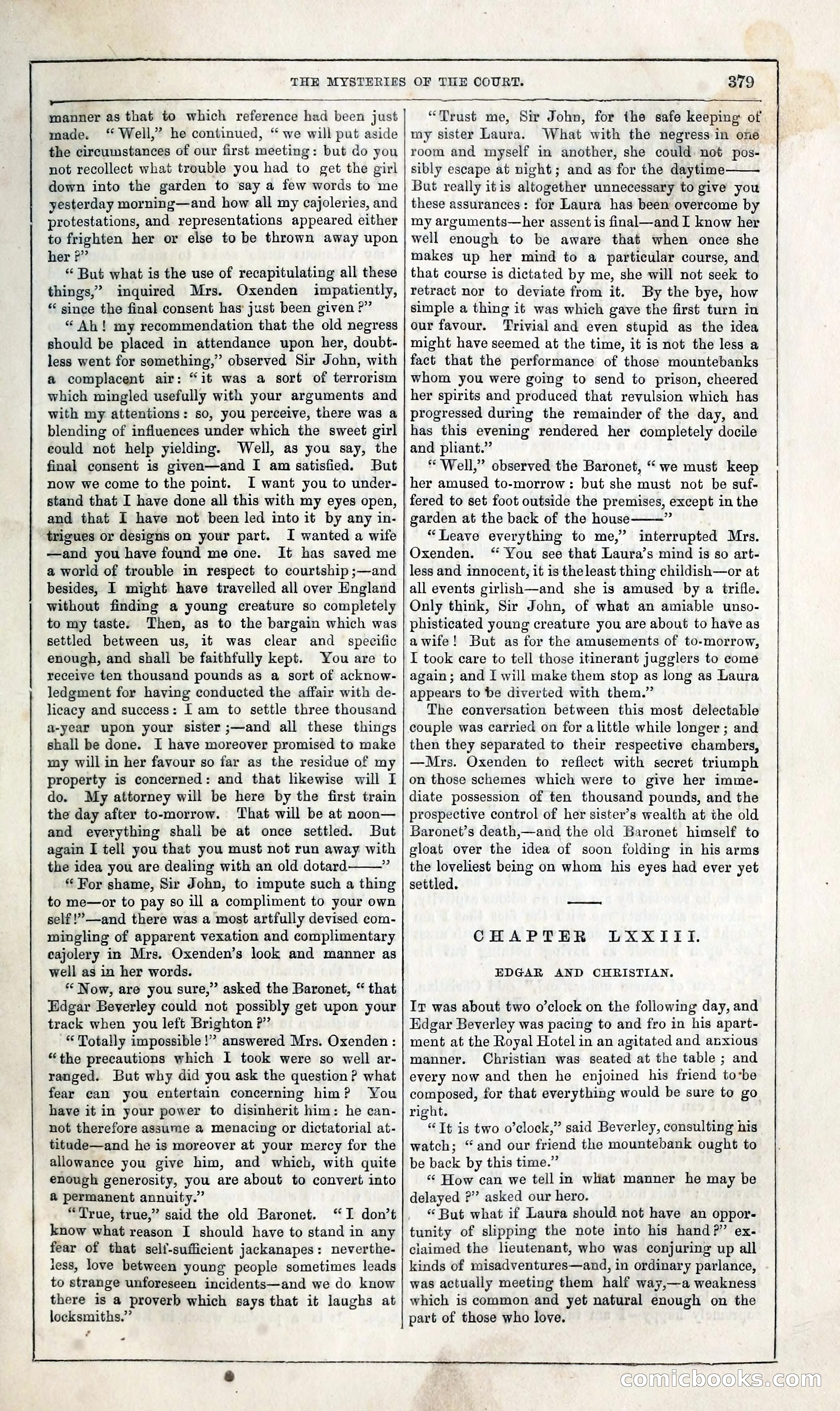
A restored page from Penny Dreadfuls, 1849. Page through the whole issue in the reader above.
📄 Transcribed text from this page (OCR, searchable)
Machine-transcribed from the original scan — historical spelling and the odd misread are preserved.
THE MYSTERIES OF THE COURT. manner as that to which reference had been just made. ‘ Well,” he continued, “ we will put aside the circumstances of our first meeting: but do you not recollect what trouble you had to get the girl down into the garden to say a few words to me yesterday morning—and how all my cajoleries, and protestations, and representations appeared either to frighten her or else to be thrown away upon her P” “ But what is the use of recapitulating all these things,” inquired Mrs. Oxenden impatiently, *‘ since the final consent has just been given ?” “ Ah! my recommendation that the old negress should be placed in attendance upon her, doubt- less went for something,” observed Sir John, with a complacent air: “it was a sort of terrorism which mingled usefully with your arguments and with my attentions: so, you perceive, there was a blending of influences under which the sweet girl eould not help yielding. Well, as you say, the final consent is given—and I am satisfied. But now we come to the point. I want you to under- stand that I have done all this with my eyes open, and that I have not been led into it by any in- trigues or designs on your part. I wanted a wife —and you have found me one. It has saved me a world of trouble in respect to courtship ;—and besides, I might have travelled all over Hngland without finding a young creature so completely to my taste. Then, as to the bargain which was settled between us, it was clear and specific enough, and shall be faithfully kept. You are to receive ten thousand pounds as a sort of acknow- ledement for having conducted the affair with de- licacy and success: I am to settle three thousand a-year upon your sister ;—and all these things shall be done. I have moreover promised to make my will in her favour so far as the residue of my property is concerned: and that likewise will I do. My attorney will be here by the first train the day after to-morrow. That will be at noon— and everything shall be at once settled. But again I tell you that you must not run away with the idea you are dealing with an old dotard a * For shame, Sir John, to impute such a thing to me—or to pay so ill a compliment to your own self !”’—and there was a most artfully devised com- mingling of apparent vexation and complimentary eajolery in Mrs. Oxenden’s look and manner as well as in her words. ** Now, are you sure,” asked the Baronet, “ that Edgar Beverley could not possibly get upon your track when you left Brighton P” “Totally impossible!” answered Mrs. Oxenden : “the precautions which 1 took were so well ar- ranged. But why did you ask the question ? what fear can you entertain concerning him? You have it in your power to disinherit him: he can- not therefore assume a menacing or dictatorial at- titude—and he is moreover at your mercy for the allowance you give him, and which, with quite enough generosity, you are about to convert into & permanent annuity.” “True, true,” said the old Baronet. “I don’t know what reason I should have to stand in any fear of that self-sufficient jackanapes: neverthe- iess, love between young people sometimes leads to strange unforeseen incidents—and we do know there is a proverb which says that it laughs at locksmiths.” a 379 “Trust me, Sir John, for the safe keeping of my sister Laura. What with the negress in one room and myself in another, she could not pos- sibly escape at night; and as for the daytime But really itis altogether unnecessary to give you these assurances: for Laura has been overcome by my arguments—her assent is final—and I know her well enough to be aware that when once she makes up her mind to a particular course, and that course is dictated by me, she will not seek to retract nor to deviate from it. By the bye, how simple a thing it was which gave the first turn in our favour. ‘Trivial and even stupid as the idea might have seemed at the time, it is not the less a fact that the performance of those mountebanks whom you were going to send to prison, cheered her spirits and produced that revulsion which has progressed during the remainder of the day, and has this evening rendered her completely docile and pliant.” * Well,” observed the Baronet, “we must keep her amused to-morrow: but she must not be suf- fered to set foot outside the premises, except in the garden at the back of the house yi “Leave everything to me,” interrupted Mrs. Oxenden. ‘“ You see that Laura’s mind is so art- less and innocent, it is theleast thing childish—or at all events girlish—and she is amused by a trifle. Only think, Sir John, of what an amiable unso- phisticated young creature you are about to have as a wife! But as for the amusements of to-morrow, I took care to tell those itinerant jugglers to come again; and [ will make them stop as long as Laura appears to be diverted with them.” The conversation between this most delectable couple was carried on for alittle while longer ; and then they separated to their respective chambers, —Mrs. Oxenden to reflect with secret triumph on those schemes which were to give her imme- diate possession of ten thousand pounds, and the prospective control of her sister’s wealth at the old Baronet’s death,—and the old Baronet himself to gloat over the idea of soon folding in his arms the loveliest being on whom his eyes had ever yet settled. ce me CHAPTER LXXIIiI. EDGAR AND CHRISTIAN. It was about two o’clock on the following day, and Edgar Beverley was pacing to and fro in his apart- ment at the Royal Hotel in an agitated and anxious manner. Christian was seated at the table ; and every now and then he enjoined his friend tovbe composed, for that everything would be sure to go right. “Tt is two o’clock,” said Beverley, consulting his watch; “and our friend the mountebank ought to be back by this time.” “ How can we tell in wliat manner he may be delayed ?” asked our hero. “ But what if Laura should not have an oppor- tunity of slipping the note into his hand?” ex- claimed the leutenant, who was conjuring up all kinds of misadventures—and, in ordinary parlance, was actually meeting them half way,—a weakness which is common and yet natural enough on the part of those who love. EO NOO S CO)