
Penny Dreadfuls, 1849 · page 377 of 394
The Mysteries of the Court of London — page 377: what you’re looking at
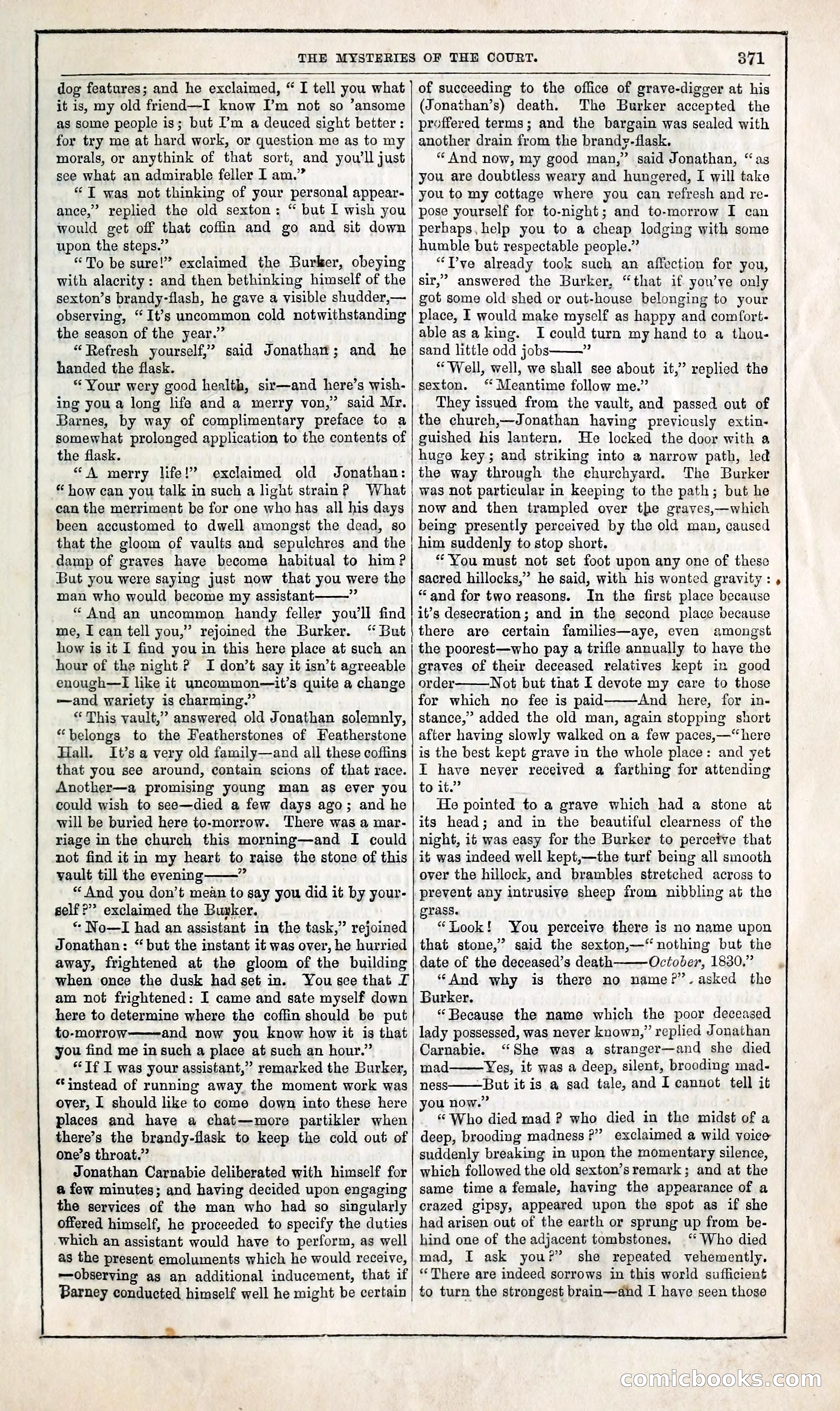
A restored page from Penny Dreadfuls, 1849. Page through the whole issue in the reader above.
📄 Transcribed text from this page (OCR, searchable)
Machine-transcribed from the original scan — historical spelling and the odd misread are preserved.
THE MYSTERIES OF THE COURT. 371 dog features; and he exclaimed, “ I tell you what it is, my old friend—I know I’m not so ’ansome as some people is; but Pm a deuced sight better: for try me at hard work, or question me as to my morals, or anythink of that sort, and you'll just see what an admirable feller 1 am.” “T was not thinking of your personal appear- ance,’ replied the old sexton: “ but I wish you would get off that coffin and go and sit down upon the steps.” “To be sure!” exclaimed the Burker, obeying with alacrity: and then bethinking himself of the sexton’s brandy-flash, he gave a visible shudder,— observing, “It’s uncommon cold notwithstanding the season of the year.” “Refresh yourself,’ said Jonathan; and he handed the flask. “Your wery good health, sir—and here’s wish- ing you a long life and a merry von,” said Mr. Barnes, by way of complimentary preface to a somewhat prolonged application to the contents of the flask. “A merry life!’ exclaimed old Jonathan: * how can you talk in such a light strainP What can the merriment be for one who has all his days been accustomed to dwell amongst the dead, so that the gloom of vaults and sepulchres and the damp of graves have become habitual to him? But you were saying just now that you were the man who would become my assistant a “ And an uncommon handy feller yowll find me, I can tell you,” rejoined the Burker. “ But how is it I find you in this here place at such an hour of the night P I don’t say it isn’t agreeable enough—lI like it uncommon—it’s quite a change —and wariety is charming.” “ This yault,” answered old Jonathan solemnly, “belongs to the Featherstones of Featherstone Hall. It’s a very old family—and all these coffins that you see around, contain scions of that race. Another—a promising young man as ever you could wish to see—died a few days ago; and he will be buried here to-morrow. ‘There was a mar- riage in the church this morning—and I could not find it in my heart to raise the stone of this yault till the evening i *‘ And you don’t mean to say you did it by your- self?’ exclaimed the Burker. ** No—I had an assistant in the task,” rejoined Jonathan: “ but the instant it was over, he hurried away, frightened at the gloom of the building when once the dusk had set in. You sce that I am not frightened: I came and sate myself down here to determine where the coffin should be put to-morrow and now you know how it is that you find me in such a place at such an hour.” “If I was your assistant,” remarked the Burker, “instead of running away the moment work was over, I should like to come down into these here places and have a chat—more partikler when there’s the brandy-flask to keep the cold out of one’s throat.” Jonathan Carnabie deliberated with himself for a few minutes; and having decided upon engaging the services of the man who had so singularly offered himself, he proceeded to specify the duties which an assistant would have to perform, as well as the present emoluments which he would receive, observing as an additional inducement, that if Barney conducted himself well he might be certain 1? ° of succeeding to the oflice of grave-digger at his (Jonathan’s) death. The Burker accepted the proffered terms; and the bargain was sealed with another drain from the brandy-flask. “ And now, my good man,” said Jonathan, “as you are doubtless weary and hungered, I will take you to my cottage where you can refresh and re- pose yourself for to-night; and to-morrow I can perhaps, help you to a cheap lodging with some humble but respectable people.” “ve already took such an affection for you, sir,” answered the Burker, “that if you’ve only got some old shed or out-house belonging to your place, I would make myself as happy and comfort- able asa king. I could turn my hand to a thou- sand little odd jobs a “Well, well, we shall see about it,” replied the sexton. ‘Meantime follow me.” They issued from the vault, and passed out of the church,—Jonathan having previcusly extin- guished his lantern, He locked the door with a huge key; and striking into a narrow path, led the way through the churchyard. The Burker was not particular in keeping to the path; but he now and then trampled over the graves,—which being presently perceived by the old man, caused him suddenly to stop short. “You must not set foot upon any one of these sacred hillocks,” he said, with his wonted gravity : “and for two reasons. In the first place because it’s desecration; and in the second place because there are certain families—aye, even amongst the poorest—who pay a trifle annually to have the graves of their deceased relatives kept in good order Not but that I devote my care to those for which no fee is paid And here, for in- stance,” added the old man, again stopping short after having slowly walked on a few paces,—“ here is the best kept grave in the whole place: and yet IT have never received a farthing for attending to it.” He pointed to a grave which had a stone at its head; and in the beautiful clearness of the night, it was easy for the Burker to perceive that it was indeed well kept,—the turf being all smooth over the hillock, and brambles stretched across to prevent any intrusive sheep from nibbling at the grass. “Look! You perceive there is no name upon that stone,” said the sexton,—“ nothing but the date of the deceased’s death October, 1830,” “And why is there no name?”.asked the Burker. “Because the name which the poor deceased lady possessed, was never known,” replied Jonathan Carnabie. “She was a stranger—and she died mad Yes, it was a deep, silent, brooding mad- ness But itis a sad tale, and 1 cannot tell it you now.” «“ Who died mad ? who died in the midst of a deep, brooding madness ?” exclaimed a wild voice suddenly breaking in upon the momentary silence, which followed the old sexton’sremark; and at the same time a female, having the appearance of a crazed gipsy, appeared upon the spot as if she had arisen out of the earth or sprung up from be- hind one of the adjacent tombstones. ‘‘ Who died mad, I ask you?” she repeated vehemently. “There are indeed sorrows in this world sufficient to turn the strongest brain—and I have seen those > EN a eee Gomrcboo (C S (C(O)