
Penny Dreadfuls, 1849 · page 356 of 394
The Mysteries of the Court of London — page 356: what you’re looking at
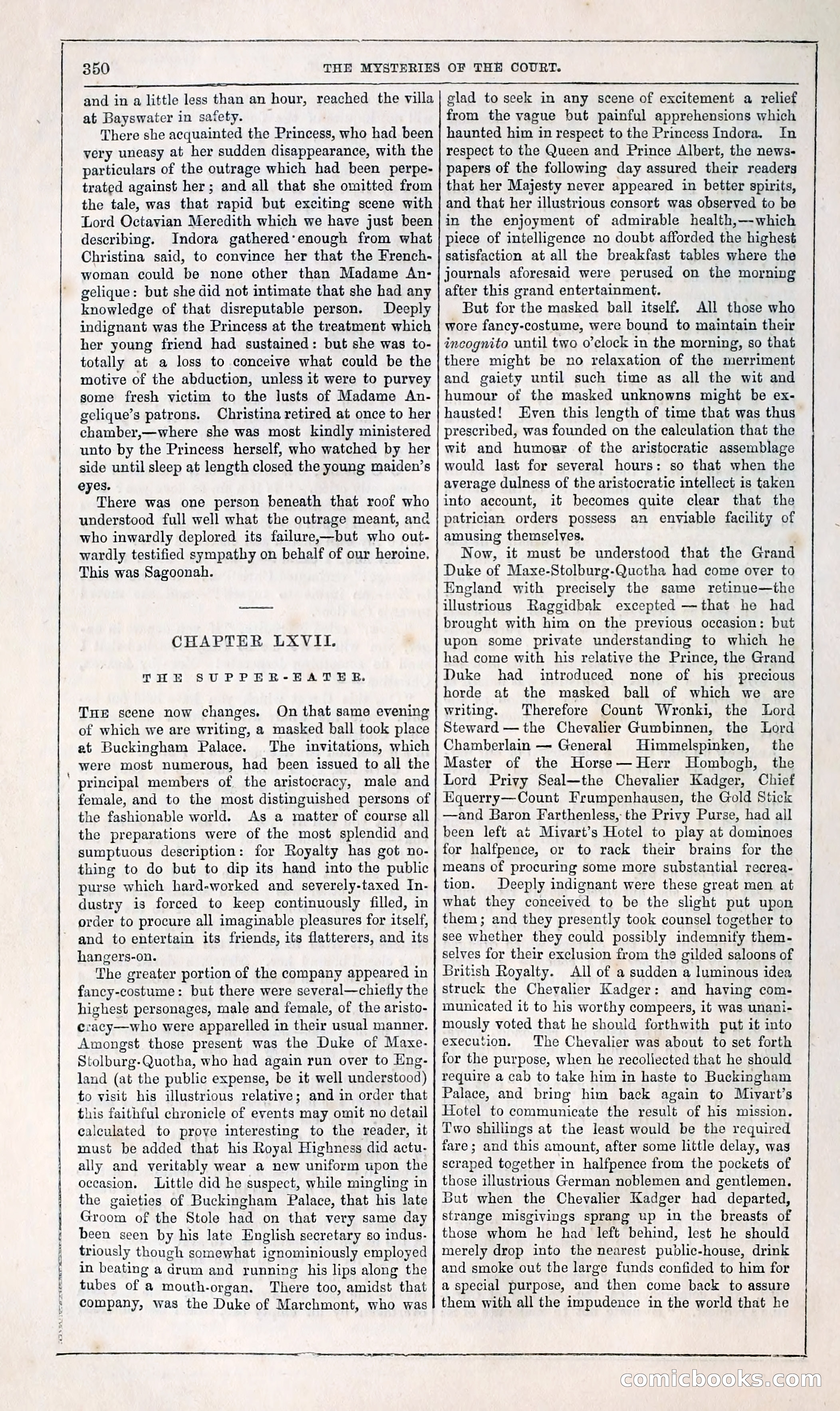
A restored page from Penny Dreadfuls, 1849. Page through the whole issue in the reader above.
📄 Transcribed text from this page (OCR, searchable)
Machine-transcribed from the original scan — historical spelling and the odd misread are preserved.
~ b OP ‘ 7 — 350 THE MYSTERIES OF THE COURT. ceae eae a a SI TNT TU TS EP TT a and in a little less than an hour, reached the villa at Bayswater in safety. There she acquainted the Princess, who had been very uneasy at her sudden disappearance, with the particulars of the outrage which had been perpe- trated against her; and all that she omitted from the tale, was that rapid but exciting scene with Lord Octavian Meredith which we have just been describing. Indora gathered*enough from what Christina said, to convince her that the French- woman could be none other than Madame An- gelique: but she did not intimate that she had any knowledge of that disreputable person. Deeply indignant was the Princess at the treatment which her young friend had sustained: but she was to- totally at a loss to conceive what could be the motive of the abduction, unless it were to purvey some fresh victim to the lusts of Madame An- gelique’s patrons. Christina retired at once to her chamber,—where she was most kindly ministered unto by the Princess herself, who watched by her side until sleep at length closed the young maiden’s eyes. "There was one person beneath that roof who understood full well what the outrage meant, anc who inwardly deplored its failure,—but who out- wardly testified sympathy on behalf of our heroine, This was Sagoonah. CHAPTER LXVII. THE SUPPER-EATER. Tue scene now changes. On that same evening of which we are writing, a masked ball took place at Buckingham Palace. The invitations, which were most numerous, had been issued to all the ‘ principal members of the aristocracy, male and female, and to the most distinguished persons of the fashionable world. As a matter of course all the preparations were of the most splendid and sumptuous description: for Royalty has got no- thing to do but to dip its hand into the public purse which hard-worked and severely-taxed In- dustry is forced to keep continuously filled, in order to procure all imaginable pleasures for itself, and to entertain its friends, its flatterers, and its hangers-on. The greater portion of the company appeared in fancy-costume: but there were several—chiefly the highest personages, male and female, of the aristo- c:acy—who were apparelled in their usual manner. Amongst those present was the Duke of Maxe- Stolburg-Quotha, who had again run over to Eng- land (at the public expense, be it well understood) to visit his illustrious relative; and in order that this faithful chronicle of events may omit no detail calculated to prove interesting to the reader, it must be added that his Royal Highness did actu- ally and veritably wear a new uniform upon the occasion. Little did he suspect, while mingling in the gaieties of Buckingham Palace, that his late Groom of the Stole had on that very same day been seen by his late English secretary so indus- triously though somewhat ignominiously employed in beating a drum and running his lips along the tubes of a mouth-organ. There too, amidst that company, was the Duke of Marchmont, who was glad to seek in any scene of excitement a relief from the vague but painful apprehensions which haunted him in respect to the Princess Indora. In respect to the Queen and Prince Albert, the news- papers of the following day assured their readers that her Majesty never appeared in better spirits, and that her illustrious consort was observed to be in the enjoyment of admirable health,—which piece of intelligence no doubt afforded the highest satisfaction at all the breakfast tables where the journals aforesaid were perused on the morning after this grand entertainment. But for the masked ball itself. All those who wore fancy-costume, were bound to maintain their incognito until two o’clock in the morning, so that there might be no relaxation of the merriment and gaiety until such time as all the wit and humour of the masked unknowns might be ex- hausted! Even this length of time that was thus prescribed, was founded on the calculation that the wit and humoar of the aristocratic assemblage would last for several hours: so that when the average dulness of the aristocratic intellect is taken into account, it becomes quite clear that the patrician orders possess an enviable facility of amusing themselves. } Now, it must be understood that the Grand Duke of Maxe-Stolburg-Quotha had come over to England with precisely the same retinue—the illustrious Raggidbak excepted —that he had brought with him on the previous occasion: but upon some private understanding to which he had come with his relative the Prince, the Grand Duke had introduced none of his precious horde at the masked ball of which we are writing. Therefore Count Wronki, the Lord Steward — the Chevalier Gumbinnen, the Lord Chamberlain — General Himmelspinken, the Master of the Horse— Herr Hombogh, the Lord Privy Seal—the Chevalier Kadger, Chief Equerry—Count Frumpenhausen, the Gold Stick —and Baron Farthenless, the Privy Purse, had all been left at Mivart’s Hotel to play at dominoes for halfpence, or to rack their brains for the means of procuring some more substantial recrea- tion. Deeply indignant were these great men at what they conceived to be the slight put upon them; and they presently took counsel together to see whether they could possibly indemnify them- selves for their exclusion from the gilded saloons of British Royalty. All of a sudden a luminous idea struck the Chevalier Kadger: and having com- municated it to his worthy compeers, it was unani- mously voted that he should forthwith put if into execution. The Chevalier was about to set forth for the purpose, when he recollected that he should require a cab to take him in haste to Buckingham Palace, and bring him back again to Mivart’s Hotel to communicate the result of his mission. Two shillings at the least would be the required fare; and this amount, after some little delay, was scraped together in halfpence from the pockets of those illustrious German noblemen and gentlemen. But when the Chevalier Kadger had departed, strange misgivings sprang up in the breasts of those whom he had left behind, lest he should merely drop into the nearest public-house, drink and smoke out the large funds confided to him for a special purpose, and then come back to assure them with all the impudence in the world that he = <. (E©) NO KS, (EO)