
Penny Dreadfuls, 1849 · page 338 of 394
The Mysteries of the Court of London — page 338: what you’re looking at
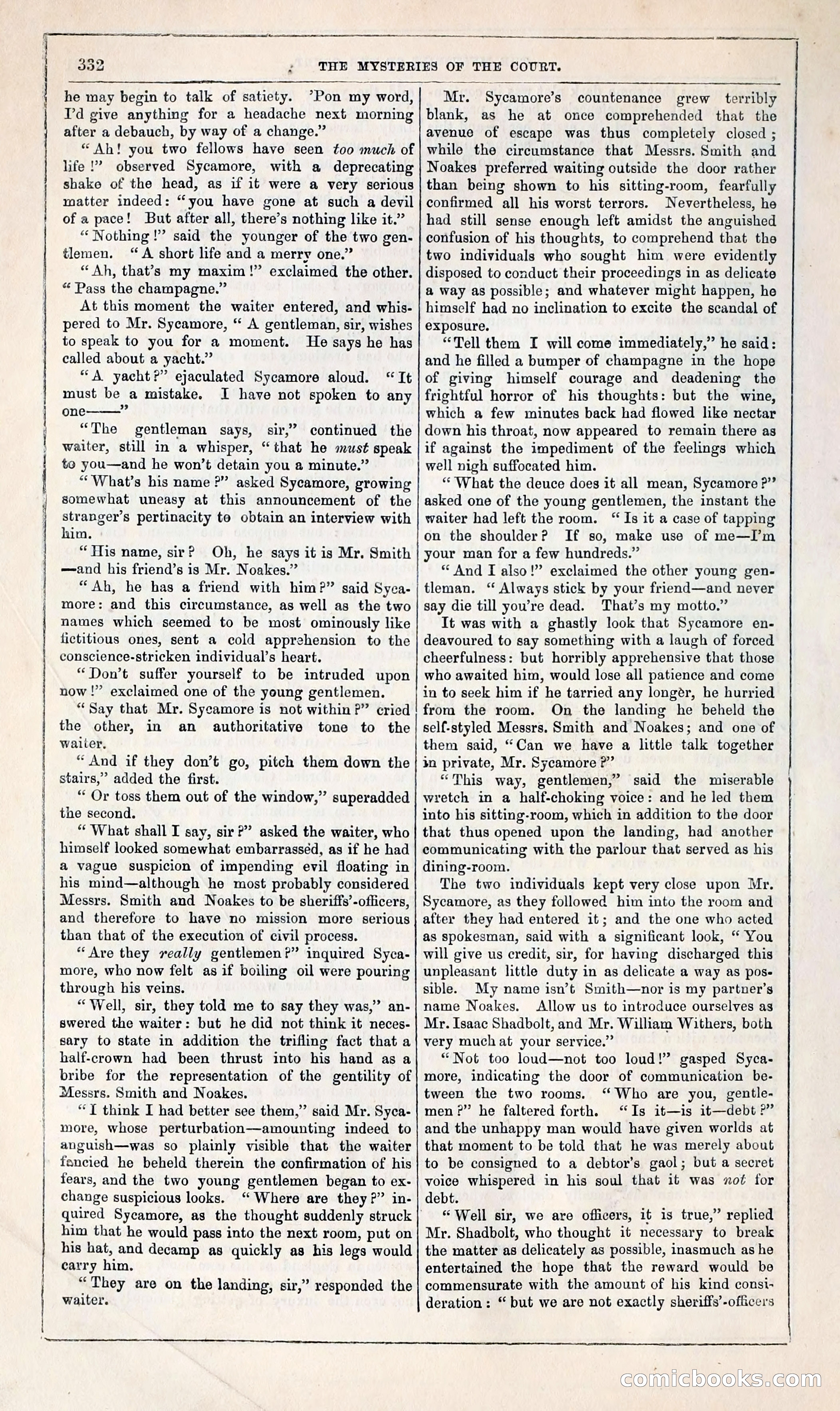
A restored page from Penny Dreadfuls, 1849. Page through the whole issue in the reader above.
📄 Transcribed text from this page (OCR, searchable)
Machine-transcribed from the original scan — historical spelling and the odd misread are preserved.
he may begin to talk of satiety. *Pon my word, I’d give anything for a headache next morning after a debauch, by way of a change.” “Ah! you two fellows have seen too much of life!” observed Sycamore, with a deprecating shake of the head, as if it were a very serious matter indeed: “you have gone at such a devil of a pace! But after all, there’s nothing like it.” “Nothing!” said the younger of the two gen- tlemen. “A short life and a merry one.” “ Ah, that’s my maxim!” exclaimed the other. “ Pass the champagne.” At this moment the waiter entered, and whis- pered to Mr. Sycamore, ‘‘ A gentleman, sir, wishes to speak to you for a moment. He says he has called about a yacht.” “A yacht?” ejaculated Sycamore aloud. must be a mistake. one a “The gentleman says, sir,” continued the waiter, still in a whisper, “that he must speak to you—and he won’t detain you a minute.” “What’s his name ?” asked Sycamore, growing somewhat uneasy at this announcement of the stranger’s pertinacity to obtain an interview with him. “His name, sir? Ob, he says it is Mr. Smith —and his friend’s is Mr. Noakes.” “Ah, he has a friend with him?” said Syea- more: and this circumstance, as well as the two names which seemed to be most ominously like fictitious ones, sent a cold apprehension to the conscience-stricken individual’s heart. “Don’t suffer yourself to be intruded upon now!” exclaimed one of the young gentlemen. “Say that Mr. Sycamore is not within ?” cried the other, in an authoritative tone to the waiter, “And if they don’t go, pitch them down the stairs,” added the first. ‘“ Or toss them out of the window,” superadded the second. “What shall I say, sir?” asked the waiter, who himself looked somewhat embarrassed, as if he had a vague suspicion of impending evil floating in his mind—although he most probably considered Messrs. Smith and Noakes to be sheriffs’-oflicers, and therefore to have no mission more serious than that of the execution of civil process. “Are they really gentlemen?” inquired Syca- more, who now felt as if boiling oil were pouring through his veins. “Well, sir, they told me to say they was,” an- swered the waiter: but he did not think it neces- sary to state in addition the trifling fact that a half-crown had been thrust into his hand as a bribe for the representation of the gentility of Messrs. Smith and Noakes. ‘““Y think I had better see them,” said Mr. Syca- more, whose perturbation—amounting indeed to anguish—was so plainly visible that the waiter fancied he beheld therein the confirmation of his fears, and the two young gentlemen began to ex- change suspicious looks. ‘“ Where are they ?” in- it It I have not spoken to any quired Sycamore, as the thought suddenly struck | him that he would pass into the next room, put on his hat, and decamp as quickly as his legs would carry him. “They are on the landing, sir,” responded the waiter. THE MYSTERIES OF THE COURT. Mr. Sycamore’s blank, as he at once comprehended that the avenue of escape was thus completely closed ; while the circumstance that Messrs. Smith and Noakes preferred waiting outside the door rather than being shown to his sitting-room, fearfully confirmed all his worst terrors. Nevertheless, he had still sense enough left amidst the anguished confusion of his thoughts, to comprehend that the two individuals who sought him were evidently disposed to conduct their proceedings in as delicate a way as possible; and whatever might happen, he himself had no inclination to excite the scandal of exposure. “Tell them I will come immediately,” he said: and he filled a bumper of champagne in the hope of giving himself courage and deadening the frightful horror of his thoughts: but the wine, which a few minutes back had flowed like nectar down his throat, now appeared to remain there as if against the impediment of the feelings which well nigh suffocated him. “What the deuce does it all mean, Sycamore P”” asked one of the young gentlemen, the instant the waiter had left the room. “Is it a case of tapping on the shoulder? If so, make use of me—I’m your man for a few hundreds.” * And I also!” exclaimed the other young gen- tleman. “ Always stick by your friend—and never say die till you’re dead. That’s my motto.” It was with a ghastly look that Sycamore en- deavoured to say something with a laugh of forced cheerfulness: but horribly apprehensive that those who awaited him, would lose all patience and come in to seek him if he tarried any longér, be hurried from the room. On the landing he beheld the self-styled Messrs. Smith and Noakes; and one of them said, “Can we have a little talk together in private, Mr. Sycamore ?” “This way, gentlemen,” said the miserable wretch in a half-choking voice: and he led them into his sitting-room, which in addition to the door that thus opened upon the landing, had another communicating with the parlour that served as his dining-room. The two individuals kept very close upon Mr. Sycamore, as they followed him into the room and after they had entered it; and the one who acted as spokesman, said with a significant look, “ You will give us credit, sir, for having discharged this unpleasant little duty in as delicate a way as pos- sible. My name isn’t Smith—nor is my partner’s name Noakes. Allow us to introduce ourselves as Mr. Isaac Shadbolt, and Mr. William Withers, both very much at your service.” “Not too loud—not too loud!” gasped Syca- more, indicating the door of communication be- tween the two rooms. ‘“ Who are you, gentle- men ?” he faltered forth. “Is it—is it—debt ?” and the unhappy man would have given worlds at that moment to be told that he was merely about to be consigned to a debtor’s gaol; but a secret voice whispered in his soul that it was xot for debt. “ Well sir, we are officers, it is true,” replied Mr. Shadbolt, who thought it necessary to break the matter as delicately as possible, inasmuch as he entertained the hope that the reward would be commensurate with the amount of his kind consi- deration: “ but we are not exactly sheriffs’-oflicers countenance grew terribly eonnicloooks (C(O)