
Penny Dreadfuls, 1849 · page 323 of 394
The Mysteries of the Court of London — page 323: what you’re looking at
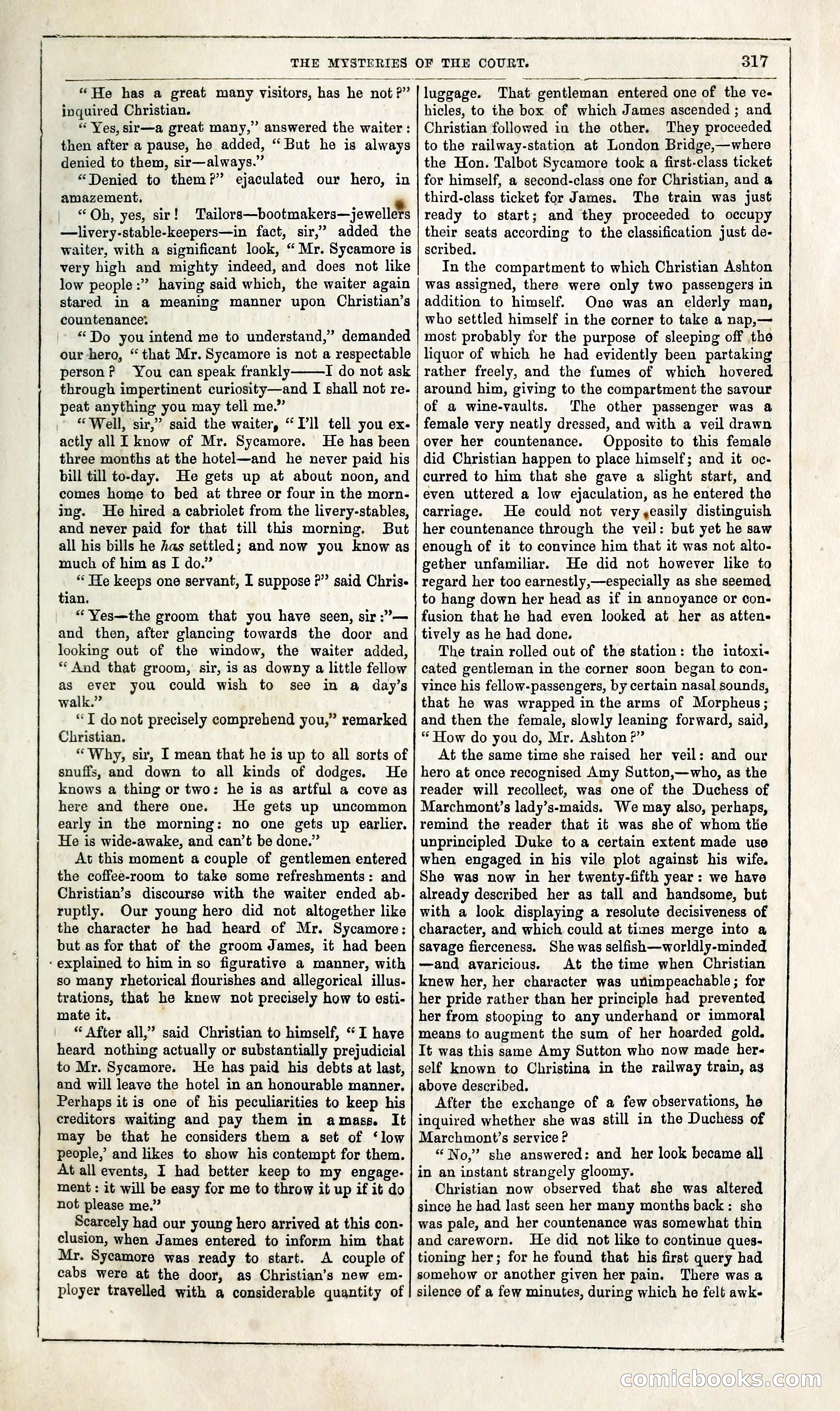
A restored page from Penny Dreadfuls, 1849. Page through the whole issue in the reader above.
📄 Transcribed text from this page (OCR, searchable)
Machine-transcribed from the original scan — historical spelling and the odd misread are preserved.
THE MYSTERIES OF THE COURT. oL7 “He has a great many visitors, has he not?’ | luggage. That gentleman entered one of the vee inquired Christian. “ Yes, sir—a great many,’ answered the waiter : then after a pause, he added, “But he is always denied to them, sir—always.” “Denied to them?” ejaculated our hero, in amazement, | “Qh, yes, sir! Tailors—bootmakers—jewellets —livery-stable-keepers—in fact, sir,’ added the waiter, with a significant look, “ Mr. Sycamore is very high and mighty indeed, and does not like low people :” having said which, the waiter again stared in @ meaning manner upon Christian’s countenance: '- “Do you intend me to understand,’ demanded our hero, “that Mr. Sycamore is not a respectable person? You can speak frankly I do not ask through impertinent curiosity—and I shall not re- peat anything you may tell me.” . “Well, sir,” said the waiter, “I'll tell you ex- actly all T know of Mr. Sycamore. He has been three months at the hotel—and he never paid his bill till to-day. He gets up at about noon, and comes home to bed at three or four in the morn- ing. He hired a cabriolet from the livery-stables, and never paid for that till this morning. But all his bills he has settled; and now you know as much of him as I do.” “He keeps one servant, I suppose ?” said Chris- tian. “Yes—the groom that you have seen, sir:”’— and then, after glancing towards the door and looking out of the window, the waiter added, *‘ And that groom, sir, is as downy a little fellow as ever you could wish to see in a day’s walk.” “T donot precisely comprehend you,” remarked Christian. “Why, sir, I mean that he is up to all sorts of snuffs, and down to all kinds of dodges. He knows a thing or two: he is as artful a cove as here and there one. He gets up uncommon early in the morning: no one gets up earlier. He is wide-awake, and can’t be done.” At this moment a couple of gentlemen entered the coffee-room to take some refreshments: and Christian’s discourse with the waiter ended ab- ruptly. Our young hero did not altogether like the character he had heard of Mr. Sycamore: but as for that of the groom James, it had been ‘explained to him in so figurative a manner, with so many rhetorical flourishes and allegorical illus- trations, that he knew not precisely how to esti- mate it. “ After all,’ said Christian to himself, “I have heard nothing actually or substantially prejudicial to Mr. Sycamore. He has paid his debts at last, and will leave the hotel in an honourable manner. Perhaps it is one of his peculiarities to keep his creditors waiting and pay them in amass. It may be that he considers them a set of ‘low people,’ and likes to show his contempt for them. At all events, I had better keep to my engage. ment : it will be easy for me to throw it up if it do not please me.” Scarcely had our young hero arrived at this con- clusion, when James entered to inform him that Mr. Sycamore was ready to start. A couple of cabs were at the door, as Christian’s new em- ployer travelled with a considerable quantity of hicles, to the box of which James ascended ; and Christian followed in the other. They proceeded to the railway-station at London Bridge,—where the Hon. Talbot Sycamore took a first-class ticket for himself, a second-class one for Christian, and a third-class ticket for James. The train was just ready to start; and they proceeded to occupy their seats according to the classification just de- scribed. In the compartment to which Christian Ashton was assigned, there were only two passengers in addition to himself. One was an elderly man, who settled himself in the corner to take a nap,— most probably for the purpose of sleeping off the liquor of which he had evidently been partaking rather freely, and the fumes of which hovered around him, giving to the compartment the savour of a wine-vaults. The other passenger was a female very neatly dressed, and with a veil drawn over her countenance. Opposite to this female did Christian happen to place himself; and it oc- curred to him that she gave a slight start, and even uttered a low ejaculation, as he entered the carriage. He could not very easily distinguish her countenance through the veil: but yet he saw enough of it to convince him that it was not alto- gether unfamiliar. He did not however like to regard her too earnestly,—especially as she seemed to hang down her head as if in annoyance or con- fusion that he had even looked at her as atten tively as he had done. The train rolled out of the station: the intoxi- cated gentleman in the corner soon began to con- vince his fellow-passengers, by certain nasal sounds, that he was wrapped in the arms of Morpheus; and then the female, slowly leaning forward, said, “‘ How do you do, Mr. Ashton ?” At the same time she raised her veil: and our hero at once recognised Amy Sutton,—who, as the reader will recollect, was one of the Duchess of Marchmont’s lady’s-maids. We may also, perhaps, remind the reader that it was she of whom the unprincipled Duke to a certain extent made use when engaged in his vile plot against his wife. She was now in her twenty-fifth year: we have already described her as tall and handsome, but with a look displaying a resolute decisiveness of character, and which could at times merge into a savage fierceness. She was selfish—worldly-minded —and avaricious. At the time when Christian knew her, her character was unimpeachable; for her pride rather than her principle had prevented her from stooping to any underhand or immoral means to augment the sum of her hoarded gold. It was this same Amy Sutton who now made her- self known to Christina in the railway train, ag above described. After the exchange of a few observations, he inquired whether she was still in the Duchess of Marchmont’s service ? “No,” she answered: and her look became all in an instant strangely gloomy. Christian now observed that she was altered since he had last seen her many months back: she was pale, and her countenance was somewhat thin and careworn. He did not like to continue ques- tioning her; for he found that his first query had somehow or another given her pain. There was a silence of a few minutes, during which he felt awk- — Reo te (C(O) 1) (@ 0)(0)(0) cS (C(O)