
Penny Dreadfuls, 1849 · page 307 of 394
The Mysteries of the Court of London — page 307: what you’re looking at
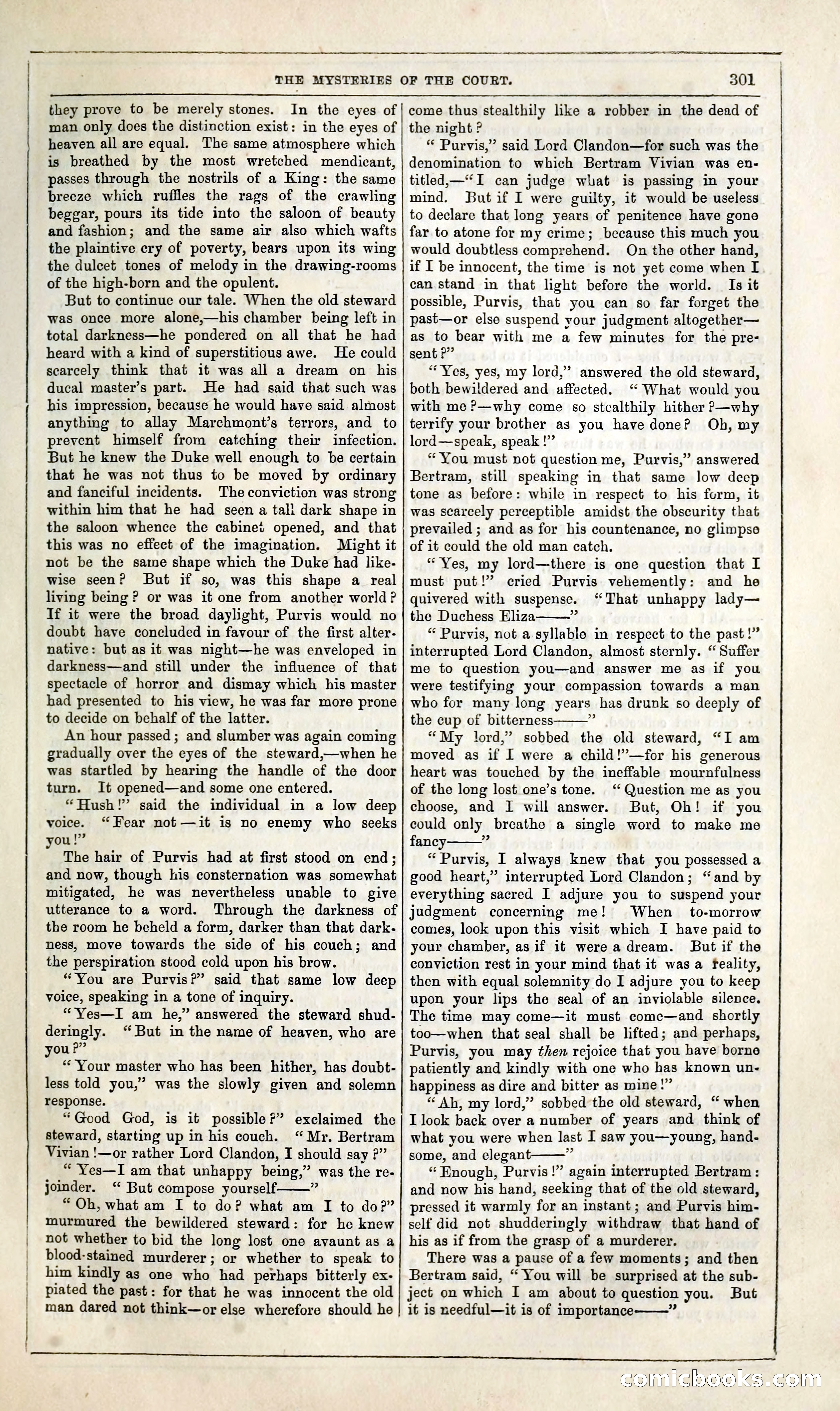
A restored page from Penny Dreadfuls, 1849. Page through the whole issue in the reader above.
📄 Transcribed text from this page (OCR, searchable)
Machine-transcribed from the original scan — historical spelling and the odd misread are preserved.
THE MYSTERIES OF THE COURT. Re eee ee rt ee 301 they prove to be merely stones. In the eyes of man only does the distinction exist: in the eyes of heaven all are equal. The same atmosphere which is breathed by the most wretched mendicant, passes through the nostrils of a King: the same breeze which ruffles the rags of the crawling beggar, pours its tide into the saloon of beauty and fashion; and the same air also which wafts the plaintive cry of poverty, bears upon its wing the dulcet tones of melody in the drawing-rooms of the high-born and the opulent. But to continue our tale. When the old steward was once more alone,—his chamber being left in total darkness—he pondered on all that he had heard with a kind of superstitious awe. He could scarcely think that it was all a dream on his ducal master’s part. He had said that such was his impression, because he would have said almost anything to allay Marchmont’s terrors, and to prevent himself from catching their infection. But he knew the Duke well enough to be certain that he was not thus to be moved by ordinary and fanciful incidents. The conviction was strong within him that he had seen a tali dark shape in the saloon whence the cabinet opened, and that this was no effect of the imagination. Might it not be the same shape which the Duke had like- wise seen? But if so, was this shape a real living being ? or was it one from another world? If it were the broad daylight, Purvis would no doubt have concluded in favour of the first alter- native: but as it was night—he was enveloped in darkness—and still under the influence of that spectacle of horror and dismay which his master had presented to his view, he was far more prone to decide on behalf of the latter. An hour passed; and slumber was again coming gradually over the eyes of the steward,—when he was startled by hearing the handle of the door turn. It opened—and some one entered. “Hush!” said the individual in a low deep voice. “Fear not—it is no enemy who seeks ou!” The hair of Purvis had at first stood on end; and now, though his consternation was somewhat mitigated, he was nevertheless unable to give utterance to a word. Through the darkness of the room he beheld a form, darker than that dark- ness, move towards the side of his couch; and the perspiration stood cold upon his brow. “You are Purvis?” said that same low deep voice, speaking in a tone of inquiry. *“’Yes—I am he,” answered the steward shud- deringly. ‘But in the name of heaven, who are you?” ‘Your master who has been hither, has doubt- less told you,” was the slowly given and solemn response. “Good God, is it possible?’ exclaimed the steward, starting up in his couch. “Mr. Bertram Vivian !—or rather Lord Clandon, I should say 2” “ Yes—I am that unhappy being,” was the re- joinder. “ But compose yourself is “ Oh, what am I to do? what am I to do?” murmured the bewildered steward: for he knew not whether to bid the long lost one avaunt as a blood-stained murderer; or whether to speak to him kindly as one who had perhaps bitterly ex- piated the past: for that he was innocent the old man dared not think—or else wherefore should he come thus stealthily like a robber in the dead of the night ? * Purvis,” said Lord Clandon—for such was the denomination to which Bertram Vivian was en- titled,—“ I can judge what is passing in your mind. Butif I were guilty, it would be useless to declare that long years of penitence have gone far to atone for my crime; because this much you would doubtless comprehend. On the other hand, if I be innocent, the time is not yet come when I can stand in that light before the world. Is it possible, Purvis, that you can so far forget the past—or else suspend your judgment altogether— as to bear with me a few minutes for the pre- sent P” “Yes, yes, my lord,” answered the old steward, both bewildered and affected. ‘“ What would you with me ?—why come s0 stealthily hither P—why terrify your brother as you have done? Oh, my lord—speak, speak!” “You must not question me, Purvis,” answered Bertram, still speaking in that same low deep tone as before: while in respect to his form, it was scarcely perceptible amidst the obscurity that prevailed ; and as for his countenance, no glimpse of it could the old man catch. “Yes, my lord—there is one question that I must put!” cried Purvis vehemently: and he quivered with suspense. “That unhappy lady— the Duchess Eliza a “ Purvis, not a syllable in respect to the past!” interrupted Lord Clandon, almost sternly. “Suffer me to question you—and answer me as if you were testifying your compassion towards a man who for many long years has drunk so deeply of the cup of bitterness . “My lord,” sobbed the old steward, “I am moved as if I were a child!”—for his generous heart was touched by the ineffable mournfulness of the long lost one’s tone. ‘Question me as you choose, and I will answer. But, Oh! if you could only breathe a single word to make me fancy o “Purvis, I always knew that you possessed a good heart,” interrupted Lord Clandon; “and by everything sacred I adjure you to suspend your judgment concerning me! When _ to-morrow comes, look upon this visit which I have paid to your chamber, asif it were a dream. But if the conviction rest in your mind that it was a feality, then with equal solemnity do I adjure you to keep upon your lips the seal of an inviolable silence. The time may come—it must come—and shortly too—when that seal shall be lifted; and perhaps, Purvis, you may then rejoice that you have borne patiently and kindly with one who has known un- happiness as dire and bitter as mine!” “Ah, my lord,” sobbed the old steward, “ when I look back over a number of years and think of what you were when last I saw you—young, hand- some, and elegant 3 “Enough, Purvis!” again interrupted Bertram: and now his hand, seeking that of the old steward, pressed it warmly for an instant ; and Purvis him- self did not shudderingly withdraw that hand of his as if from the grasp of a murderer. There was a pause of a few moments; and then Bertram said, “ You will be surprised at the sub- ject on which I am about to question you. But it is needful—it is of importance a oe a a ae Ee ee (C(O) Nn) (C 0)(0)(0) ES (©)