
Penny Dreadfuls, 1849 · page 298 of 394
The Mysteries of the Court of London — page 298: what you’re looking at
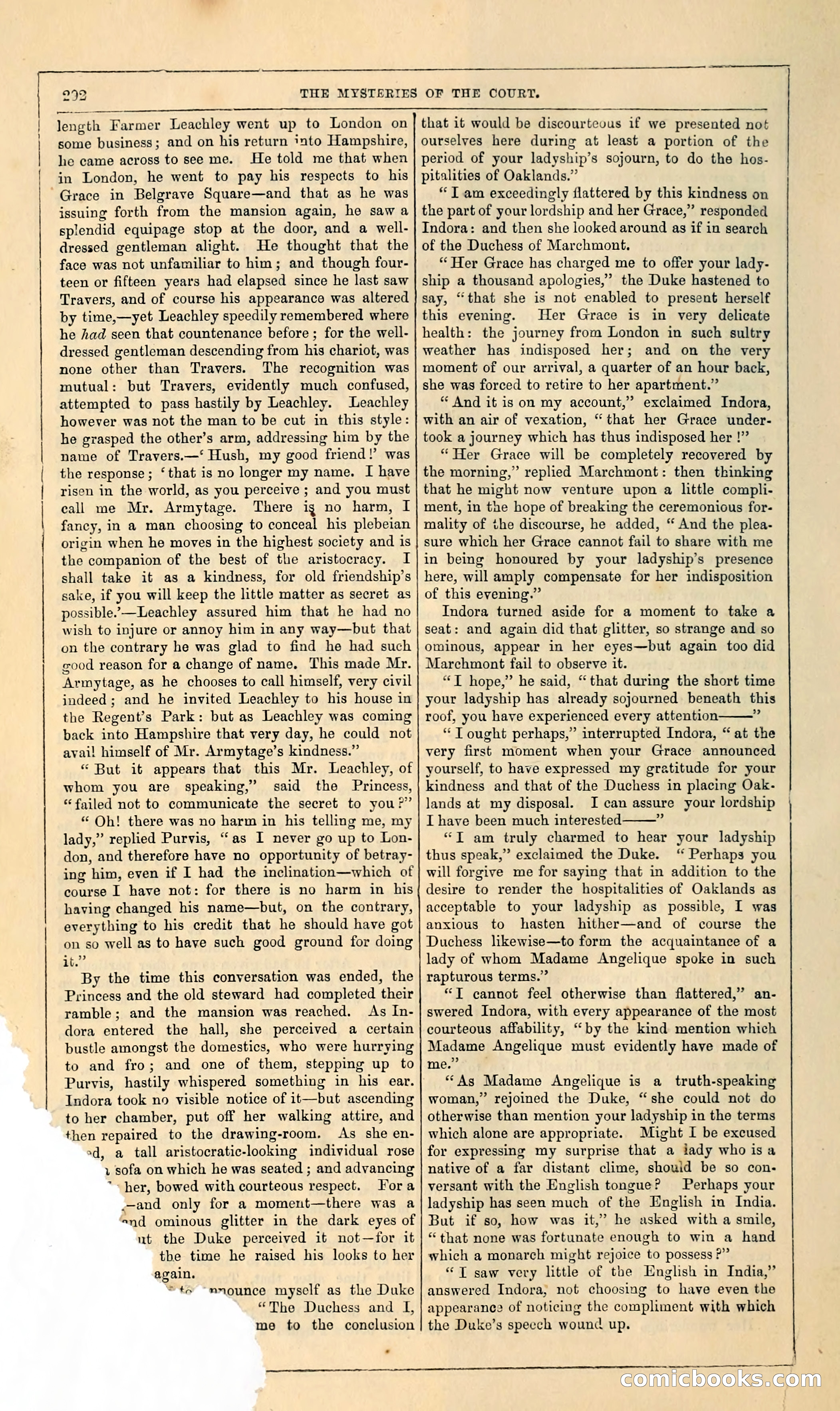
A restored page from Penny Dreadfuls, 1849. Page through the whole issue in the reader above.
📄 Transcribed text from this page (OCR, searchable)
Machine-transcribed from the original scan — historical spelling and the odd misread are preserved.
) | | | | | | 292 length Farmer Leachley went up to London on some business; and on his return into Hampshire, he came across to see me. He told me that when in London, he went to pay his respects to his Grace in Belgrave Square—and that as he was issuing forth from the mansion again, he saw a splendid equipage stop at the door, and a well- dressed gentleman alight. He thought that the face was not unfamiliar to him; and though four- teen or fifteen years had elapsed since he last saw Travers, and of course his appearance was altered by time,—yet Leachley speedily remembered where he had seen that countenance before ; for the well- dressed gentleman descending from his chariot, was none other than Travers. The recognition was mutual: but Travers, evidently much confused, attempted to pass hastily by Leachley. Leachley however was not the man to be cut in this style: he grasped the other’s arm, addressing him by the name of Travers.—‘ Hush, my good friend!’ was the response; ‘that is no longer my name. I have risen in the world, as you perceive ; and you must eall me Mr. Armytage. There ig no harm, I fancy, in a man choosing to conceal his plebeian origin when he moves in the highest society and is the companion of the best of the aristocracy. I shall take it as a kindness, for old friendship’s sake, if you will keep the little matter as secret as possible.’—Leachley assured him that he had no wish to injure or annoy him in any way—but that on the contrary he was glad to find he had such good reason for a change of name. This made Mr. Armytage, as he chooses to call himself, very civil indeed; and he invited Leachley to his house in the Regent’s Park: but as Leachley was coming back into Hampshire that very day, he could not avai! himself of Mr. Armytage’s kindness.” “ But it appears that this Mr. Leachley, of whom you are speaking,’ said the Princess, “failed not to communicate the secret to you?” “ Oh! there was no harm in his telling me, my lady,” replied Purvis, “as I never go up to Lon- don, and therefore have no opportunity of betray- ing him, even if I had the inclination—which of course I have not: for there is no harm in his having changed his name—but, on the contrary, everything to his credit that he should have got on so well as to have such good ground for doing it.” By the time this conversation was ended, the Princess and the old steward had completed their ramble; and the mansion was reached. As In- dora entered the hall, she perceived a certain bustle amongst the domestics, who were hurrying to and fro; and one of them, stepping up to Purvis, hastily whispered something in his ear. Indora took no visible notice of it—but ascending to her chamber, put off her walking attire, and then repaired to the drawing-room. As she en- od, a tall aristocratic-looking individual rose . sofa on which he was seated ; and advancing her, bowed with courteous respect. Fora .-and only for a moment—there was a end ominous glitter in the dark eyes of ut the Duke perceived it not—for it the time he raised his looks to her again. “te ~mmounce myself as the Duke “The Duchess and I, me to the conclusion THE MYSTERIES OF THE COURT. that it would be discourteous if we presented not ourselves here during at least a portion of the period of your ladyship’s sojourn, to do the hos- pitalities of Oaklands.” “Tam exceedingly flattered by this kindness on the part of your lordship and her Grace,” responded Indora: and then she looked around as if in search of the Duchess of Marchmont. “Her Grace has charged me to offer your lady- ship a thousand apologies,” the Duke hastened to say, “that she is not enabled to present herself this evening. Her Grace is in very delicate health: the journey from London in such sultry weather has indisposed her; and on the very moment of our arrival, a quarter of an hour back, she was forced to retire to her apartment.” “ And it is on my account,” exclaimed Indora, with an air of vexation, “that her Grace under- took a journey which has thus indisposed her !” “Her Grace will be completely recovered by the morning,’ replied Marchmont: then thinking that he might now venture upon a little compli- ment, in the hope of breaking the ceremonious for- mality of the discourse, he added, “ And the plea- sure which her Grace cannot fail to share with me in being honoured by your ladyship’s presence here, will amply compensate for her indisposition of this evening.” Indora turned aside for a moment to take a seat: and again did that glitter, so strange and so ominous, appear in her eyes—but again too did Marchmont fail to observe it. “T hope,” he said, “that during the short time your ladyship has already sojourned beneath this roof, you have experienced every attention o “ T ought perhaps,’ interrupted Indora, “at the very first moment when your Grace announced yourself, to have expressed my gratitude for your kindness and that of the Duchess in placing Oak- lands at my disposal. I can assure your lordship I have been much interested A “JT am truly charmed to hear your ladyship thus speak,” exclaimed the Duke. “ Perhaps you will forgive me for saying that in addition to the desire to render the hospitalities of Oaklands as acceptable to your ladyship as possible, I was anxious to hasten hither—and of course the Duchess likewise—to form the acquaintance of a lady of whom Madame Angelique spoke in such rapturous terms.” “T cannot feel otherwise than flattered,” an- swered Indora, with every appearance of the most courteous affability, “by the kind mention which Madame Angelique must evidently have made of me, ““As Madame Angelique is a_ truth-speaking woman,” rejoined the Duke, “she could not do otherwise than mention your ladyship in the terms which alone are appropriate. Might I be excused for expressing my surprise that a lady whoisa native of a far distant clime, should be so con- versant with the English tongue? Perhaps your ladyship has seen much of the English in India. But if so, how was it,” he asked with a smile, “that none was fortunate enough to win a hand which a monarch might rejoice to possess ?” “ T saw very little of the English in India,” answered Indora; not choosing to have even the appearance of noticing the compliment with which the Duke’s speech wound up. Gomichboo S (E(0