
Penny Dreadfuls, 1849 · page 285 of 394
The Mysteries of the Court of London — page 285: what you’re looking at
A restored page from Penny Dreadfuls, 1849. Page through the whole issue in the reader above.
📄 Transcribed text from this page (OCR, searchable)
Machine-transcribed from the original scan — historical spelling and the odd misread are preserved.
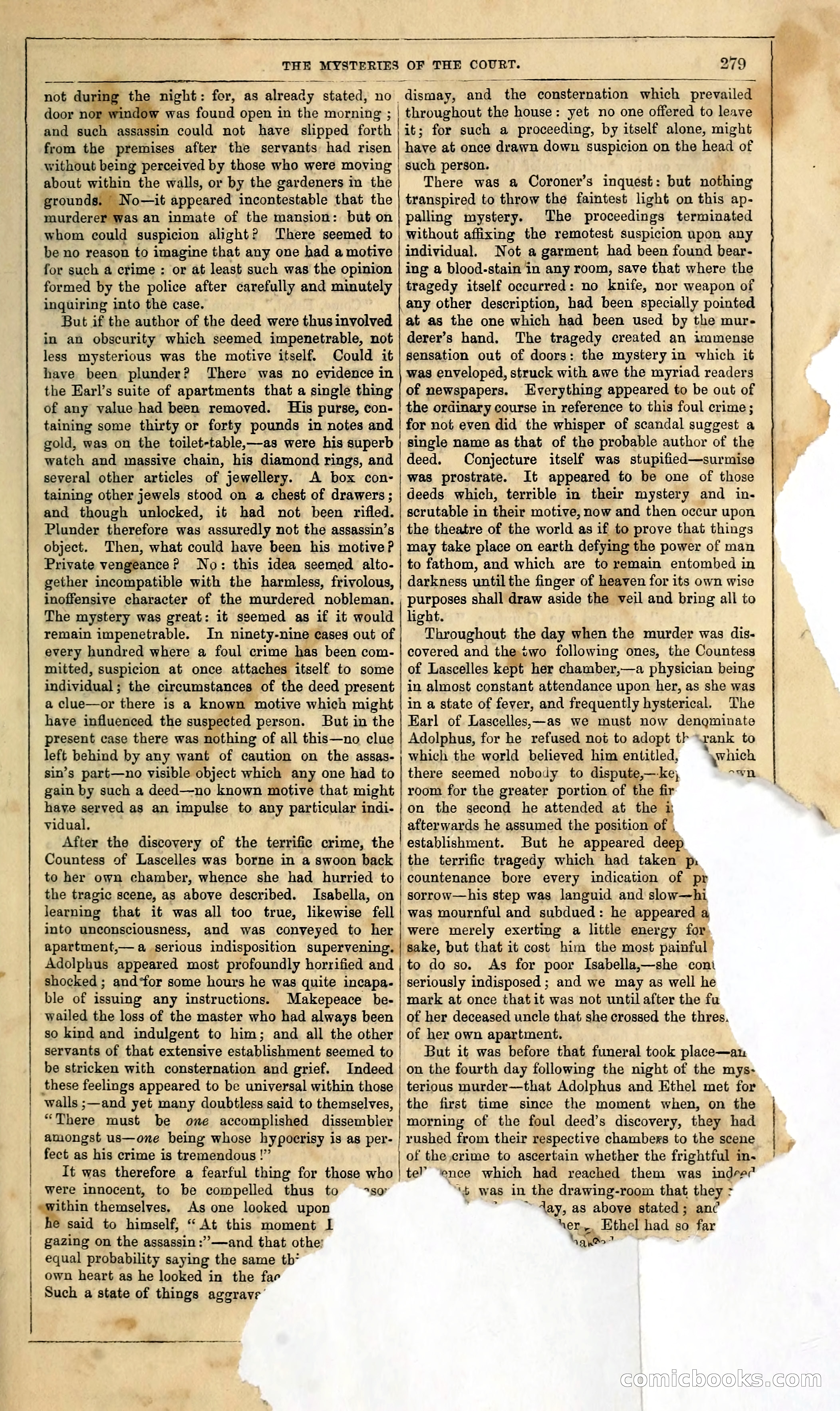
THE MYSTERIES OF THE COURT. — 279 six x the nicht : for, as already stated: no dismay, and the consternation which prevailed yw was found open in the morning ; ssassin could not have slipped forth from the premises after the servants had risen without being perceived by those who were moving about within the walls, or by the gardeners in the grounds o—it appeared incontestable that the murder as an inmate of the mansion: but on whom could suspicion alight? There seemed to be no reason to imagine that any one had a motive for such a crime : or at least such was the opinion formed by the police after carefully and minutely inguiring into the case. But if the author of the deed were thus involved in an obscurity which seemed impenetrable, not less mysterious was the motive itself. Could it have been plunder? There was no evidence in the Earl’s suite of apartments that a single thing of any value had been removed. His purse, con- taining some thirty or forty pounds in notes and gold, was on the toilet-table,—as were his superb watch and massive chain, his diamond rings, and several other articles of jewellery. A box con- taining other jewels stood on a chest of drawers; and though unlocked, it had not been rifled. Plunder therefore was assuredly not the assassin’s object. Then, what could have been his motive? Private vengeance? No: this idea seemed alto- gether incompatible with the harmless, frivolous, inoffensive character of the murdered nobleman. The mystery was great: it ssemed as if it would remain impenetrable. In ninety- -nine cases out of every hundred where a foul crime has been com- mitted, suspicion at once attaches: ‘itself to some individual ; the circumstances of the deed present a clue—or ‘there is a known motive which might haye influenced the suspected person. But in the present case there was nothing of all this—no clue left behind by any want of caution on the assas- sin’s part—no visible object which any one had to gain by such a deed—no known motive that might haye served as an impulse to any particular indi- vidual. After the discovery of the terrific crime, the Countess of Lascelles was borne in a swoon back to her own chamber, whence she had hurried to the tragic scene, as above described. Isabella, on learning that it was all too true, likewise fell into unconsciousness, and was conveyed to her apartment,— a serious indisposition supervening. Adolphus appeared most profoundly horrified and shocked ; and*for some hours he was quite incapa- ble of issuing any instructions. Makepeace be- wailed the loss of the master who had always been so kind and indulgent to him; and all the other servants of that extensive establishment seemed to be stricken with consternation and grief. Indeed these feelings appeared to be universal within those walls ;—and yet many doubtless said to themselves, “There must be one accomplished dissembler amongst us—one being whose hypocrisy is as per- fect as his crime is tremendous!” It was therefore a fearful thing for those who | tel” were innocent, to be compelled thus to | sithin themselves. As one looked upon said to himself, “At this moment I gazing on the assassin :”’—and that othe: equal probability saying the same tb° own heart as he looked in the fae Such a state of things aggravr ie *so’ | throughout the house: yet no one offered to leave it; for such a proceeding, by itself alone, might have at once drawn down suspicion on the head of such person. There was a Coroner’s inquest: but nothing transpired to throw the faintest light on this ap- palling mystery. The proceedings terminated without affixing the remotest suspicion upon any individual. Not a garment had been found bear- ing a blood-stain in any room, save that where the tragedy itself occurred: no knife, nor weapon of any other description, had been specially pointed at as the one which had been used by the mur- derer’s hand. The tragedy created an immense sensation out of doors: the mystery in which it was enveloped, struck with awe the myriad readers of newspapers. Everything appeared to be ont of the ordinary course in reference to this foul crime; for not even did the whisper of scandal suggest a single name as that of the probable author of the deed. Conjecture itself was stupified—surmise was prostrate. It appeared to be one of those deeds which, terrible in their mystery and in- scrutable in their motive, now and then occur upon the theatre of the world as if to prove that things may take place on earth defying the power of man to fathom, and which are to remain entombed in darkness until the finger of heaven for its own wise purposes shall draw aside the veil and bring all to light. Throughout the day when the murder was dis- covered and the two following ones, the Countess of Lascelles at her chamber,—a physician being in almost constant attendance upon her, as she was in a state of fever, and frequently hysterical. The Earl of Lascelles,—as we must now dengminate Adolphus, for he refused not to adopt th “rank to which the world believed him entitled, ‘which there seemed nobody to dispute,—-ke) own room for the greater portion of the fir on the second he attended at the x afterwards he assumed the position of , establishment. But he appeared deep the terrific tragedy which had taken p, countenance bore every indication of pr sorrow—his step was languid and slow—hi was mournful and subdued: he appeared a were merely exerting a little energy for sake, but that it cost him the most painful to do so. As for poor Isabella,—she coni seriously indisposed ; and we may as well he mark at once thatit was not until after the fu of her deceased uncle that she crossed the thres. of her own apartment. But it was before that funeral took place—au on the fourth day following the night of the mys- terious murder—that Adolphus and Ethel met for the first time since the moment when, on the morning of the foul deed’s discovery, they had rushed from their respective chambers to the scene of the crime to ascertain whether the frightful in- ence which had reached them was indrec ™ was in the drawing-room that they - lay, as above stated; anc ‘er... Ethel had ¢ so far ae? 6)(0)©) (C(O) S (C(O)