
Penny Dreadfuls, 1849 · page 280 of 394
The Mysteries of the Court of London — page 280: what you’re looking at
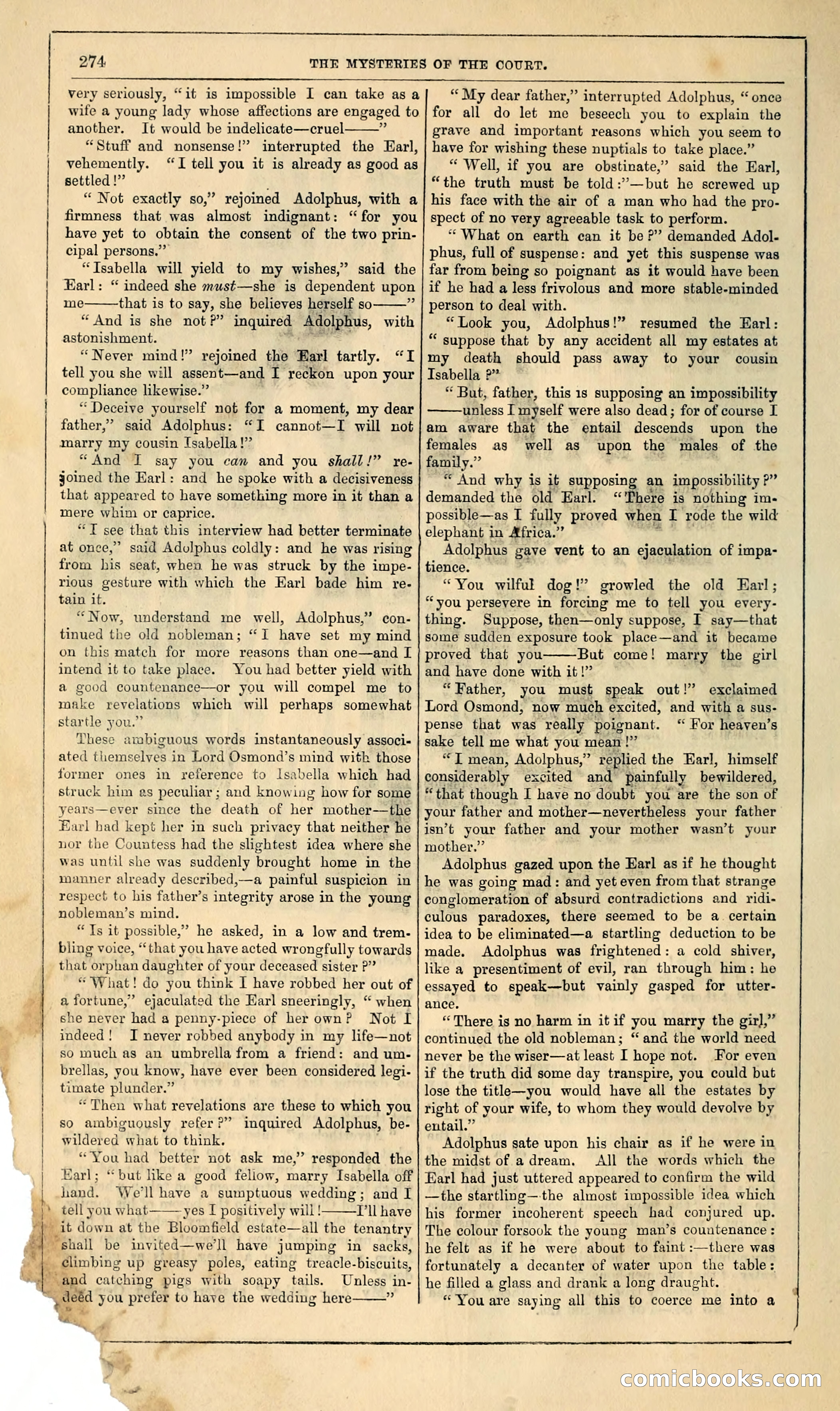
A restored page from Penny Dreadfuls, 1849. Page through the whole issue in the reader above.
📄 Transcribed text from this page (OCR, searchable)
Machine-transcribed from the original scan — historical spelling and the odd misread are preserved.
ait tell yop w hat——— yes I positively ta ! 2'74 very seriously, “it is impossible I can take as a wife a young lady whose affections are engaged to PP] another. It would be indelicate—cruel “Stuff and nonsense!” interrupted the Earl, “T tell you it is already as good as vehemently. settled !” “ Not exactly so,” firmness that was almost indignant: have yet to obtain the consent of the two prin- cipal persons.” “Tsabella will yield to my wishes,” said the Earl: “ indeed she must—she is dependent upon me that is to say, she believes herself so a “And is she not?” inquired Adolphus, with astonishment. “Never mind!” rejoined the Earl tartly. ce I tell you she will assent—and I reckon upon your compliance likewise.” |“ Deceive yourself not for a moment, my dear father,’ said Adolphus: “I cannot—I will not marry my cousin Isabella!” “And I say you can and you shall!” re- yoined the Karl: and he spoke with a decisiveness that appeared to have something more in it than a mere whim or caprice. “T see that this interview had better terminate at once,’ said Adolphus coldly: and he was rising from his seat, when he was struck by the impe- rious gesture with which the Earl bade him re- tain it. “Now, understand me well, Adolphus,” con- tinued the old nobleman; “I have set my mind on this match for more reasons than one—and I intend it to take place. You had better yield with a good countenance—or you will compel me to make revelations which will perhaps somewhat startle you.” These ambiguous words instantaneously associ- ated themselves in Lord Osmond’s mind with those former ones in reference to Isabella which had struck him as peculiar; and knowing how for some | years—ever since the death of her mother—the | ®arl had kept her in such privacy that neither he nor the Countess had the slightest idea where she was until she was suddenly brought home in the | manner already deseribed,—a painful ‘suspicion in respect to his father’s integrity arose in the young nobleman’s mind. “Ts it possible,” he asked, in a low and trem- bling voice, “that you have acted wrongfully towards that orphan daughter of your deceased sister P” * What! do you think I have robbed her out of a fortune,’ ejaculated the Karl sneeringly, “ when she never had a penny-piece of her own? Not I indeed! I never robbed anybody in my life—not so much as an umbrella from a friend: and um- brellas, you know, have ever been considered legi- timate plunder.” | “Then what revelations are these to which you | so ambiguously refer?” inquired Adolphus, be- | wildered what to think. | “You had better not ask me,” responded the | Earl ; | hand, | “but hke a good feliow, marry Isabella off We'll have a sumptuous wedding; and I I'll have shall Ba invited we'll hive jumping in sacks, _ climbing up greasy poles, eating treacle- biscuits, and catching pigs with soapy tails. Unless in- ~ deéd you prefer to have the wedding here i rejoined Adolphus, with a “for you THE MYSTERIES OF THE COURT. ““ My dear father,” interrupted Adolphus, “ once for all do let me beseech you to explain the grave and important reasons which you seem to have for wishing these nuptials to take place.” “ Well, if you are obstinate,” said the Earl, “the truth must be told:”’—but he screwed up his face with the air of a man who had the pro- spect of no very agreeable task to perform. “What on earth can it be?” demanded Adol- phus, full of suspense: and yet this suspense was far from being so poignant as it would have been if he had a less frivolous and more stable-minded person to deal with. “Look you, Adolphus!” resumed the Earl: “suppose that by any accident all my estates at my death should pass away to your cousin Isabella °” “ But, father, this 1s supposing an impossibility unless T myself were also dead; for of course I am aware that the entail descends upon the females as well as upon the males of the family.” “And why is it supposin an impossibility ey demanded the old Earl. here is nothing im- possible—as I fully proved when I rode the wild elephant in Africa.” Adolphus gave vent to an ejaculation of impa- tience. “You wilful dog!’ growled the old Earl; “you perseyere in forcing me to tell you every- thing. Suppose, then—only suppose, I say—that some sudden exposure took place—and it became proved that you But come! marry the girl and have done with it!” “Father, you must speak out!” exclaimed Lord Osmond; now much excited, and with a sus- pense that was really poignant. ‘ For heayen’s sake tell me what you mean!’ “I mean, Adolphus,” replied the Earl, himself considerably excited and painfully bewildered, “that though I have no doubt you are the son of your father and mother—nevertheless your father isn’t your father and your mother wasn’t your mother.” Adolphus gazed upon the Earl as if he thought he was going mad: and yet even from that strange conglomeration of absurd contradictions and ridi- culous paradoxes, there seemed to be a certain idea to be eliminated—a startling deduction to be made. Adolphus was frightened: a cold shiver, like a presentiment of evil, ran through him: he essayed to speak—but vainly gasped for utter- ance. “There is no harm in it if you marry the gir],” continued the old nobleman; “ and the world need never be the wiser—at least I hope not. For even if the truth did some day transpire, you could but lose the title—you would have all the estates by right of your wife, to whom they would devolve by entail.” Adolphus sate upon his chair as if he were in the midst of a dream, All the words which the Earl had just uttered appeared to confirm the wild —the startling—the almost impossible idea which his former incoherent speech had conjured up. The colour forsook the young man’s countenance: he felt as if he were about to faint :—there was fortunately a decanter of water upon the table: he filled a glass and drank a long draught. “You are saying all this to coerce me into a }?? <SiiGO GEomicboo