
Penny Dreadfuls, 1849 · page 264 of 394
The Mysteries of the Court of London — page 264: what you’re looking at
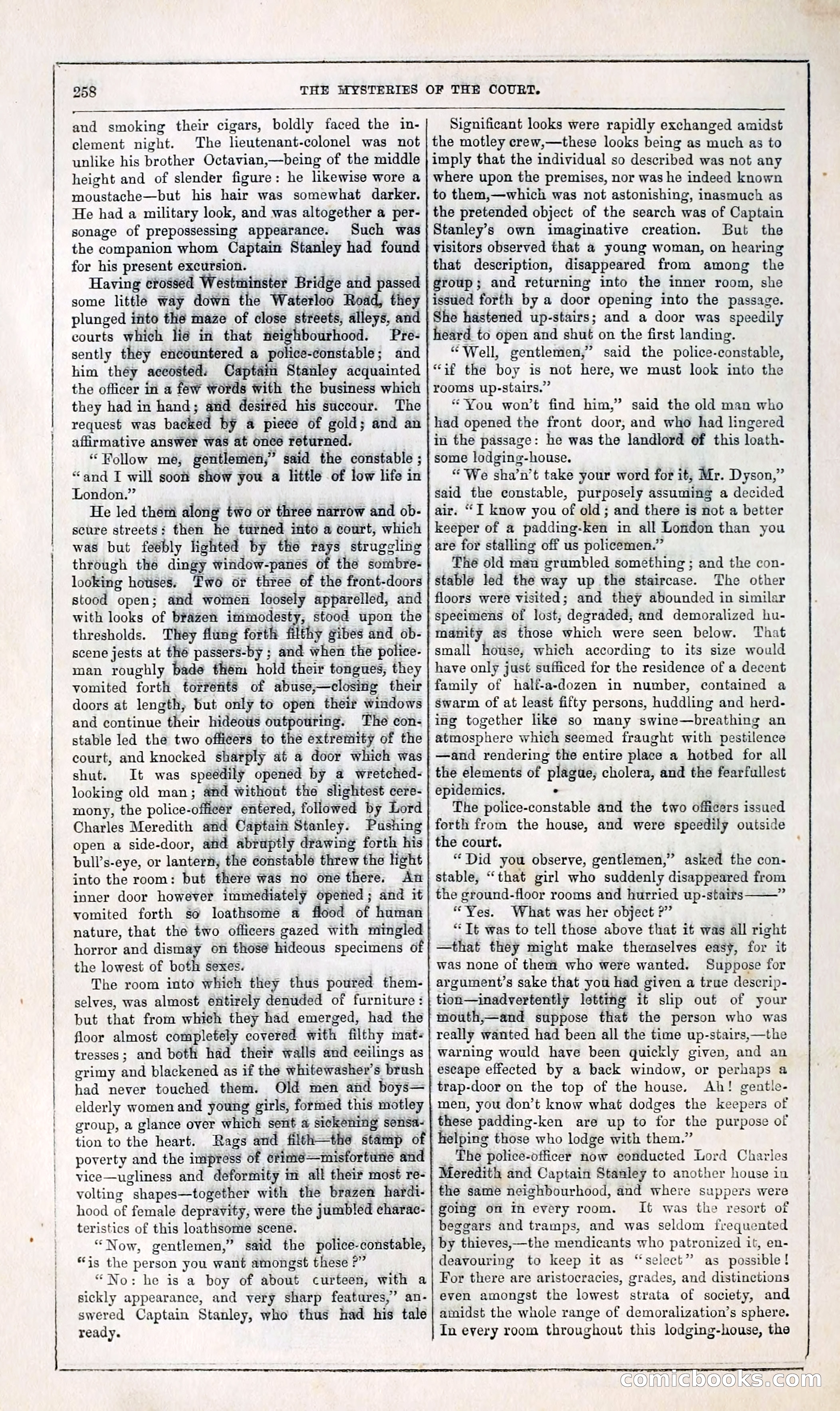
A restored page from Penny Dreadfuls, 1849. Page through the whole issue in the reader above.
📄 Transcribed text from this page (OCR, searchable)
Machine-transcribed from the original scan — historical spelling and the odd misread are preserved.
EE TT TT ehh sss ss ¢ 258 and smoking their cigars, boldly faced the in- clement night. The lieutenant-colonel was not unlike his brother Octavian,—being of the middle height and of slender figure: he likewise wore a moustache—but his hair was somewhat darker. He had a military look, and was altogether a per- sonage of prepossessing appearance. Such was the companion whom Captain Stanley had found for his present excursion. Having crossed Westminster Bridge and passed some little way down the Waterloo Road, they plunged into the maze of close streets, alleys, and courts which lié in that neighbourhood. Pre- sently they encountered a police-constable; and him they aceosted. Captain Stanley acquainted the officer in a few words with the business which they had in hand; and desiréd his succour. The request was backed by a piece of gold; and an affirmative answer was at once returned. “Follow me, gentlemen,’ said the constable ; “and I will soon show you a little of low life in London.” ) He led them along two or three narrow and ob- secure streets: then he turned into a court, which was but feebly lighted by the rays struggling through the dingy window-panes of the sombre- looking houses. Two or three of the front-doors stood open; and women loosely apparelled, and with looks of brazen immodesty, stood upon the thresholds. They flung forth filthy gibes and ob- scene jests at the passers-by ; and when the police- man roughly bade them hold their tongues, they vomited forth forrenfs of abuse,—closing their doors at length, but only to open their windows and continue their hideous outpouring. The con- stable led the two officers to the extremity of the court, and knocked sharply at a door which was shut. It was speedily opened by a wretched- looking old man; and without the slightest cere- mony, the police-officer entered, followed by Lord Charles Meredith and Captain Stanley. Pushing open a side-door, and abruptly drawing forth his bull’s-eye, or lantern, the constable threw the light into the room: but there was no one there. An inner door however immediately opened; and it vomited forth so loathsome a flood of human nature, that the two officers gazed with mingled horror and dismay on thosé hideous specimens of the lowest of both sexes. : The room into which they thus poured them- selves, was almost entirely denuded of furniture: but that from which they had emerged, had the floor almost completely covered with filthy mat- tresses; and both had their walls and ceilings as erimy and blackened as if the whitewasher’s brush had never touched them. Old men and boys— elderly women and young girls, formed this motley group, a glance over which sent a sickenig sensa- tion to the heart. Rags and filth—the stamp of poverty and the impress of efime—misfortune and vice—ugliness and deformity im all their most re- volting shapes—together with the brazen hardt- hood of female depravity, were the jumbled eharac- teristics of this loathsome scene. | “Now, gentlemen,” said the police-constable, “is the person you want amongst these ?” “No: he is a boy of about curteen, with a sickly appearance, and very sharp features,’ an- swered Captain Stanley, who thus had his tale ready. THE MYSTERIES OF THE COURT. Significant looks were rapidly exchanged amidst the motley crew,—these looks being as much as to imply that the individual so described was not any where upon the premises, nor was he indeed known to them,—which was not astonishing, inasmuch as the pretended object of the search was of Captain Stanley’s own imaginative creation. But the visitors observed that a young woman, on hearing that description, disappeared from among the group; and returning into the inner room, she issued forth by a door opening into the passage. She hastened up-stairs; and a door was speedily heard to open and shut on the first landing. “Well, gentlemen,” said the police-constable, “if the boy is not here, we must look into the rooms up-stairs.” * You won't find him,” said the old man who had opened the front door, and who had lingered in the passage: he was the landlord of this loath- some lodging-house. “We sha’n’t take your word for it, Mr. Dyson,” said the constable, purposely assuming a decided air. “I know you of old; and there is not a better keeper of a padding-ken in all London than you are for stalling off us policemen.” The old man grumbled something ; and the con- stable led the way up the staircase. The other floors were visited; and they abounded in similar specimens of lost, degraded; and demoralized hu- manity as those which were seen below. That small house, which according to its size would have only just sufficed for the residence of a decent family of half-a-dozen in number, contained a swarm of at least fifty persons, huddling and herd- ing together like so many swine—breathing an atmosphere which seemed fraught with pestilence —and rendering the entire place a hotbed for all the elements of plague, cholera, and the fearfullest epidemics. . The police-constable and the two officers issued forth from the house, and were speedily outside the court. “Did you observe, gentlemen,” asked the con- stable, “that girl who suddenly disappeared from the ground-floor rooms and hurried up-stairs if “Yes. What was her object ?” | “It was to tell those above that it was all right —that they might make themselves easy, for it was none of them who were wanted. Suppose for argument’s sake that you had given a true descrip- tion—inadvertently lettine it slip out of your mouth,—and suppose that the person who was really wanted had been all the time up-stairs,—the warning would have been quickly given, and an escape effected by a back window, or perhaps a trap-door on the top of the house. Ah! gentle- men, you don’t know what dodges the keepers of these padding-ken are up to for the purpose of helping those who lodge with them.” The police-officer now conducted Lord Charles Meredith and Captain Stanley to another house in the same neighbourhood, and where suppers were goins on in every room. It was the resort of beggars and tramps, and was seldom frequented by thieves,—the mendicants who patronized it, en- deavouring to keep it as “select” as possible! For there are aristocracies, grades, and distinctions even amongst the lowest strata of society, and amidst the whole range of demoralization’s sphere. In every room throughout this lodging-house, the —— ee COMMCOOOKS. ©