
Penny Dreadfuls, 1849 · page 250 of 394
The Mysteries of the Court of London — page 250: what you’re looking at
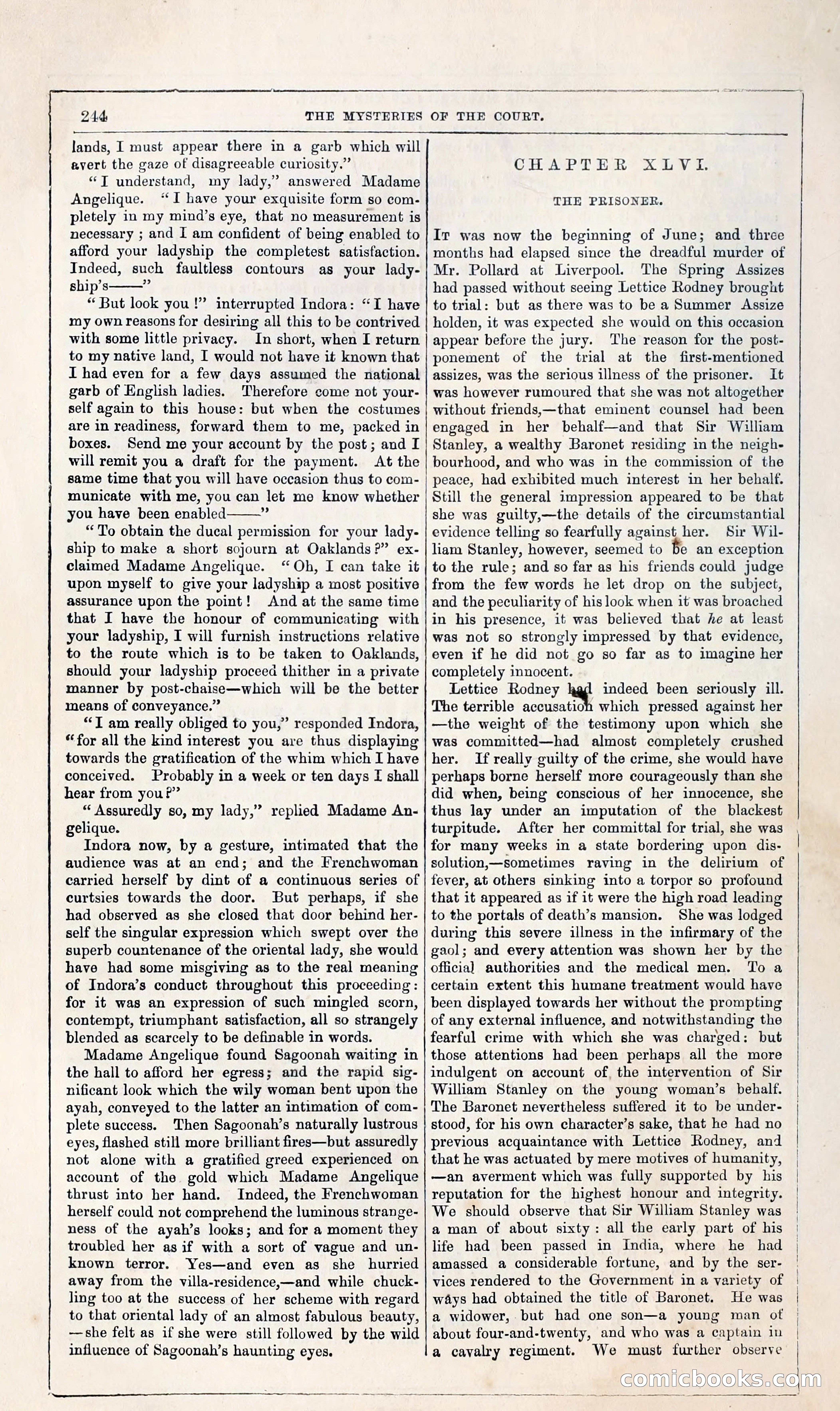
A restored page from Penny Dreadfuls, 1849. Page through the whole issue in the reader above.
📄 Transcribed text from this page (OCR, searchable)
Machine-transcribed from the original scan — historical spelling and the odd misread are preserved.
24.4: —— lands, I must appear there in a garb which will avert the gaze of disagreeable curiosity.” “JT understand, my lady,” answered Madame Angelique. “I have your exquisite form so com- pletely in my mind’s eye, that no measurement is necessary ; and I am confident of being enabled to afford your ladyship the completest satisfaction. Indeed, such faultless contours as your lady- ship’s x “ But look you!” interrupted Indora: “I have my own reasons for desiring all this to be contrived with some little privacy. In short, when I return to my native land, I would not have it known that I had even for a few days assumed the national garb of English ladies. Therefore come not your- self again to this house: but when the costumes are in readiness, forward them to me, packed in boxes. Send me your account by the post; and I will remit you a draft for the payment. At the same time that you will have occasion thus to com- municate with me, you can let me know whether you have been enabled te “To obtain the ducal permission for your lady- ship to make a short sojourn at Oaklands?” ex- claimed Madame Angelique. ‘Oh, I can take it upon myself to give your ladyship a most positive assurance upon the point! And at the same time that I have the honour of communicating with your ladyship, I will furnish instructions relative to the route which is to be taken to Oaklands, should your ladyship proceed thither in a private manner by post-chaise—which will be the better means of conveyance.” “TI am really obliged to you,” responded Indora, for all the kind interest you are thus displaying towards the gratification of the whim which I have conceived. Probably in a week or ten days I shall hear from you?” “ Assuredly so, my lady, gelique. Indora now, by a gesture, intimated that the audience was at an end; and the Frenchwoman carried herself by dint of a continuous series of curtsies towards the door. But perhaps, if she had observed as she closed that door behind her- self the singular expression which swept over the superb countenance of the oriental lady, she would have had some misgiving as to the real meaning of Indora’s conduct throughout this proceeding: for it was an expression of such mingled scorn, contempt, triumphant satisfaction, all so strangely blended as scarcely to be definable in words. Madame Angelique found Sagoonah waiting in the hall to afford her egress; and the rapid sig- nificant look which the wily woman bent upon the ayah, conveyed to the latter an intimation of com- plete success. Then Sagoonah’s naturally lustrous eyes, flashed still more brilliant fires—but assuredly not alone with a gratified greed experienced on account of the gold which Madame Angelique thrust into ber hand. Indeed, the Frenchwoman herself could not comprehend the luminous strange- ness of the ayah’s looks; and for a moment they troubled her as if with a sort of vague and un- known terror. Yes—and even as she hurried away from the villa-residence,—and while chuck- ling too at the success of her scheme with regard to that oriental lady of an almost fabulous beauty, —she felt as if she were still followed by the wild influence of Sagoonah’s haunting eyes. 9? replied Madame An- RE LE TG A I ht THE MYSTERIES OF THE COURT. a CHAPTER XLVL THE PRISONER. It was now the beginning of June; and three months had elapsed since the dreadful murder of Mr. Pollard at Liverpool. The Spring Assizes had passed without seeing Lettice Rodney brought to trial: but as there was to be a Summer Assize holden, it was expected she would on this occasion appear before the jury. The reason for the post- ponement of the trial at the first-mentioned assizes, was the serious illness of the prisoner. It was however rumoured that she was not altogether without friends,—that eminent counsel had been engaged in her behalf—and that Sir William Stanley, a wealthy Baronet residing in the neigh- bourhood, and who was in the commission of the peace, had exhibited much interest in her behalf. Still the general impression appeared to be that she was guilty,—the details of the circumstantial evidence telling so fearfully against her. Sir Wil- liam Stanley, however, seemed to be an exception to the rule; and so far as his friends could judge from the few words he let drop on the subject, and the peculiarity of his look when it was broached in his presence, it was believed that he at least was not so strongly impressed by that evidence, even if he did not go so far as to imagine her completely innocent. Lettice Rodney indeed been seriously ill. The terrible accusatioh which pressed against her —the weight of the testimony upon which she was committed—had almost completely crushed her. If really guilty of the crime, she would have perhaps borne herself more courageously than she did when, being conscious of her innocence, she thus lay under an imputation of the blackest turpitude. After her committal for trial, she was for many weeks in a state bordering upon dis- solution,—sometimes raving in the delirium of fever, at others sinking into a torpor so profound that it appeared as if it were the high road leading to the portals of death’s mansion. She was lodged during this severe illness in the infirmary of the gaol; and every attention was shown her by the officia) authorities and the medical men. To a certain extent this humane treatment would have been displayed towards her without the prompting of any external influence, and notwithstanding the fearful crime with which she was charged: but those attentions had been perhaps all the more indulgent on account of, the intervention of Sir William Stanley on the young woman’s behalf. The Baronet nevertheless suffered it to be under- stood, for his own character’s sake, that he had no previous acquaintance with Lettice Rodney, and that he was actuated by mere motives of humanity, —an averment which was fully supported by his reputation for the highest honour and integrity. We should observe that Sir William Stanley was a man of about sixty: all the early part of his life had been passed in India, where he had amassed a considerable fortune, and by the ser- vices rendered to the Government in a variety of ways had obtained the title of Baronet. He was a widower, but had one son—a young man ot about four-and-twenty, and who was a captain in a cavalry regiment. We must further observe Ne eee | (CORNIECLOOOKS a