
Penny Dreadfuls, 1849 · page 241 of 394
The Mysteries of the Court of London — page 241: what you’re looking at
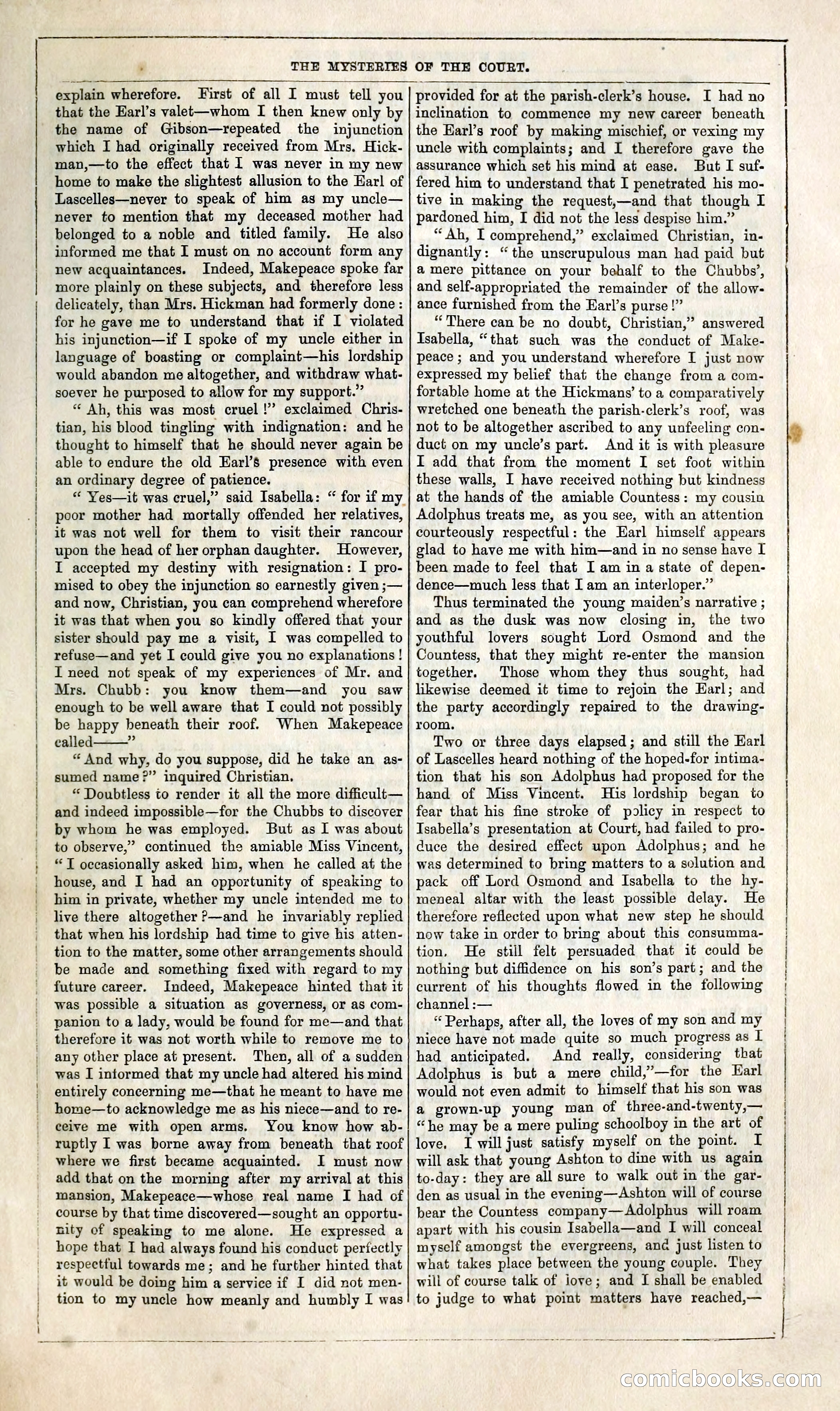
A restored page from Penny Dreadfuls, 1849. Page through the whole issue in the reader above.
📄 Transcribed text from this page (OCR, searchable)
Machine-transcribed from the original scan — historical spelling and the odd misread are preserved.
——— LLL LLL LLL LLL LLL LA LLL LLL LLL LLL LE LLL LLL LL LLL LLL LIAL LLL LL LCL LIC A LT cnt 6 THE MYSTERIES explain wherefore. First of all I must tell you that the Earl’s valet—whom I then knew only by the name of Gibson—repeated the injunction which I had originally received from Mrs. Hick- man,—to the effect that 1 was never in my new home to make the slightest allusion to the Karl of Lascelles—never to speak of him as my uncle— never to mention that my deceased mother had belonged to a noble and titled family. He also informed me that I must on no account form any new acquaintances. Indeed, Makepeace spoke far more plainly on these subjects, and therefore less delicately, than Mrs. Hickman had formerly done: for he gave me to understand that if I violated his injunction—if I spoke of my uncle either in language of boasting or complaint—his lordship would abandon me altogether, and withdraw what- soever he purposed to allow for my support.” “ Ah, this was most cruel!’ exclaimed Chris- tian, his blood tingling with indignation: and he thought to himself that he should never again be able to endure the old Earl’s presence with even an ordinary degree of patience. “ Yes—it was cruel,” said Isabella: “ for if my poor mother had mortally offended her relatives, it was not well for them to visit their rancour upon the head of her orphan daughter. However, I accepted my destiny with resignation: I pro- mised to obey the injunction so earnestly given ;— and now, Christian, you can comprehend wherefore it was that when you so kindly offered that your sister should pay me a visit, I was compelled to refuse—and yet I could give you no explanations ! I need not speak of my experiences of Mr. and Mrs. Chubb: you know them—and you saw enough to be well aware that I could not possibly be happy beneath their roof. When Makepeace called - “ And why, do you suppose, did he take an as- sumed name?” inquired Christian. “ Doubtless to render it all the more difficult— and indeed impossible—for the Chubbs to discover by whom he was employed. But as I was about to observe,’ continued the amiable Miss Vincent, “ T occasionally asked him, when he called at the house, and I had an opportunity of speaking to him in private, whether my uncle intended me to live there altogether P—and he invariably replied that when his lordship had time to give his atten- tion to the matter, some other arrangements should be made and something fixed with regard to my future career. Indeed, Makepeace hinted that it was possible a situation as governess, or as com- panion to a lady, would be found for me—and that therefore it was not worth while to remove me to any other place at present. Then, all of a sudden was I informed that my uncle had altered his mind entirely concerning me—that he meant to have me home—to acknowledge me as his niece—and to re- ceive me with open arms. You know how ab- ruptly I was borne away from beneath that roof where we first became acquainted. I must now add that on the morning after my arrival at this mansion, Makepeace—whose real name I had of course by that time discovered—sought an opportu- nity of speaking to me alone. He expressed a hope that I had always found his conduct perfectly respectful towards me; and he further hinted that it would be doing him a service if I did not men- tion to my uncle how meanly and humbly I was OF THE COURT. inclination to commence my new career beneath the EHarl’s roof by making mischief, or vexing my uncle with complaints; and I therefore gave the assurance which set his mind at ease. But I suf- fered him to understand that I penetrated his mo- tive in making the request,—and that though I pardoned him, I did not the less despise him.” “Ah, I comprehend,” exclaimed Christian, in- dignantly: “the unscrupulous man had paid but a mere pittance on your behalf to the Chubbs’, and self-appropriated the remainder of the allow- ance furnished from the Earl’s purse!” “There can be no doubt, Christian,” answered Isabella, “that such was the conduct of Make- peace ; and you understand wherefore I just now expressed my belief that the change from a com- fortable home at the Hickmans’ to a comparatively wretched one beneath the parish-clerk’s roof, was not to be altogether ascribed to any unfeeling con- duct on my uncle’s part. And it is with pleasure I add that from the moment I set foot within these walls, I have received nothing but kindness at the hands of the amiable Countess: my cousin Adolphus treats me, as you see, with an attention courteously respectful: the Earl himself appears glad to have me with him—and in no sense have [ been made to feel that I am in a state of depen- dence—much less that I am an interloper.” Thus terminated the young maiden’s narrative ; and as the dusk was now closing in, the two youthful lovers sought Lord Osmond and the Countess, that they might re-enter the mansion together. Those whom they thus sought, had likewise deemed it time to rejoin the Earl; and the party accordingly repaired to the drawing- yoom. Two or three days elapsed; and still the Earl of Lascelles heard nothing of the hoped-for intima- tion that his son Adolphus had proposed for the hand of Miss Vincent. His lordship began to fear that his fine stroke of policy in respect to Tsabella’s presentation at Court, had failed to pro- duce the desired effect upon Adolphus; and he was determined to bring matters to a solution and pack off Lord Osmond and Isabella to the hy- meneal altar with the least possible delay. He therefore reflected upon what new step he should now take in order to bring about this consumma- tion, He still felt persuaded that it could be nothing but diffidence on his son’s part; and the current of his thoughts flowed in the following channel :— “Perhaps, after all, the loves of my son and my niece have not made quite so much progress as 1 had anticipated. And really, considering that Adolphus is but a mere child,’—for the Karl would not even admit to himself that his son was a grown-up young man of three-and-twenty,— “he may be a mere puling schoolboy in the art of love, I will just satisfy myself on the pomt. I will ask that young Ashton to dine with us again to-day: they are all sure to walk out in the gar- den as usual in the evening—Ashton will of course bear the Countess company—Adolphus will roam apart with his cousin Isabella—and I will conceal myself amongst the evergreens, anc just listen to what takes place between the young couple. They will of course talk of joye; and JI shall be enabled to judge to what point matters have reached,— — a a wr provided for at the parish-clerk’s house. I had no LL ae mn a es ne (C(O) AN) 0)(0)(0) @) S (c©@)