
Penny Dreadfuls, 1849 · page 222 of 394
The Mysteries of the Court of London — page 222: what you’re looking at
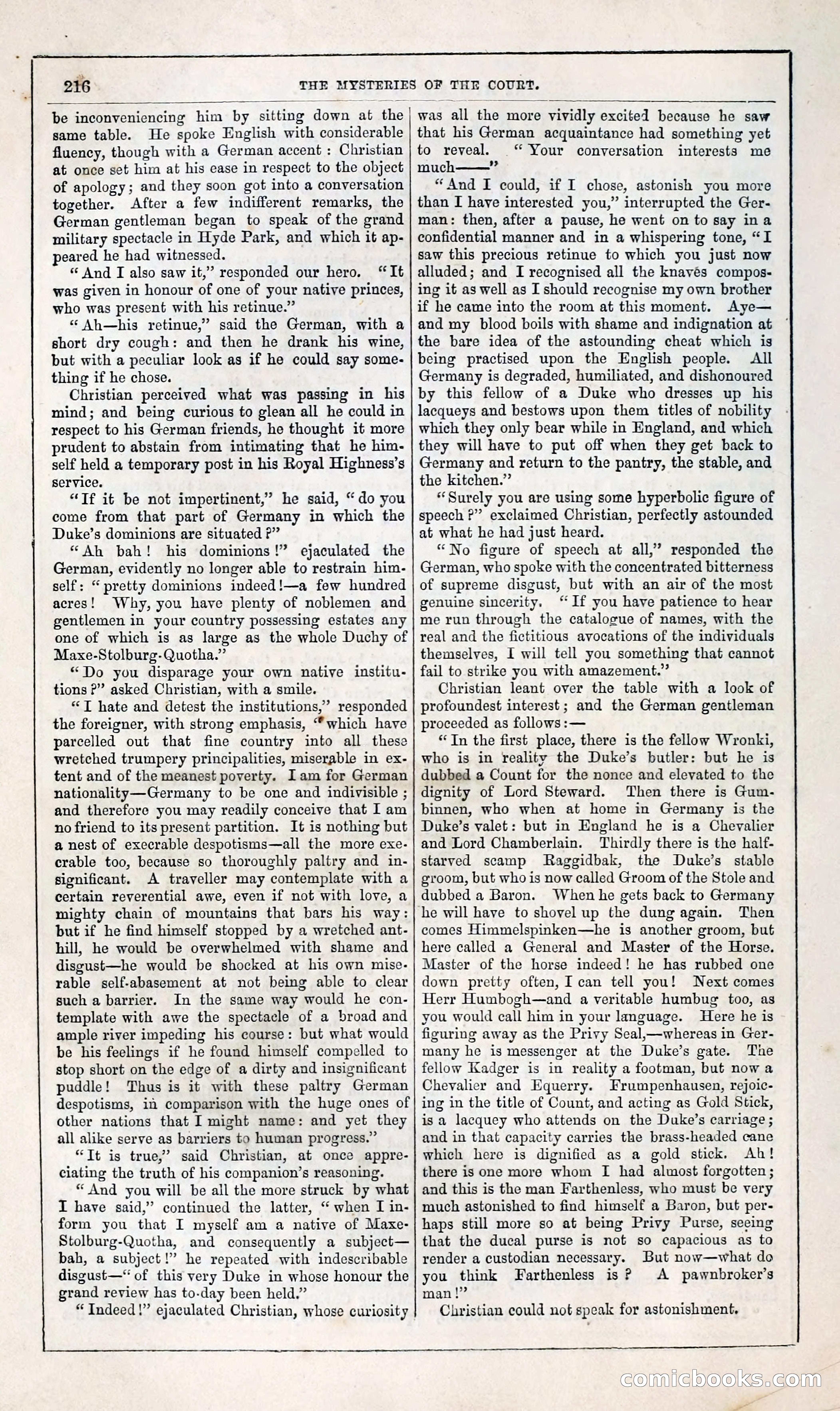
A restored page from Penny Dreadfuls, 1849. Page through the whole issue in the reader above.
📄 Transcribed text from this page (OCR, searchable)
Machine-transcribed from the original scan — historical spelling and the odd misread are preserved.
216 THE MYSTERIES OF THE COURT. be inconveniencing him by sitting down at the same table. He spoke English with considerable fluency, though with a German accent : Christian at once set him at his ease in respect to the object of apology; and they soon got into a conversation together. After a few indifferent remarks, the German gentleman began to speak of the grand military spectacle in Hyde Park, and which it ap- peared he had witnessed. * And I also saw it,” responded our hero. “It was given in honour of one of your native princes, who was present with his retinue.” “ Ah—his retinue,” said the German, with a short dry cough: and then he drank his wine, but with a peculiar look as if he could say some- thing if he chose. Christian perceived what was passing in his mind; and being curious to glean all he could in respect to his German friends, he thought it more prudent to abstain from intimating that he him- self held a temporary post in his Royal Highness’s service. “Tf it be not impertinent,” he said, “do you come from that part of Germany in which the Duke’s dominions are situated ?” “Ah bah! his dominions!” ejaculated the German, evidently no longer able to restrain him- self: “ pretty dominions indeed!—a few hundred acres! Why, you have plenty of noblemen and gentlemen in your country possessing estates any one of which is as large as the whole Duchy of Maxe-Stolburg-Quotha.” “Do you disparage your own native institu- tions P” asked Christian, with a smile. “T hate and detest the institutions,’ responded the foreigner, with strong emphasis, “which have parcelled out that fine country into all these wretched trumpery principalities, miserable in ex- tent and of the meanest poverty. Iam for German nationality—Germany to be one and indivisible ; and therefore you may readily conceive that I am no friend to its present partition. It is nothing but a nest of execrable despotisms—all the more exe- erable too, because so thoroughly paltry and in- significant. A traveller may contemplate with a certain reverential awe, even if not with love, a mighty chain of mountains that bars his way: but if he find himself stopped by a wretched ant- hill, he would be overwhelmed with shame and disgust—he would be shocked at his own mise- rable self-abasement at not being able to clear such a barrier. In the same way would he con- template with awe the spectacle of a broad and ample river impeding his course: but what would be his feelings if he found himself compelled to stop short on the edge of a dirty and insignificant puddle! Thus is it with these paltry German despotisms, in comparison with the huge ones of other nations that I might name: and yet they all alike serve as barriers to human progress.” “It is true,’ said Christian, at once appre- ciating the truth of his companion’s reasoning. “And you will be all the more struck by what I have said,’ continued the latter, “ when I in- form you that I myself am a native of Maxe- Stolburg-Quotha, and consequently a subject— bah, a subject!” he repeated with indescribable disgust— of this very Duke in whose honour the grand review has to-day been held.” “ Indeed!” ejaculated Christian, whose curiosity ————e was all the more vividly excited because he saw that his German acquaintance had something yet to reveal. “ Your conversation interests me much 2 “And I could, if I chose, astonish you more than I have interested you,” interrupted the Ger- man: then, after a pause, he went on to say ina confidential manner and in a whispering tone, “I saw this precious retinue to which you just now alluded; and I recognised all the knavés compos- ing it as well as I should recognise my own brother if he came into the room at this moment. Aye— and my blood boils with shame and indignation at the bare idea of the astounding cheat which is being practised upon the English people. All Germany is degraded, humiliated, and dishonoured by this fellow of a Duke who dresses up his lacqueys and bestows upon them titles of nobility which they only bear while in England, and which they will have to put off when they get back to Germany and return to the pantry, the stable, and the kitchen.” “Surely you are using some hyperbolic figure of speech P” exclaimed Christian, perfectly astounded at what he had just heard. “No figure of speech at all,” responded the German, who spoke with the concentrated bitterness of supreme disgust, but with an air of the most genuine sincerity. ‘If you have patience to hear me run through the catalogue of names, with the real and the fictitious avocations of the individuals themselves, I will tell you something that cannot fail to strike you with amazement.” Christian leant over the table with a look of profoundest interest; and the German gentleman proceeded as follows :— “Tn the first place, there is the fellow Wronki, who is in reality the Duke’s butler: but he is dubbed a Count for the nonce and elevated to the dignity of Lord Steward. Then there is Gum- binnen, who when at home in Germany is the Duke’s valet: but in England he is a Chevalier and Lord Chamberlain. Thirdly there is the half- starved scamp MRaggidbak, the Duke’s stable groom, but who is now called Groom of the Stole and dubbed a Baron. When he gets back to Germany he will have to shovel up the dung again. Then comes Himmelspinken—he is another groom, but here called a General and Master of the Horse. Master of the horse indeed! he has rubbed one down pretty often, I can tell you! Next comes Herr Humbogh—and a veritable humbug too, as you would call him in your language. Here he is firuring away as the Privy Seal,—whereas in Ger- many he is messenger at the Duke’s gate. The fellow Kadger is in reality a footman, but nowa Chevalier and Equerry. Frumpenhausen, rejoic- ing in the title of Count, and acting as Gold Stick, is a lacquey who attends on the Duke’s carriage ; and in that capacity carries the brass-headed cane which here is dignified as a gold stick. Ah! there is one more whom [I had almost forgotten; and this is the man Farthenless, who must be very much astonished to find himself a Baron, but per- haps still more so at being Privy Purse, seeing that the ducal purse is not so capacious as to render a custodian necessary. But now—what do you think Farthenless is? A pawnbroker’s man!” Christian could not speak for astonishment, —~~- CONNICELOOO S (C(O)