
Penny Dreadfuls, 1849 · page 21 of 394
The Mysteries of the Court of London — page 21: what you’re looking at
A restored page from Penny Dreadfuls, 1849. Page through the whole issue in the reader above.
📄 Transcribed text from this page (OCR, searchable)
Machine-transcribed from the original scan — historical spelling and the odd misread are preserved.
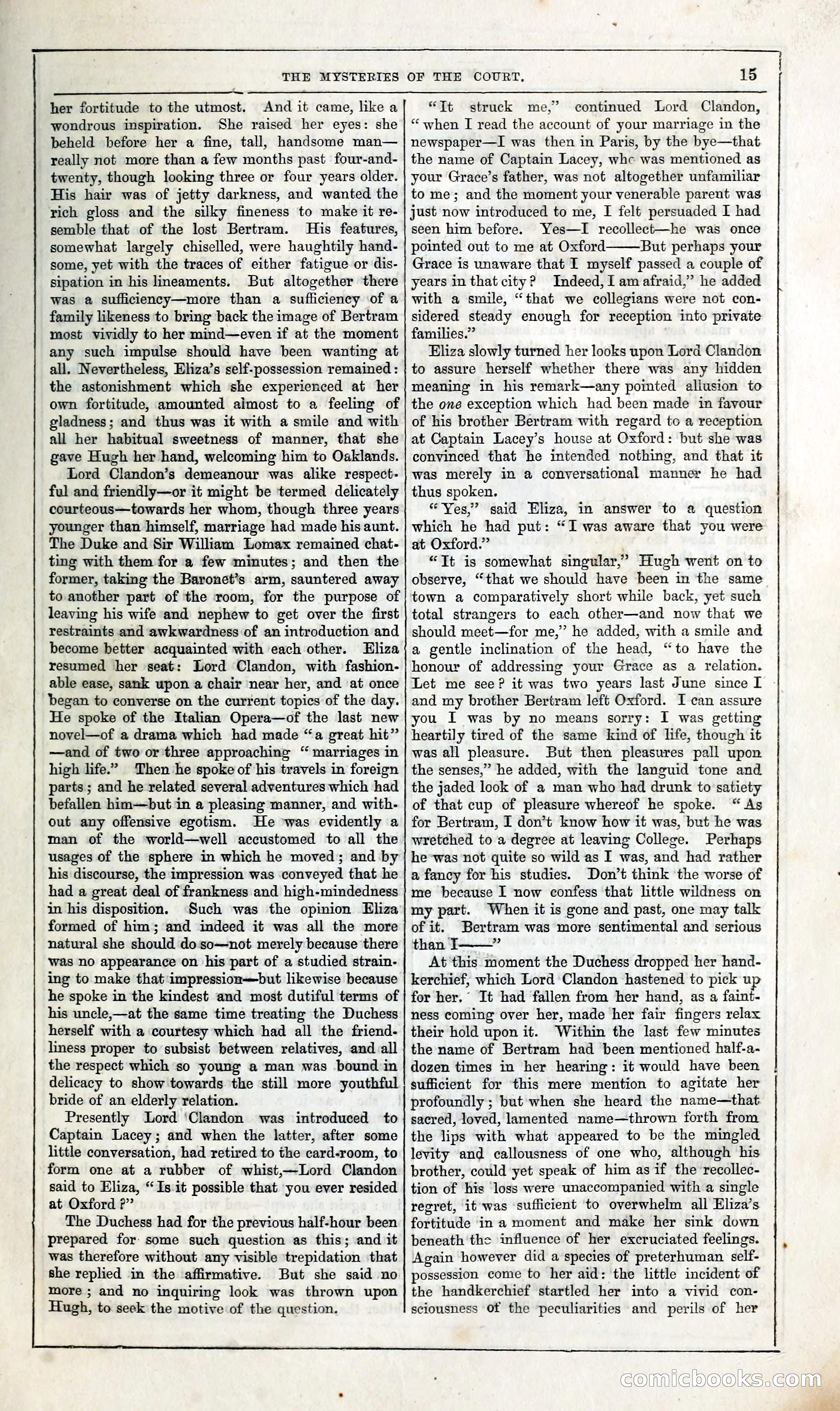
Ps her fortitude to the utmost. And it came, like a wondrous inspiration. She raised her eyes: she beheld before her a fine, tall, handsome man— really not more than a few months past four-and- twenty, though looking three or four years older. His hair was of jetty darkness, and wanted the rich gloss and the silky fineness to make it re- semble that of the lost Bertram. His features, somewhat largely chiselled, were haughtily hand- some, yet with the traces of either fatigue or dis- sipation in his lineaments. But altogether there was @ sufficiency—more than a sufficiency of a family likeness to bring back the image of Bertram most vividly to her mind—even if at the moment any such impulse should have been wanting at all. Nevertheless, Eliza’s self-possession remained : the astonishment which she experienced at her own fortitude, amounted aimost to a feeling of gladness; and thus was it with a smile and with all her habitual sweetness of manner, that she gave Hugh her hand, welcoming him to Oaklands. Lord Clandon’s demeanour was alike respect- ful and friendly—or it might be termed delicately courteous—towards her whom, though three years younger than himself, marriage had made his aunt. The Duke and Sir William Lomax remained chat- ting with them for a few minutes; and then the former, taking the Baronet’s arm, sauntered away to another part of the room, for the purpose of leaving his wife and nephew to get over the first restraints and awkwardness of an introduction and become better acquainted with each other. Eliza resumed her seat: Lord Clandon, with fashion- able ease, sank upon a chair near her, and at once began to converse on the current topics of the day. He spoke of the Italian Opera—of the last new novel—of a drama which had made “a great hit” —and of two or'three approaching “ marriages in high life.” Then he spoke of his travels in foreign parts ; and he related several adventures which had befallen him—but in a pleasing manner, and with- out any offensive egotism. He was evidently a man of the ‘world—well accustomed to all the usages of the sphere in which he moved; and by his discourse, the impression was conveyed that he had a great deal of frankness and high-mindedness in his disposition. Such was the opinion Eliza formed of him; and indeed it was all the more natural she should do‘so—not merely because there was no appearance on his part of a studied strain- ing to make that impression—but likewise because he spoke in the kindest and most dutiful terms of his uncle,—at the same time treating the Duchess herself with a courtesy which had all the friend- liness proper to subsist between relatives, and all the respect which so young a man was bound in delicacy to show towards. the still more youthful bride of an elderly relation. Presently Lord ‘Clandon was introduced to Captain Lacey; and when the latter, after some little conversation, had retired to the card-room, to form one at a rubber of whist,—Lord Clandon said to Eliza, “Is it possible that you ever resided at Oxford ?” The Duchess had for the previous half-hour been prepared for. some such question as this; and it was therefore without any visible trepidation that she replied in the affirmative. But she said no more ; and no inquiring look was thrown upon Hugh, to seek the motive of the question. . 15 “Tt struck me,’ continued Lord Clandon, “when I read the account of your marriage in the newspaper—I was then in Paris, by the bye—that the name of Captain Lacey, whc was mentioned as your Grace’s father, was not altogether unfamiliar to me; and the moment your venerable parent was just now introduced to me, I felt persuaded I had seen him before. Yes—I recollect—he was once pointed out to me at Oxford But perhaps your Grace is unaware that I myself passed a couple of years in that city? Indeed, I am afraid,” he added with a smile, “that we collegians were not con- sidered steady enough for reception into private families.” Eliza slowly turned her looks upon Lord Clandon to assure herself whether there was any hidden meaning in his remark—any poimted allusion to the one exception which had been made in favour of his brother Bertram with regard to a reception at Captain Lacey’s house at Oxford: but she was convinced that he intended nothing, and that it was merely in @ conversational manner he had thus spoken. “Yes,” said Eliza, in answer to a question which he had put: “I was aware that you were at Oxford.” “Tt is somewhat singular,” Hugh went on to observe, “that we should have been in the same town a comparatively short while back, yet such total strangers to each other—and now that we should meet—for me,” he added, with a smile and a gentle inclination of the head, “to have the honour of addressing your Grace as a relation. Let me see? it was two years last June since I and my brother Bertram left Oxford. I can assure you I was by no means sorry: I was getting heartily tired of the same kind of life, though it was all pleasure. But then pleasures pall upon the senses,” he added, with the languid tone and the jaded look of a man who had drunk to satiety of that cup of pleasure whereof he spoke. “As for Bertram, I don’t know how it was, but he was wretched to a degree at leaving Collere. Perhaps he*was not quite so wild as I was, and had rather a fancy for his studies. Don’t think the worse of me because I now confess that little wildness on my part. When it is gone and past, one may talk of it. Bertram was more sentimental and serious than I “ At this moment the Duchess dropped her hand- kerchief, which Lord Clandon hastened to pick up for her.’ It had fallen from her hand, as a faint- ness coming over her, made her fair fingers relax their hold upon it. "Within the last few minutes the name of Bertram had been mentioned half-a- dozen times in her hearing: it would have been sufficient for this mere mention to agitate her profoundly ; but when she heard the name—that sacred, loved, lamented name—thrown forth from the lips with what appeared to be the mingled levity and callousness of one who, although his brother, could yet speak of him as if the recollec- tion of his loss were unaccompanied with a single regret, it was sufficient to overwhelm all Eliza’s fortitude in a moment and make her sink down beneath the influence of her excruciated feelings. Again however did a species of preterhuman self- possession come to her aid: the little incident of the handkerchief startled her into a vivid con- sciousness Of the peculiarities and perils of her ee eS er et i eT. a. me. Gl klar) a, aa. ee ee ee Pn el THE MYSTERIES OF THE COURT. (C(O) 6)(0)(0) KS (C(O)