
Penny Dreadfuls, 1849 · page 201 of 394
The Mysteries of the Court of London — page 201: what you’re looking at
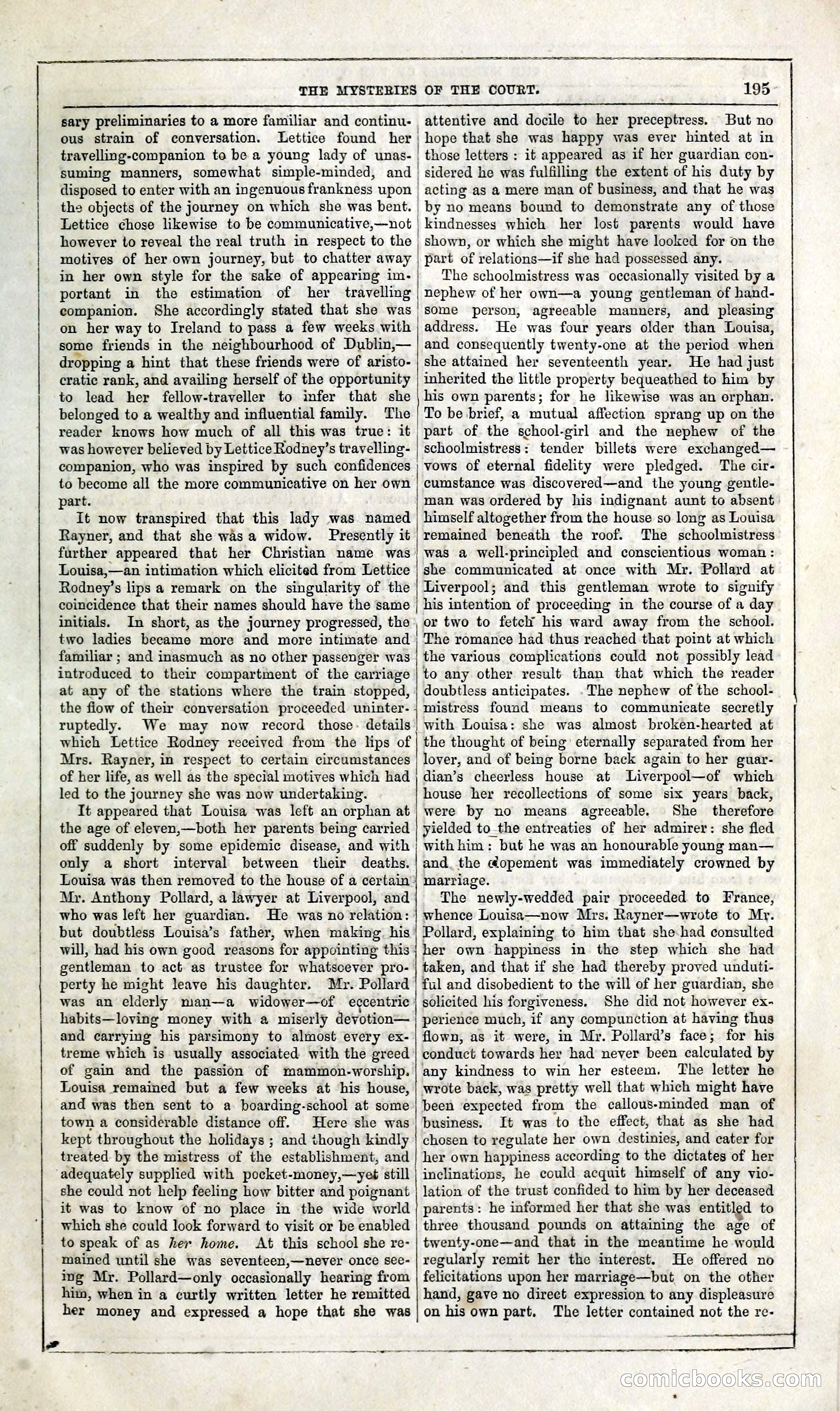
A restored page from Penny Dreadfuls, 1849. Page through the whole issue in the reader above.
📄 Transcribed text from this page (OCR, searchable)
Machine-transcribed from the original scan — historical spelling and the odd misread are preserved.
THE MYSTERIES OF THE COURT. sary preliminaries to a more familiar and continu- attentive and docile to her preceptress. Lettice found her | hope that she was happy was ever hinted at in ous strain of conversation. 195 But no travelling-companion to be a young lady of unas- | those letters: it appeared as if her guardian con- suming manners, somewhat simple-minded, and | sidered he was fulfilling the extent of his duty by disposed to enter with an ingenuous frankness upon the objects of the journey on which she was bent. | | acting as a mere man of business, and that he was by no means bound to demonstrate any of those Lettice chose likewise to be communicative,—not | kindnesses which her lost parents would have however to reveal the real truth in respect to the motives of her own journey, but to chatter away in her own style for the sake of appearing im- portant in the estimation of her travelling companion. She accordingly stated that she was on her way to Ireland to pass a few weeks with some friends in the neighbourhood of Dublin,— dropping a hint that these friends were of aristo- cratic rank, and availing herself of the opportunity to lead her fellow-traveller to infer that she belonged to a wealthy and influential family. The reader knows how much of all this was true: if was however believed by Lettice Rodney’s travelling- companion, who was inspired by such confidences to become all the more communicative on her own part. It now transpired that this lady was named Rayner, and that she wasa widow. Presently it further appeared that her Christian name was Louisa,—an intimation which elicited from Lettice Rodney’s lips a remark on the singularity of the coincidence that their names should have the same initials. In short, as the journey progressed, the two ladies became more and more intimate and familiar ; and inasmuch as no other passenger was introduced to their compartment of the carriage at any of the stations where the train stopped, the fiow of their conversation proceeded uninter- ruptedly. We may now record those- details which Lettice Rodney received from the lips of Mrs. Rayner, in respect to certain circumstances of her life, as well as the special motives which had led to the journey she was now undertaking. It appeared that Louisa was left an orphan at the age of eleven,—both her parents being carried off suddenly by some epidemic disease, and with only a short interval between their deaths. a Louisa was then removed to the house of a certain” My. Anthony Pollard, a lawyer at Liverpool, and who was left her guardian. He was no relation: but doubtless Louisa’s father, when making. his will, had his own good reasons for appointing this: gentleman to act as trustee for whatscever pro- perty he might leave his daughter. Mr. Pollard was an elderly man—a widower—of eccentric: habits—loving money with a miserly devotion— and carrying his parsimony to almost every ex- treme which is usually associated with the greed of gain and the passion of mammon-worship. Louisa remained but a few weeks at his house, and was then sent to a boarding-school at some town a considerable distance off. Here she was kept throughout the holidays ; and though kindly treated by the mistress of the establishment, and ‘adequately supplied with pocket-money,—yeé still she could not help feeling how bitter and poignant it was to know of no place in the wide world which she could look forward to visit or be enabled to speak of as her home. At this school she re- mained until she was seventeen,—never once see- ing Mr. Pollard—only occasionally hearing from him, when in a curtly written letter he remitted her money and expressed a hope that she was f= or i er ee eee — -~—--— — —— Jor oer A A A A EE A shown, or which she might have looked for on the part of relations—if she had possessed any. The schoolmistress was occasionally visited by a nephew of her own—a young gentleman of hand- some person, agreeable manners, and pleasing address. He was four years older than Louisa, and consequently twenty-one at the period when she attained her seventeenth year. He had just inherited the little property bequeathed to him by his own parents; for he likewise was an orphan. To be brief, a mutual affection sprang up on the part of the school-girl and the nephew of the schoolmistress: tender billets were exchanged— vows of eternal fidelity were pledged. The cir- cumstance was discovered—and the young gentle- man was ordered by his indignant aunt to absent himself altogether from the house so long as Louisa remained beneath the roof. The schoolmistress was a well-principled and conscientious woman : she communicated at once with Mr. Pollard at Liverpool; and this gentleman wrote to signify his intention of proceeding in the course of a day or two to feteclt his ward away from the school. The romance had thus reached that point at which the various complications could not possibly lead to any other result than that which the reader doubtless anticipates. . The nephew of the school- mistress found means to communicate secretly with Louisa: she was almost broken-hearted at the thought of being eternally separated from her lover, and of being borne back again to her guar- dian’s cheerless house at lLiverpool—of which house her recollections of some six years back, were by no means agreeable. She _ therefore yielded to_the entreaties of her admirer: she fled with him: but he was an honourable young man— and. the «opement was immediately crowned by marriage. The newly-wedded pair proceeded to France, whence Louisa—now Mrs. Rayner—wrote to Mr. Pollard, explaining to him that she had consulted her own happiness in the step which she had taken, and that if she had thereby proved unduti- ful and disobedient to the will of her guardian, she solicited his forgiveness. She did not however ex- perience much, if any compunction at having thus flown, as it were, in Mr. Pollard’s face; for his conduct towards her had never been calculated by any kindness to win her esteem. The letter he wrote back, was pretty well that which might have been expected from the callous-minded man of business. It was to the effect, that as she had chosen to regulate her own destinies, and cater for her own happiness according to the dictates of her inclinations, he could acquit himself of any vio- lation of the trust confided to him by her deceased parents: he informed her that she was entitled to three thousand pounds on attaining the age of twenty-one—and that in the meantime he would regularly remit her the interest. He offered no felicitations upon her marriage—but on the other hand, gave no direct expression to any displeasure on his own part. The letter contained not the re- (C(O) nn) (C 6)(0)(0) S CO)