
Penny Dreadfuls, 1849 · page 193 of 394
The Mysteries of the Court of London — page 193: what you’re looking at
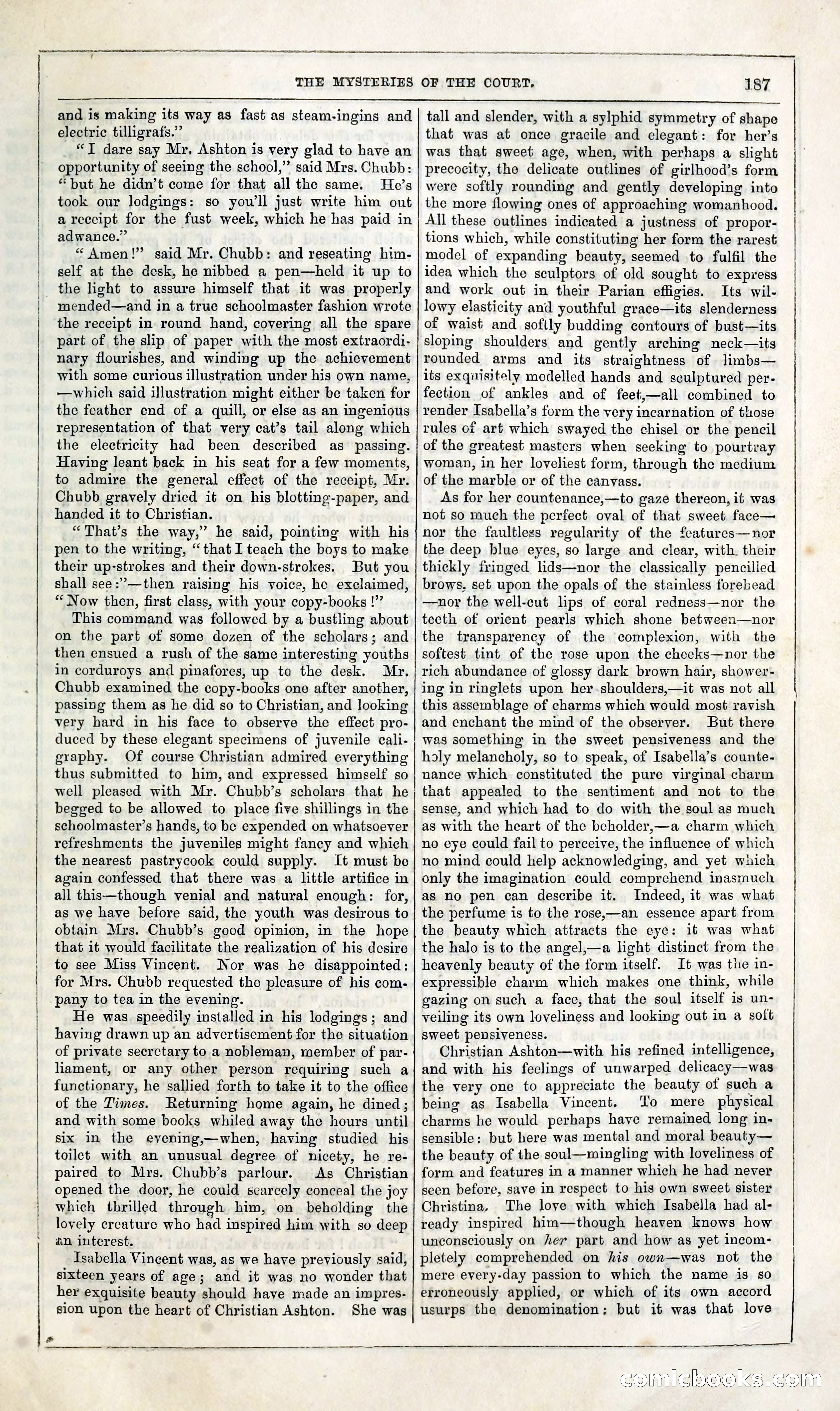
A restored page from Penny Dreadfuls, 1849. Page through the whole issue in the reader above.
📄 Transcribed text from this page (OCR, searchable)
Machine-transcribed from the original scan — historical spelling and the odd misread are preserved.
& a a ee A THE MYSTERIES OF THE COURT. re et 187 gee oe LL ae nents and is making its way as fast as steam-ingins and electric tilligrafs.”’ “I dare say Mr, Ashton is very glad to have an opportunity of seeing the school,” said Mrs. Chubb: “but he didn’t come for that all the same. He’s took our lodgings: so you'll just write him out a receipt for the fust week, which he has paid in adwance.” “ Amen!” said Mr. Chubb: and reseating him- self at the desk, he nibbed a pen—held it up to the light to assure himself that it was properly mended—and in a true schoolmaster fashion wrote the receipt in round hand, covering all the spare part of the slip of paper with the most extraordi- nary flourishes, and winding up the achievement with some curious illustration under his own name, —which said illustration might either be taken for the feather end of a quill, or else as an ingenious representation of that very cat’s tail along which the electricity had been described as passing. Having leant back in his seat for a few moments, to admire the general effect of the receipt, Mr. Chubb gravely dried it on his blotting-paper, and handed it to Christian. “That’s the way,” he said, pointing with his pen to the writing, “that I teach the boys to make their up-strokes and their down-strokes. But you shall see:’—then raising his voice, he exclaimed, “* Now then, first class, with your copy-books !” This and was follawed by a bustling about on the part of some dozen of the scholars; and then ensued a rush of the same interesting youths in corduroys and pinafores, up to the desk. Mr. Chubb examined the copy-books one after another, passing them as he did so to Christian, and looking very hard in his face to observe the effect pro- duced by these elegant specimens of juvenile cali- graphy. Of course Christian admired everything thus submitted to him, and expressed himself so well pleased with Mr. Chubb’s scholars that he | begged to be allowed to place five shillings in the schoolmaster’s hands, to be expended on whatsoever refreshments the juveniles might fancy and which the nearest pastrycook could supply. It must be again confessed that there was a little artifice in all this—though venial and natural enough: for, as we have before said, the youth was desirous to obtain Mrs. Chubb’s eood opinion, in the hope that it would facilitate ‘the realization of his desire to see Miss Vincent. Nor was he disappointed: for Mrs. Chubb requested the pleasure of his com- pany to tea in the evening. He was speedily installed in his lodgings; and having drawn up an advertisement for the situation of private secretary to a nobleman, member of par- liament, or any other person requiring such a functionary, he sallied forth to take it to the office of the Times. Returning home again, he dined; and with some books whiled away the hours until six in the eyvening,—when, having studied his toilet with an unusual degree of nicety, he re- paired to Mrs. Chubb’s parlour. As Christian opened the door, he could scarcely conceal the joy which thrilled through him, on beholding the lovely creature who had inspired him with so deep in interest. Isabella Vincent was, as we have previously said, sixteen years of age; and it was no wonder that her exquisite beauty should have made an impres- sion upon the heart of Christian Ashton. She was ———————————— LL tall and slender, with a sylphid symmetry of shape that was at once gracile and elegant: for her’s was that sweet age, when, with perhaps a slight precocity, the delicate outlines of girlhood’s form were softly rounding and gently developing into the more flowing ones of approaching womanhood. All these outlines indicated a justness of propor- tions which, while constituting her form the rarest model of expanding beauty, seemed to fulfil the idea which the sculptors of old sought to express and work out in their Parian effigies. Its wil- lowy elasticity and youthful grace—its slenderness of waist and softly budding contours of bust—its sloping shoulders and gently arching neck—its rounded arms and its straightness of limbs— its exqitisitely modelled hands and sculptured per- fection of ankles and of feet,—all combined to render Isabella’s form the very incarnation of those rules of art which swayed the chisel or the pencil of the greatest masters when seeking to pourtray woman, in her loveliest form, through the medium of the marble or of the canvass. As for her countenance,—to gaze thereon, it was not so much the perfect oval of that sweet face— nor the faultless regularity of the features—nor the deep blue eyes, so large and clear, with. their thickly fringed lids—nor the classically pencilled brows. set upon the opals of the stainless forehead —nor the well-cut lips of coral redness—nor the teeth of orient pearls which shone between—nor the transparency of the complexion, with the softest tint of the rose upon the cheeks—nor the rich abundance of glossy dark brown hair, shower- ing in ringlets upon her shoulders,—it was not all this assemblage of charms which would most ravish and enchant the mind of the observer. But there was something in the sweet pensiveness and the holy melancholy, so to speak, of Isabella’s counte- nance which constituted the pure virginal charm that appealed to the sentiment and not to the sense, and which had to do with the soul as much as with the heart of the beholder,—a charm which no eye could fail to perceive, the influence of which no mind could help acknowledging, and yet which only the imagination could comprehend inasmuch as no pen can describe it. Indeed, it was what the perfume is to the rose,—an essence apart from the beauty which attracts the eye: 1t was what the halo is to the angel,—a light distinct from the heavenly besuty of the form itself. It was the in- expressible charm which makes one think, while gazing on such a face, that the soul itself is un- veiling its own loveliness and looking out in a sott sweet pevsiveness. Christian Ashton—with his refined intelligence, and with his feelings of unwarped delicacy—was the very one to appreciate the beauty of such a being as Isabella Vincent. To mere physical charms he would perhaps have remained long in- sensible: but here was mental and moral beauty— the beauty of the soul—mingling with loveliness of form and features in a manner which he had never seen before, save in respect to his own sweet sister Christina. The love with which Isabella had al- ready inspired him—though heayen knows how unconsciously on hey part and how as yet incom: pletely comprehended on his own—was not the mere every-day passion to which the name is so erroneously applied, or which of its own accord usurps the denomination: but it was that love (C(O) KS 6)(0)(0) (C(O)