
Penny Dreadfuls, 1849 · page 19 of 394
The Mysteries of the Court of London — page 19: what you’re looking at
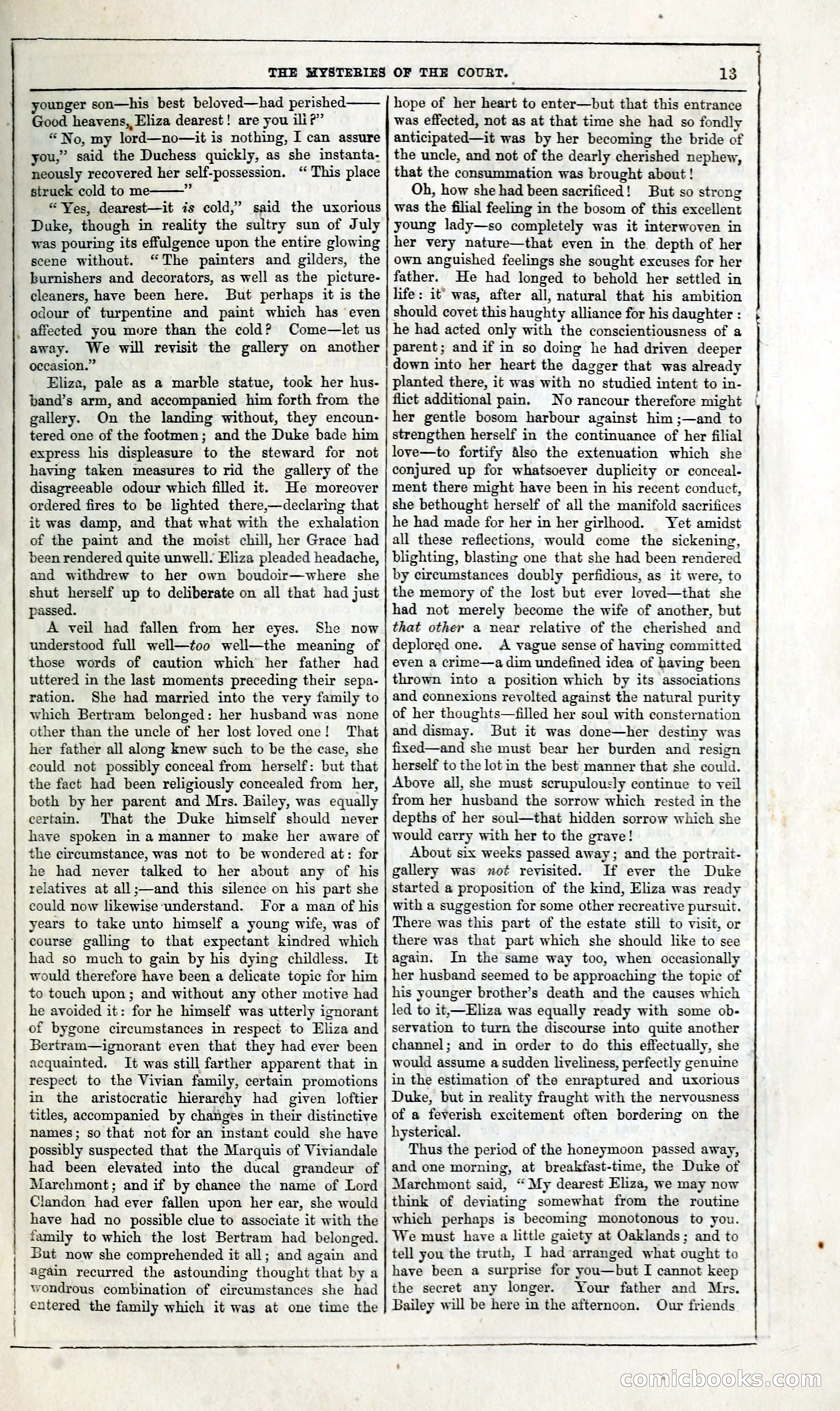
A restored page from Penny Dreadfuls, 1849. Page through the whole issue in the reader above.
📄 Transcribed text from this page (OCR, searchable)
Machine-transcribed from the original scan — historical spelling and the odd misread are preserved.
er hg f THE MYSTERIES OF THE COURT. younger son—his best beloved—had perished Good heavens, Eliza dearest! are you ili?” “No, my lord—no—it is nothing, I can assure you,” said the Duchess quickly, as she instanta- neously recovered her self-possession. ‘ This place struck cold to me——”’ “Yes, dearest—it is cold,’ said the uxorious Duke, though in reality the sultry sun of July was pouring its effulgence upon the entire glowing scene without. “The painters and gilders, the burnishers and decorators, as well as the picture- cleaners, have been here. But perhaps it is the odour of turpentine and paint which has even affected you more than the cold? Come—let us away. We will revisit the gallery on another occasion.” Blizz, pale as a marble statue, took her hus- band’s arm, and accompanied him forth from the gallery. On the landing without, they encoun- tered one of the footmen; and the Duke bade him express his displeasure to the steward for not having taken measures to rid the gallery of the disagreeable odour which filled it. He moreover ordered fires to be lighted there,—declaring that it was damp, and that what with the exhalation of the paint and the moist chill, her Grace had been rendered quite unwell. Eliza pleaded headache, and withdrew to her own boudoir—where she shut herself up to deliberate on all that had just passed. A veil had fallen from her eyes. She now understood full well—too well—the meaning of those words of caution which her father had uttered in the last moments preceding their sepa- ration. She had married into the very family to which Bertram belonged: her husband was none other than the uncle of her lost loved one! That her father all along knew such to be the case, she could not possibly conceal from herself: but that the fact had been religiously concealed from her, both by her parent and Mrs. Bailey, was equally certain. That the Duke himself should never haye spoken ina manner to make her aware of the circumstance, was not to be wondered at: for he had never talked to her about any of his relatives at all;—and this silence on his part she could now likewise ‘understand. For a man of his years to take unto himself a young wife, was of course galling to that expectant kindred which had so much to gain by his dying childless. It would therefore have been a delicate topic for him to touch upon; and without any other motive had he avoided it: for he himself was utterly ignorant of bygone circumstances in respect to Eliza and Bertram—ignorant even that they had ever been acquainted. It was still farther apparent that in respect to the Vivian family, certain promotions in the aristocratic hierarchy had given loftier titles, accompanied by changes in their distinctive names; so that not for an imstant could she have possibly suspected that the Marquis of Viviandale had been elevated into the ducal grandeur of Marchmont; and if by chance the name of Lord Clandon had ever fallen upon her ear, she would have had no possible clue to associate it with the family to which the lost Bertram had belonged. But now she comprehended it all; and again and again recurred the astounding thought that by a wondrous combination of circumstances she had entered the family which it was at one time the 13 hope of her heart to enter—but that this entrance was effected, not as at that time she had so fondly anticipated—it was by her becoming the bride of the uncle, and not of the dearly cherished nephew, that the consummation was brought about! Oh, how she had been sacrificed! But so strong was the filial feeling in the bosom of this excellent young lady—so completely was it interwoven in her very nature—that even in the depth of her own anguished feelings she sought excuses for her father. He had longed to behold her settled in life: it’ was, after all, natural that his ambition should covet this haughty alliance for his daughter : he had acted only with the conscientiousness of a parent; and if in so doing he had driven deeper down into her heart the dagger that was already planted there, it was with no studied intent to in- flict additional pain. No rancour therefore might her gentle bosom harbour against him ;—and to strengthen herself in the continuance of her filial love—to fortify Also the extenuation which she conjured up for whatsoever duplicity or conceal- ment there might have been in his recent conduct, she bethought herself of all the manifold sacrifices he had made for her in her girlhood. Yet amidst all these reflections, would come the sickening, blighting, blasting one that she had been rendered by circumstances doubly perfidious, as it were, to the memory of the lost but ever loved—that she had not merely become the wife of another, but that other a near relative of the cherished and deplored one. A vague sense of having committed even a crime—a dim undefined idea of having been thrown into a position which by its associations and connexions revolted against the natural purity of her thoughts—filled her soul with consternation and dismay. But it was done—her destiny was fixed—and she must bear her burden and resign herself to the lot in the best manner that she could. Above all, she must scrupulously continue to veil from her husband the sorrow which rested in the depths of her soul—that hidden sorrow which she would carry with her to the grave! About six weeks passed away; and the portrait- gallery was mot revisited. If ever the Duke started a proposition of the kind, Eliza was ready with a suggestion for some other recreative pursuit. There was this part of the estate still to visit, or there was that part which she should like to see again. In the same way too, when occasionally her husband seemed to be approaching the topic of his younger brother’s death and the causes which led to it,—Eliza was equally ready with some ob- servation to turn the discourse into quite another channel; and in order to do this effectually, she would assume a sudden liveliness, perfectly genuine in the estimation of the enraptured and uxorious Duke, but in reality fraught with the nervousness of a feverish excitement often bordermg on the hysterical. Thus the period of the honeymoon passed away, and one morning, at breakfast-time, the Duke of Marchmont said, “ My dearest Eliza, we may now think of deviating somewhat from the routine which perhaps is becoming monotonous to you. We must have a little gaiety at Oaklands; and to tell you the truth, I had arranged what ought to have been a surprise for you—but I cannot keep the secret any longer. Your father and Mrs, Bailey will be here in the afternoon. Our friends LLL EE LLL OE A LC CE CC Tt, rr CC ee _——es— DOO > a (CO) S CO