
Penny Dreadfuls, 1849 · page 189 of 394
The Mysteries of the Court of London — page 189: what you’re looking at
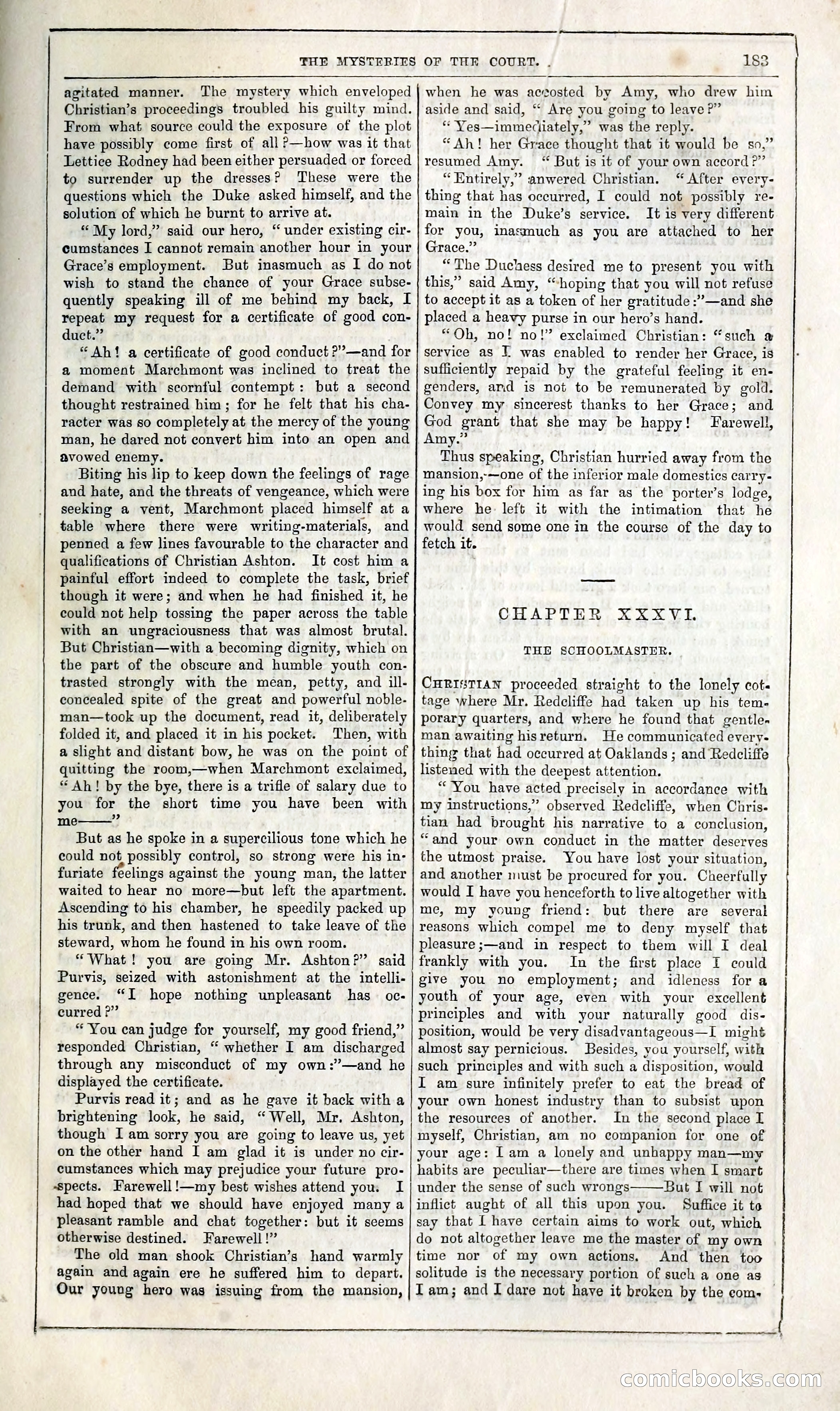
A restored page from Penny Dreadfuls, 1849. Page through the whole issue in the reader above.
📄 Transcribed text from this page (OCR, searchable)
Machine-transcribed from the original scan — historical spelling and the odd misread are preserved.
THE MYSTERIES OF THE COURT... 183 agitated manner. The mystery which enveloped Christian’s proceedings troubled his guilty mind. From what source could the exposure of the plot have possibly come first of all ?—how was it that Lettice Rodney had been either persuaded or forced to surrender up the dresses? These were the questions which the Duke asked himself, and the solution of which he burnt to arrive at. “ My lord,” said our hero, “ under existing cir- cumstances I cannot remain another hour in your Grace’s employment. But inasmuch as I do not wish to stand the chance of your Grace subse- quently speaking ill of me behind my back, I repeat my request for a certificate of good con- duct.” “Ah! a certificate of good conduct ?”’—and for a moment Marchmont was inclined to treat the demand with scornful contempt: but a second thought restrained him; for he felt that his cha- racter was so completely at the mercy of the young man, he dared not convert him into an open and avowed enemy. Biting his lip to keep down the feelings of rage and hate, and the threats of vengeance, which were seeking a vent, Marchmont placed himself at a table where there were writing-materials, and penned a few lines favourable to the character and qualifications of Christian Ashton. It cost him a painful effort indeed to complete the task, brief though it were; and when he had finished it, he could not help tossing the paper across the table with an ungraciousness that was almost brutal. But Christian—with a becoming dignity, which on the part of the obscure and humble youth con- trasted strongly with the mean, petty, and ill- concealed spite of the great and powerful noble- man—took up the document, read it, deliberately folded it, and placed it in his pocket. Then, with a slight and distant bow, he was on the point of quitting the room,—when Marchmont exclaimed, “Ah! by the bye, there is a trifle of salary due to you for the short time you have been with me 3) But as he spoke in a supercilious tone which he could not possibly control, so strong were his in- furiate feelings against the young man, the latter waited to hear no more—but left the apartment. Ascending to his chamber, he speedily packed up his trunk, and then hastened to take leave of the steward, whom he found in his own room. “What! you are going Mr. Ashton?” said Purvis, seized with astonishment at the intelli- gence. “J hope nothing unpleasant has oc- curred ?” “You can judge for yourself, my good friend,” responded Christian, “ whether I am discharged through any misconduct of my own:”’—and he displayed the certificate. Purvis read it; and as he gave it back with a brightening look, he said, “Well, Mr. Ashton, though I am sorry you are going to leave us, yet on the other hand I am glad it is under no cir- cumstances which may prejudice your future pro- -Spects. Farewell!—my best wishes attend you. I had hoped that we should have enjoyed many a pleasant ramble and chat together: but it seems otherwise destined. Farewell!” The old man shook Christian’s hand warmly again and again ere he suffered him to depart. Our young hero was issuing from the mansion, when he was aceosted by Amy, who drew him aside and said, “ Are you going to leave?” * Yes—immeciiately,” was the reply. “Ah! her Grace thought that it would be so,” resumed Amy. “ But is it of your own accord?” “Entirely,” anwered Christian. “After every- thing that has occurred, I could not possibly re- main in the Duke’s service. It is very different for you, inasmuch as you are attached to her Grace.” “The Duchess desired me to present you with this,” said Amy, “hoping that you will not refuse to accept it as a token of her gratitude :’—and she placed a heavy purse in our hero’s hand. “Oh, no! no!” exclaimed Christian: “such @ service as I was enabled to render her Grace, is sufficiently repaid by the grateful feeling it en- genders, amd is not to be remunerated by gold. Convey my sincerest thanks to her Grace; and God grant that she may be happy! Farewell, Amy.” Thus speaking, Christian hurried away from the mansion,-—one of the inferior male domestics carry- ing his box for him as far as the porter’s lodge, where he left it with the intimation that he would send some one in the course of the day to fetch it. CHAPTER XXXVI. THE SCHOOLMASTER, CHRISTIAN proceeded straight to the lonely cot. tage where Mr. Redcliffe had taken up his tem- porary quarters, and where he found that gentle. man awaiting hisreturn. He communicated every- thing that had occurred at Oaklands ; and Redcliffe listened with the deepest attention. “You have acted precisely in accordance with my instructions,’ observed Redcliffe, when Chris- tian had brought his narrative to a conclusion, “and your own conduct in the matter deserves the utmost praise. You have lost your situation, and another must be procured for you. Cheerfully would I have you henceforth to live altogether with me, my young friend: but there are several reasons which compel me to deny myself that pleasure ;—and in respect to them will I deal frankly with you. In the first place I could give you no employment; and idleness for a youth of your age, even with your excellent principles and with your naturally good dis- position, would be very disadvantageous—I might almost say pernicious. Besides, you yourself, with such principles and with such a disposition, would I am sure infinitely prefer to eat the bread of your own honest industry than to subsist upon the resources of another. In the second place I myself, Christian, am no companion for one of your age: Lam a lonely and unhappy man—my habits are peculiar—there are times when I smart under the sense of such wrongs But I will not inflict aught of all this upon you. Suffice it to say that I have certain aims to work out, which do not altogether leave me the master of my own time nor of my own actions. And then too solitude is the necessary portion of such a one as Tam; and I dare not haye it broken by the com. — (C(O) nn) (C 0)(0)(0) CS (c©)