
Penny Dreadfuls, 1849 · page 185 of 394
The Mysteries of the Court of London — page 185: what you’re looking at
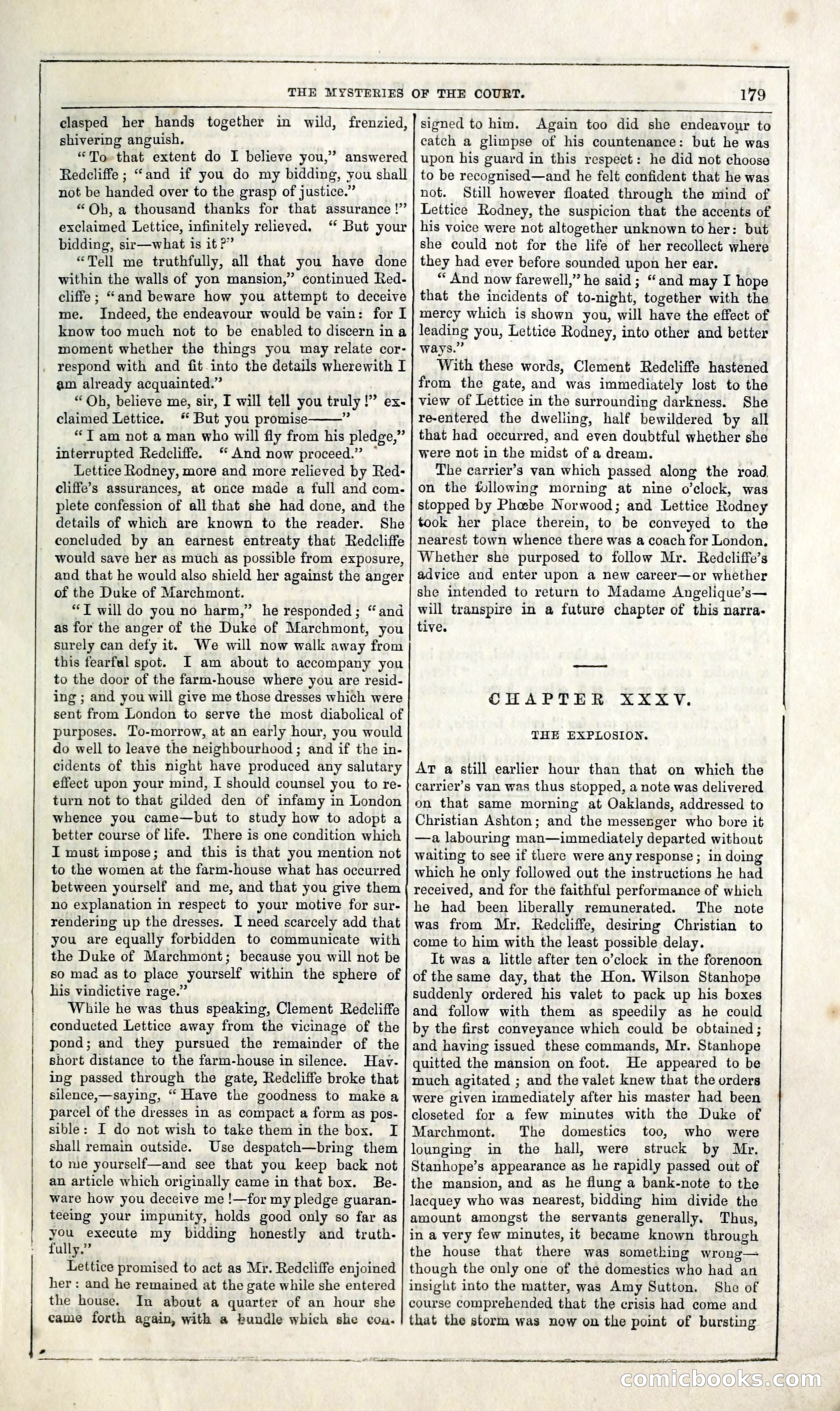
A restored page from Penny Dreadfuls, 1849. Page through the whole issue in the reader above.
📄 Transcribed text from this page (OCR, searchable)
Machine-transcribed from the original scan — historical spelling and the odd misread are preserved.
” THE MYSTERIES OF THE COURT. clasped her hands together in wild, frenzied, shivering anguish. “To that extent do I believe you,” answered Redcliffe ; “and if you do my bidding, you shall not be handed over to the grasp of justice.” “ Oh, a thousand thanks for that assurance!” exclaimed Lettice, infinitely relieved. “ But your bidding, sir—what 1s it ?” “Tell me truthfully, all that you have done within the walls of yon mansion,” continued Red- cliffe ; “and beware how you attempt to deceive me. Indeed, the endeavour would be vain: for I know too much not to be enabled to discern in a moment whether the things you may relate cor- . respond with and fit.into the details wherewith I am already acquainted.” “ Oh, believe me, sir, I will tell you truly!” ex. claimed Lettice. * But you promise i “‘T am not a man who will fly from his pledge,” interrupted Redcliffe. ‘‘ And now proceed.” — Lettice Rodney, more and more relieved by Red- cliffe’s assurances, at once made a full and com. plete confession of all that she had done, and the details of which are known to the reader. She concluded by an earnest entreaty that Redcliffe would save her as much as possible from exposure, and that he would also shield her against the anger of the Duke of Marchmont. “T will do you no harm,” he responded; “and as for the anger of the Duke of Marchmont, you surely can defy it. We will now walk away from this fearful spot. I am about to accompany you to the door of the farm-house where you are resid- ing ; and you will give me those dresses which were sent from London to serve the most diabolical of purposes. To-morrow, at an early hour, you would do well to leave the neighbourhood; and if the in- cidents of this night have produced any salutary effect upon your mind, I should counsel you to re- turn not to that gilded den of infamy in London whence you came—but to study how to adopt a better course of life. There is one condition which I must impose; and this is that you mention not to the women at the farm-house what has occurred between yourself and me, and that you give them no explanation in respect to your motive for sur- rendering up the dresses. I need scarcely add that you are equally forbidden to communicate with the Duke of Marchmont; because you will not be so mac as to place yourself within the sphere of his vindictive rage.” While he was thus speaking, Clement Redcliffe conducted Lettice away from the vicinage of the pond; and they pursued the remainder of the short distance to the farm-house in silence. Hayv- ing passed through the gate, Redcliffe broke that silence,—saying, “ Have the goodness to make a parcel of the dresses in as compact a form as pos- sible: I do not wish to take them in the box. I shall remain outside. Use despatch—bring them to me yourself—and see that you keep back not an article which originally came in that box. Be- ware how you deceive me !—for my pledge guaran- teeing your impunity, holds good only so far as you execute my bidding honestly and truth- fully.” Lettice promised to act as Mr. Redcliffe enjoined her: and he remained at the gate while she entered the house. In about a quarter of an hour she came forth again, with a bundle which she con. re tr EE ee 179 signed to him. Again too did she endeavour to catch a glimpse of his countenance: but he was upon his guard in this respect: he did not choose to be recognised—and he felt confident that he was not. Still however floated through the mind of Lettice Rodney, the suspicion that the accents of his voice were not altogether unknown to her: but she could not for the life of her recollect where they had ever before sounded upon her ear. ““ And now farewell,” he said; “and may I hope that the incidents of to-night, together with the mercy which is shown you, will have the effect of leading you, Lettice Rodney, into other and better ways.” With these words, Clement Redcliffe hastened from the gate, and was immediately lost to the view of Lettice in the surrounding darkness. She re-entered the dwelling, half bewildered by all that had oecurred, and even doubtful whether she were not in the midst of a dream. The carrier’s van which passed along the road, on the following morning at nine o'clock, was stopped by Phoebe Norwood; and Lettice Rodney took her place therein, to be conveyed to the nearest town whence there was a coach for London. Whether she purposed to follow Mr. Redcliffe’s advice and enter upon a new career—or whether she intended to return to Madame Angelique’s— will transpire in a future chapter of this narra- tive. Se CHAPTER XXXV. THE EXPLOSION. At a still earlier hour than that on which the carrier’s yan was thus stopped, a note was delivered on that same morning at Oaklands, addressed to Christian Ashton; and the messenger who bore it —a labouring man—immediately departed without waiting to see if tliere were any response; in doing which he only followed out the instructions he had received, and for the faithful performance of which he had been liberally remunerated. The note was from Mr. Redcliffe, desiring Christian to come to him with the least possible delay. It was a little after ten o’clock in the forenoon of the same day, that the Hon. Wilson Stanhope suddenly ordered his valet to pack up his boxes and follow with them as speedily as he could by the first conveyance which could be obtained; and having issued these commands, Mr. Stanhope quitted the mansion on foot. He appeared to be much agitated ; and the valet knew that the orders were given iramediately after his master had been closeted for a few minutes with the Duke of Marchmont. The domestics too, who were lounging in the hall, were struck by Mr. Stanhope’s appearance as he rapidly passed out of the mansion, and as he flung a bank-note to the lacquey who was nearest, bidding him divide the amount amongst the servants generally. Thus, in a very few minutes, it became known through the house that there was something wrong— though the only one of the domestics who had an insight into the matter, was Amy Sutton. She of course comprehended that the crisis had come and that the storm was now on the point of bursting LIL es (€(@) S o(6)