
Penny Dreadfuls, 1849 · page 155 of 394
The Mysteries of the Court of London — page 155: what you’re looking at
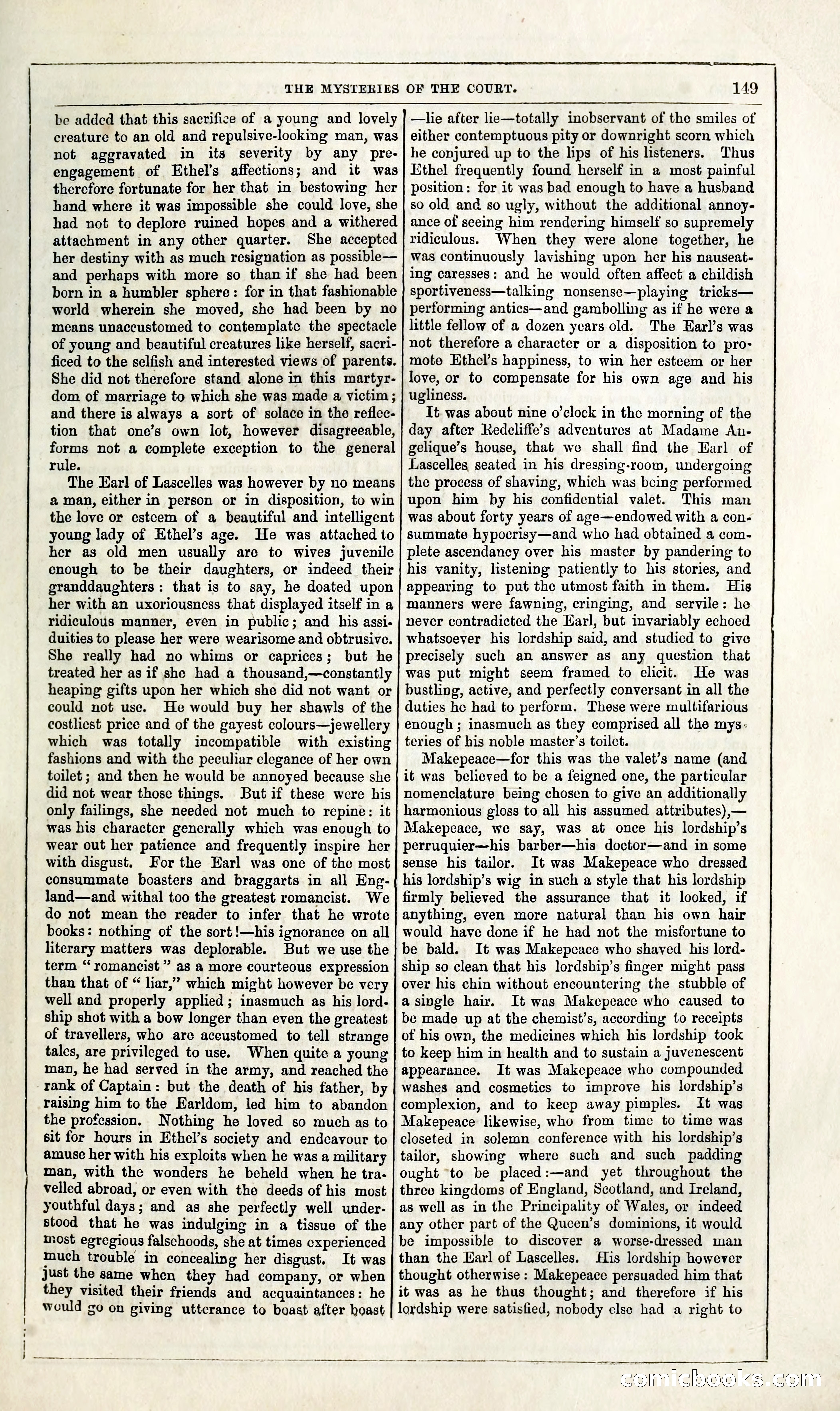
A restored page from Penny Dreadfuls, 1849. Page through the whole issue in the reader above.
📄 Transcribed text from this page (OCR, searchable)
Machine-transcribed from the original scan — historical spelling and the odd misread are preserved.
THE MYSTERIES be added that this sacrifice of a young and lovely creature to an old and repulsive-looking man, was not aggravated in its severity by any pre- engagement of Ethel’s affections; and it was therefore fortunate for her that in bestowing her hand where it was impossible she could love, she had not to deplore ruined hopes and a withered attachment in any other quarter. She accepted her destiny with as much resignation as possible— and perhaps with more so than if she had been born in a humbler sphere: for in that fashionable world wherein she moved, she had been by no means unaccustomed to contemplate the spectacle of young and beautiful creatures like herself, sacri- ficed to the selfish and interested views of parents. She did not therefore stand alone in this martyr- dom of marriage to which she was made a victim ; and there is always a sort of solace in the reflec- tion that one’s own lot, however disagreeable, forms not a complete exception to the general rule. The Earl of Lascelles was however by no means aman, either in person or in disposition, to win the love or esteem of a beautiful and intelligent young lady of Ethel’s age. He was attached to her as old men usually are to wives juvenile enough to be their daughters, or indeed their granddaughters: that is to say, he doated upon her with an uxoriousness that displayed itself in a ridiculous manner, even in public; and his assi- duities to please her were wearisome and obtrusive. She really had no whims or caprices; but he treated her as if she had a thousand,—constantly heaping gifts upon her which she did not want or could not use. He would buy her shawls of the costliest price and of the gayest colours—jewellery which was totally incompatible with existing fashions and with the peculiar elegance of her own toilet ; and then he would be annoyed because she did not wear those things. But if these were his only failings, she needed not much to repine: it was his character generally which was enough to wear out her patience and frequently inspire her with disgust. For the Earl was one of the most consummate boasters and braggarts in all Eng- land—and withal too the greatest romancist. We do not mean the reader to infer that he wrote books: nothing of the sort!—his ignorance on all literary matters was deplorable. But we use the term “romancist ” as a more courteous expression than that of “ liar,” which might however be very well and properly applied; inasmuch as his lord- ship shot with a bow longer than even the greatest of travellers, who are accustomed to tell strange tales, are privileged to use. When quite a young man, he had served in the army, and reached the rank of Captain: but the death of his father, by raising him to the Earldom, led him to abandon the profession. Nothing he loved so much as to sit for hours in Ethel’s society and endeavour to amuse her with his exploits when he was a military man, with the wonders he beheld when he tra- velled abroad, or even with the deeds of his most youthful days; and as she perfectly well under- stood that he was indulging in a tissue of the most egregious falsehoods, she at times experienced much trouble in concealing her disgust. It was just the same when they had company, or when they visited their friends and acquaintances: he would go on giving utterance to boast after hoast OF THE COURT. 149 —lie after lie—totally inobservant of the smiles of either contemptuous pity or downright scorn which he conjured up to the lips of his listeners. Thus Ethel frequently found herself in a most painful position: for it was bad enough to have a husband so old and so ugly, without the additional annoy- ance of seeing him rendering himself so supremely ridiculous. When they were alone together, he was continuously lavishing upon her his nauseat- ing caresses: and he would often affect a childish sportiveness—talking nonsense—playing tricks— performing antics—and gambolling as if he were a little fellow of a dozen years old. The Earl’s was not therefore a character or a disposition to pro- mote Ethel’s happiness, to win her esteem or her love, or to compensate for his own age and his ugliness. It was about nine o’clock in the morning of the day after Redcliffe’s adventures at Madame An- gelique’s house, that we shall find the Earl of Lascelles seated in his dressing-room, undergoing the process of shaving, which was being performed upon him by his confidential valet. This man was about forty years of ase—endowed with a con- summate hypocrisy—and who had obtained a com- plete ascendancy over his master by pandering to his vanity, listening patiently to his stories, and appearing to put the utmost faith in them. His manners were fawning, cringing, and servile: he never contradicted the Earl, but invariably echoed whatsoever his lordship said, and studied to give precisely such an answer as any question that was put might seem framed to elicit. He was bustling, active, and perfectly conversant in all the duties he had to perform. These were multifarious enough; inasmuch as they comprised all the mys: teries of his noble master’s toilet. Makepeace—for this was the valet’s name (and it was believed to be a feigned one, the particular nomenclature being chosen to give an additionally harmonious gloss to all his assumed attributes),— Makepeace, we say, was at once his lordship’s perruquier—his barber—his doctor—and in some sense his tailor. It was Makepeace who dressed his lordship’s wig in such a style that his lordship firmly believed the assurance that it looked, if anything, even more natural than his own hair would have done if he had not the misfortune to be bald. It was Makepeace who shaved his lord- ship so clean that his lordship’s finger might pass over his chin without encountering the stubble of a single hair. It was Makepeace who caused to be made up at the chemist’s, according to receipts of his own, the medicines which his lordship took to keep him in health and to sustain a juvenescent appearance. It was Makepeace who compounded washes and cosmetics to improve his lordship’s complexion, and to keep away pimples. It was Makepeace likewise, who from time to time was closeted in solemn conference with his lordship’s tailor, showing where such and such padding ought “to be placed:—and yet throughout the three kingdoms of England, Scotland, and Ireland, as well as in the Principality of Wales, or indeed any other part of the Queen’s dominions, it would be impossible to discover a worse-dressed man than the Earl of Lascelles. His lordship however thought otherwise : Makepeace persuaded him that it was as he thus thought; and therefore if his lordship were satisfied, nobody else had a right to a a ec ————_——————$— ee (C(O) (C 6)(0)(0) Ss (C(O)