
Penny Dreadfuls, 1849 · page 141 of 394
The Mysteries of the Court of London — page 141: what you’re looking at
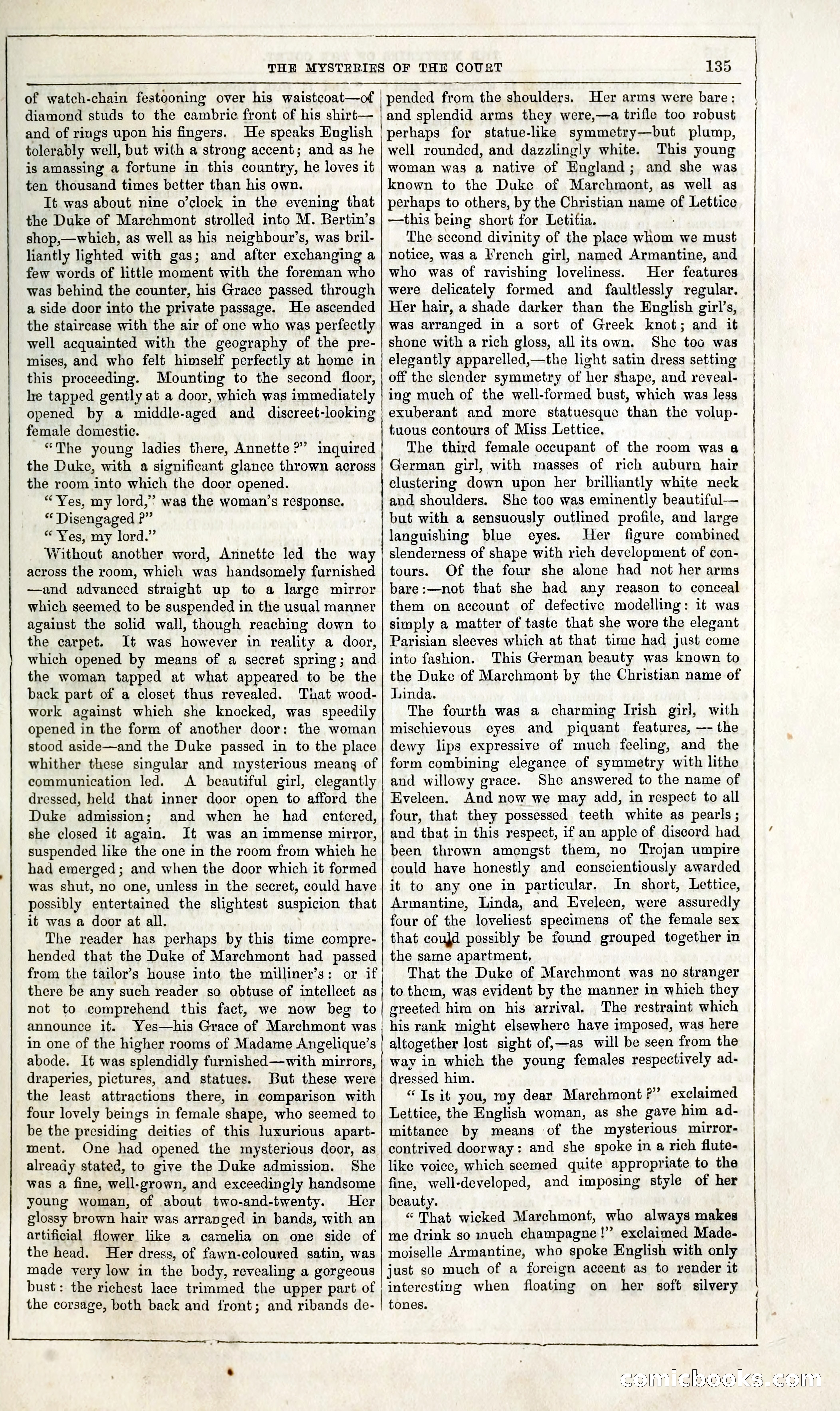
A restored page from Penny Dreadfuls, 1849. Page through the whole issue in the reader above.
📄 Transcribed text from this page (OCR, searchable)
Machine-transcribed from the original scan — historical spelling and the odd misread are preserved.
_—_ THE MYSTERIES OF THE COURT of watch-chain festooning over his waistcoat—of diamond studs to the cambric front of his shirt— and of rings upon his fingers. He speaks English tolerably well, but with a strong accent; and as he is amassing a fortune in this country, he loves it ten thousand times better than his own. It was about nine o’clock in the evening that the Duke of Marchmont strolled into M. Bertin’s shop,—which, as well as his neighbour’s, was bril- liantly lighted with gas; and after exchanging a few words of little moment with the foreman who was behind the counter, his Grace passed through a side door into the private passage. He ascended the staircase with the air of one who was perfectly well acquainted with the geography of the pre- mises, and who felt himself perfectly at home in this proceeding. Mounting to the second floor, he tapped gently at a door, which was immediately opened by a middle-aged and discreet-looking female domestic. “The young ladies there, Annette?” inquired the Duke, with a significant glance thrown across the room into which the door opened. “Yes, my lord,’’ was the woman’s response. “ Disengaged P” “Yes, my lord.” Without another word, Annette led the way across the room, which was handsomely furnished —and advanced straight up to a large mirror which seemed to be suspended in the usual manner against the solid wall, though reaching down to the carpet. It was however in reality a door, which opened by means of a secret spring; and the woman tapped at what appeared to be the back part of a closet thus revealed. That wood- work against which she knocked, was speedily opened in the form of another door: the woman stood aside—and the Duke passed in to the place whither these singular and mysterious meang of communication led. A beautiful girl, elegantly dressed, held that inner door open to afford the Duke admission; and when he had entered, she closed if again. It was an immense mirror, suspended like the one in the room from which he had emerged; and when the door which it formed was shut, no one, unless in the secret, could have possibly entertained the slightest suspicion that it was a door at all. The reader has perhaps by this time compre- hended that the Duke of Marchmont had passed from the tailor’s house into the milliner’s: or if there be any such reader so obtuse of intellect as not to comprehend this fact, we now beg to announce it. Yes—his Grace of Marchmont was in one of the higher rooms of Madame Angelique’s abode. It was splendidly furnished—with mirrors, draperies, pictures, and statues. But these were the least attractions there, in comparison with four lovely beings in female shape, who seemed to be the presiding deities of this luxurious apart- ment. One had opened the mysterious door, as already stated, to give the Duke admission. She was a fine, well-grown, and exceedingly handsome young woman, of about two-and-twenty. Her glossy brown hair was arranged in bands, with an artificial flower like a camelia on one side of the head. Her dress, of fawn-coloured satin, was made very low in the body, revealing a gorgeous bust: the richest lace trimmed the upper part of 135 pended from the shoulders. Her arms were bare; and splendid arms they were,—a trifle too robust perhaps for statue-like symmetry—but plump, well rounded, and dazzlingly white. This young woman was a native of England; and she was known to the Duke of Marchmont, as well as perhaps to others, by the Christian name of Lettice —this being short for Letitia. The second divinity of the place whom we must notice, was a French girl, named Armantine, and who was of ravishing loveliness. Her features were delicately formed and faultlessly regular. Her hair, a shade darker than the English girl’s, was arranged in a sort of Greek knot; and it shone with a rich gloss, allits own. She too was elegantly apparelled,—the light satin dress setting off the slender symmetry of her shape, and reveal- ing much of the well-formed bust, which was less exuberant and more statuesque than the volup- tuous contours of Miss Lettice. The third female occupant of the room was a German girl, with masses of rich auburn hair clustering down upon her brilliantly white neck and shoulders. She too was eminently beautiful— but with a sensuously outlined profile, and large languishing blue eyes. Her figure combined slenderness of shape with rich development of con- tours. Of the four she alone had not her arms bare:—not that she had any reason to conceal them on account of defective modelling: it was simply a matter of taste that she wore the elegant Parisian sleeves which at that time had just come into fashion. This German beauty was known to the Duke of Marchmont by the Christian name of Linda. The fourth was a charming Irish girl, with mischievous eyes and piquant features, —- the dewy lips expressive of much feeling, and the form combining elegance of symmetry with lithe and willowy grace. She answered to the name of Eveleen. And now we may add, in respect to all four, that they possessed teeth white as pearls ; and that in this respect, if an apple of discord had been thrown amongst them, no Trojan umpire could have honestly and conscientiously awarded it to any one in particular. In short, Lettice, Armantine, Linda, and Eveleen, were assuredly four of the loveliest specimens of the female sex that coujd possibly be found grouped together in the same apartment, That the Duke of Marchmont was no stranger to them, was evident by the manner in which they greeted him on his arrival. The restraint which his rank might elsewhere have imposed, was here altogether lost sight of,—as will be seen from the way in which the young females respectively ad- dressed him. “Ts it you, my dear Marchmont?” exclaimed Lettice, the English woman, as she gave him ad- mittance by means of the mysterious murror- contrived doorway: and she spoke in a rich flute- like voice, which seemed quite appropriate to the fine, well-developed, and imposing style of her beauty. «That wicked Marchmont, who always makes me drink so much champagne!” exclaimed Made- moiselle Armantine, who spoke English with only just so much of a foreign accent as to vender it interesting when floating on her soft silvery the corsage, both back and front; and ribands de- | tones. i (C(O) @ 6)(0)(0) S (c©)