
Penny Dreadfuls, 1849 · page 131 of 394
The Mysteries of the Court of London — page 131: what you’re looking at
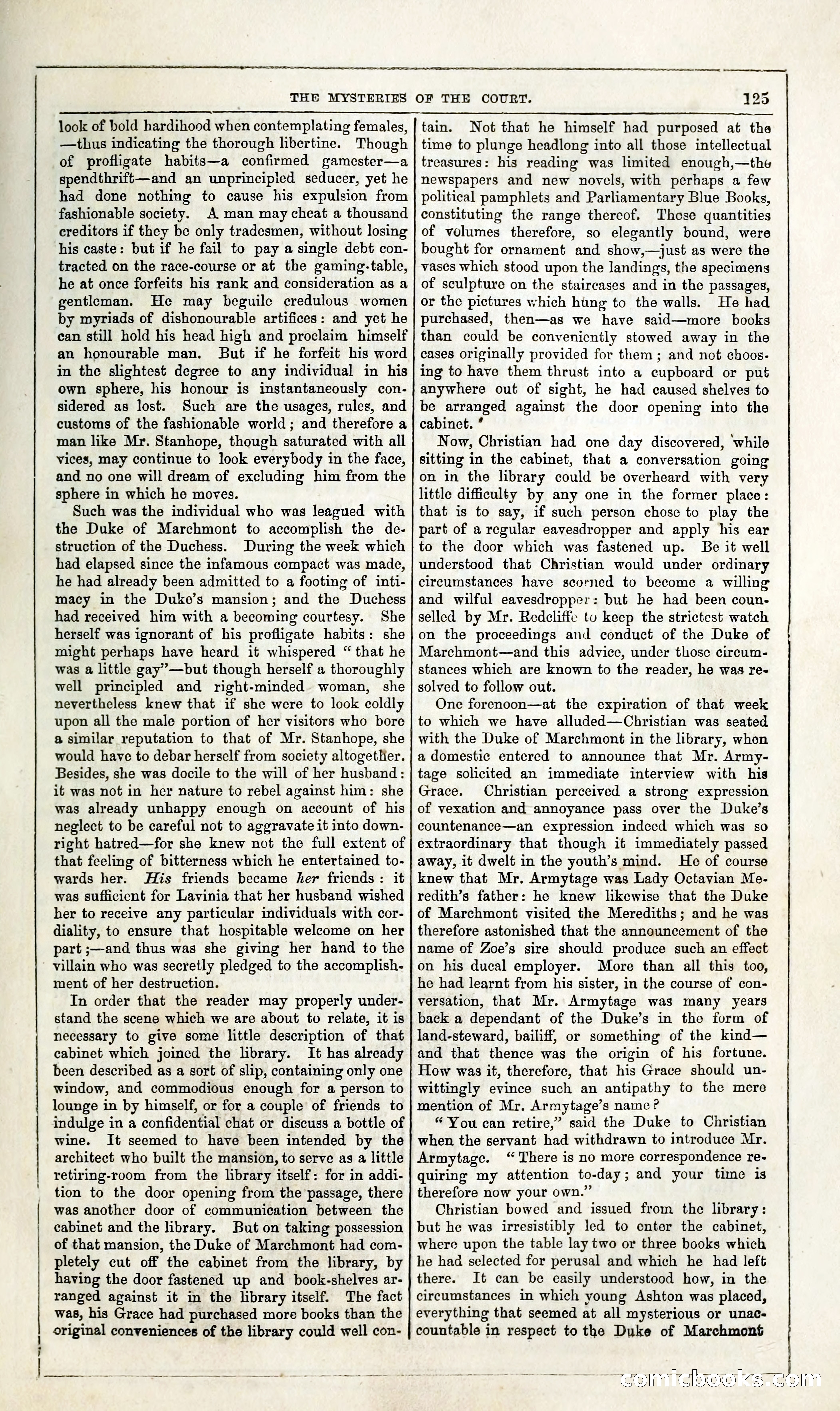
A restored page from Penny Dreadfuls, 1849. Page through the whole issue in the reader above.
📄 Transcribed text from this page (OCR, searchable)
Machine-transcribed from the original scan — historical spelling and the odd misread are preserved.
THE MYSTERIES look of bold hardihood when contemplating females, —thus indicating the thorough libertine. Though of profligate habits—a confirmed gamester—a spendthrift—and an unprincipled seducer, yet he had done nothing to cause his expulsion from fashionable society. A man may cheat a thousand creditors if they be only tradesmen, without losing his caste: but if he fail to pay a single debt con- tracted on the race-course or at the gaming-table, he at once forfeits his rank and consideration as a gentleman. He may beguile credulous women by myriads of dishonourable artifices: and yet he can still hold his head high and proclaim himself an honourable man. But if he forfeit his word in the slightest degree to any individual in his own sphere, his honour is instantaneously con- sidered as lost. Such are the usages, rules, and customs of the fashionable world; and therefore a man like Mr. Stanhope, though saturated with all vices, may continue to look everybody in the face, and no one will dream of excluding him from the sphere in which he moves. Such was the individual who was leagued with the Duke of Marchmont to accomplish the de- struction of the Duchess. During the week which had elapsed since the infamous compact was made, he had already been admitted to a footing of inti- macy in the Duke’s mansion; and the Duchess had received him with a becoming courtesy. She herself was ignorant of his profligate habits: she might perhaps have heard it whispered “ that he was a little gay”’—but though herself a thoroughly well principled and right-minded woman, she nevertheless knew that if she were to look coldly upon all the male portion of her visitors who bore & similar reputation to that of Mr. Stanhope, she would have to debar herself from society altogetHer. Besides, she was docile to the will of her husband: it was not in her nature to rebel against him: she was already unhappy enough on account of his neglect to be careful not to aggravate it into down- right hatred—for she knew not the full extent of that feeling of bitterness which he entertained to- wards her. His friends became her friends: it was sufficient for Lavinia that her husband wished her to receive any particular individuals with cor- diality, to ensure that hospitable welcome on her part ;—and thus was she giving her hand to the villain who was secretly pledged to the accomplish- ment of her destruction. In order that the reader may properly under- stand the scene which we are about to relate, it is necessary to give some little description of that cabinet which joined the library. It has already been described as a sort of slip, containing only one window, and commodious enough for a person to lounge in by himself, or for a couple of friends to indulge in a confidential chat or discuss a bottle of wine. It seemed to have been intended by the architect who built the mansion, to serve as a little retiring-room from the library itself: for in addi- tion to the door opening from the passage, there was another door of communication between the cabinet and the library. But on taking possession of that mansion, the Duke of Marchmont had com- pletely cut off the cabinet from the library, by having the door fastened up and book-shelves ar- ranged against it in the library itself. The fact was, his Grace had purchased more books than the original conveniences of the library could well con- OF THE COURT. 125 tain. time to plunge headlong into all those intellectual treasures: his reading was limited enough,—the newspapers and new novels, with perhaps a few political pamphlets and Parliamentary Blue Books, constituting the range thereof. Those quantities of volumes therefore, so elegantly bound, were bought for ornament and show,—just as were the vases which stood upon the landings, the specimens of sculpture on the staircases and in the passages, or the pictures which hung to the walls. He had purchased, then—as we have said—more books than could be conveniently stowed away in the cases originally provided for them; and not choos- ing to have them thrust into a cupboard or put anywhere out of sight, he had caused shelves to be arranged against the door opening into the cabinet. * Now, Christian had one day discovered, while sitting in the cabinet, that a conversation going on in the library could be overheard with very little difficulty by any one in the former place: that is to say, if such person chose to play the part of a regular eavesdropper and apply his ear to the door which was fastened up. Be it well understood that Christian would under ordinary circumstances have scorned to become a willing and wilful eavesdropper: but he had been coun- selled by Mr. Redcliffe tu keep the strictest watch on the proceedings and conduct of the Duke of Marchmont—and this advice, under those circum- stances which are known to the reader, he was res solved to follow out. One forenoon—at the expiration of that week to which we have alluded—Christian was seated with the Duke of Marchmont in the library, when a domestic entered to announce that Mr. Army- tage solicited an immediate interview with his Grace. Christian perceived a strong expression of vexation and annoyance pass over the Duke’s countenance—an expression indeed which was so extraordinary that though it immediately passed away, it dwelt in the youth’s mind. He of course knew that Mr. Armytage was Lady Octavian Me- redith’s father: he knew likewise that the Duke of Marchmont visited the Merediths; and he was therefore astonished that the announcement of the name of Zoe’s sire should produce such an effect on his ducal employer. More than all this too, he had learnt from his sister, in the course of con- versation, that Mr. Armytage was many years back a dependant of the Duke’s in the form of land-steward, bailiff, or something of the kind— and that thence was the origin of his fortune. How was it, therefore, that his Grace should un- wittingly evince such an antipathy to the mere mention of Mr. Armytage’s name? “ You can retire,” said the Duke to Christian when the servant had withdrawn to introduce Mr. Armytage. ‘There is no more correspondence re- quiring my attention to-day; and your time is therefore now your own.” Christian bowed and issued from the library: but he was irresistibly led to enter the cabinet, where upon the table lay two or three books which he had selected for perusal and which he had left there. It can be easily understood how, in the circumstances in which young Ashton was placed, everything that seemed at all mysterious or unac- countable in respect to the Duke of Marchmont (COLL KS Not that he himself had purposed at the I@ JOO QO