
Penny Dreadfuls, 1849 · page 10 of 394
The Mysteries of the Court of London — page 10: what you’re looking at
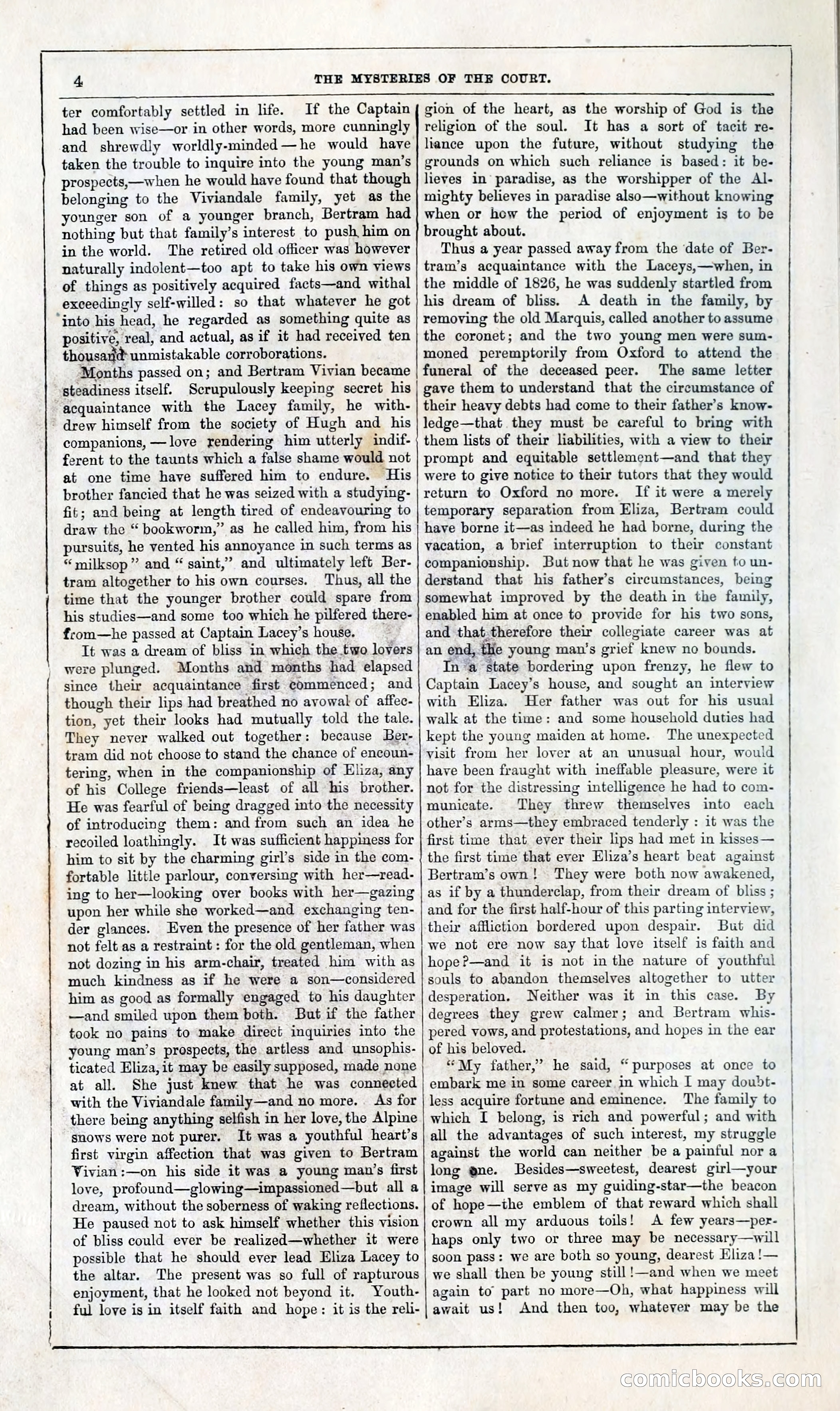
A restored page from Penny Dreadfuls, 1849. Page through the whole issue in the reader above.
📄 Transcribed text from this page (OCR, searchable)
Machine-transcribed from the original scan — historical spelling and the odd misread are preserved.
| a + THE MYSTERIES OF THE COURT. eT LEER ee eee a ee ee ee a ee eee tae eee ter comfortably settled in life. If the Captain had been wise—or in other words, more cunningly and shrewdly worldly-minded—he would have taken the trouble to inquire into the young man’s prospects,—when he would have found that though belonging to the Viviandale family, yet as the younger son of a younger branch, Bertram had nothing but that family’s interest to push, him on in the world. The retired old officer was however naturally indolent—too apt to take his own views of things as positively acquired facts—and withal exceedingly self-willed: so that whatever he got ‘into his head, he regarded as something quite as positive, real, and actual, as if it had received ten thousand: unmistakable corroborations. Months passed on; and Bertram Vivian became steadiness itself. Scrupulously keeping secret his “acquaintance with the Lacey family, he with- - drew himself from the society of Hugh and his companions, —love rendering him utterly indif- ferent to the taunts which a false shame would not at one time have suffered him to endure. His brother fancied that he was seized with a studying- fit; and being at length tired of endeavouring to draw the “ bookworm,” as he called him, from his pursuits, he vented his annoyance in such terms as “ milksop ” and “ saint,” and ultimately left Ber- tram altogether to his own courses. Thus, all the time that the younger brother could spare from his studies—and some too which he pilfered there- from—he passed at Captain Lacey’s house. It was a dream of bliss in which the.two lovers were plunged. Months and months had elapsed since their acquaintance first commenced; and though their lips had breathed no avowal of affec- tion, yet their looks had mutually told the tale. They never walked out together: because Ber- tram did not choose to stand the chance of encoun- tering, when in the companionship of Eliza, any of his College friends—least of all his brother. He was fearful of being dragged into the necessity of introducing them: and from such an idea he recoiled loathingly. It was sufficient happiness for him to sit by the charming girl’s side in the com- fortable little parlour, conversing with her—read- ing to her—looking over books with her—gazing upon her while she worked—and exchanging ten- der glances. Even the presence of her father was not felt as a restraint: for the old gentleman, when not dozing in his arm-chair, treated him with as much kindness as if he were a son—considered him as good as formally engaged to his daughter —and smiled upon them both. But if the father took no pains to make direct inquiries into the young man’s prospects, the artless and unsophis- ticated Eliza, it may be easily supposed, made none at all. She just knew that he was connected with the Viviandale family—and no more. As for there being anything selfish in her love, the Alpine snows were not purer. It was a youthful heart’s first virgin affection that was given to Bertram Vivian :—on his side it was a young man’s first love, profound—glowing—impassioned—but all a dream, without the soberness of waking reflections. He paused not to ask himself whether this vision of bliss could ever be realized—whether it were possible that he should ever lead Eliza Lacey to the altar. The present was so full of rapturous enjoyment, that he looked not beyond it. Youth- ful love is in itself faith and hope: it is the reli- gion of the heart, as the worship of God is the religion of the soul. It has a sort of tacit re- lance upon the future, without studying the grounds on which such reliance is based: it be- lieves in paradise, as the worshipper of the Al- mighty believes in paradise also—without knowing when or how the period of enjoyment is to be brought about. Thus a year passed away from the date of Ber- tram’s acquaintance with the Laceys,—when, in the middle of 1826, he was suddenly startled from his dream of bliss. A death in the family, by removing the old Marquis, called another to assume the coronet; and the two young men were sum- moned peremptorily from Oxford to attend the funeral of the deceased peer. The same letter gave them to understand that the circumstance of their heavy debts had come to their father’s know- ledge—that they must be careful to bring with them lists of their liabilities, with a view to their prompt and equitable settlement—and that they were to give notice to their tutors that they would return to Oxford no more. If it were a merely temporary separation from Eliza, Bertram could have borne it—as indeed he had borne, during the vacation, a brief interruption to their constant companionship. But now that he was given to un- derstand that his father’s circumstances, being somewhat improved by the death in the family, enabled him at once to provide for his two sons, and that.therefore their collegiate career was at an end, the young man’s grief knew no bounds. Ina state bordering upon frenzy, he flew to Captain Lacey’s house, and sought an interview with Eliza. Her father was out for his usual walk at the time: and some household duties had kept the young maiden at home. The unexpected visit from her lover at an unusual hour, would have been fraught with ineffable pleasure, were it not for the distressing intelligence he had to com- municate. They threw themselves into each other’s arms—they embraced tenderly : it was the first time that ever their lips had met in kisses— the first time that ever Eliza’s heart beat against Bertram’s own! They were both now awakened, as if by a thunderclap, from their dream of bliss ; and for the first half-hour of this parting interview, their affliction bordered upon despair. But did we not ere now Say that love itself is faith and hope?—and it is not in the nature of youthful souls to abandon themselves altogether to utter desperation. Neither was it in this case. By degrees they grew calmer; and Bertram whis- pered vows, and protestations, and hopes in the ear of his beloved. “My father,” he said, “purposes at once to embark me in some career in which I may doubt- less acquire fortune and eminence. The family to which I belong, is rich and powerful; and with all the advantages of such interest, my struggle against the world can neither be a painful nor a long gne. Besides—sweetest, dearest girl—your image will serve as my guiding-star—the beacon of hope—ihe emblem of that reward which shall crown all my arduous toils! A few years—per- haps only two or three may be necessary—will soon pass: we are both so young, dearest Eliza !— we shall then be young still!—and when we meet again to part no more—Oh, what happiness will await us! And then too, whatever may be the en ae Go JOO AMC S (c©)