
Penny Dreadfuls, 1849 · page 92 of 394
The Mysteries of the Court of London — page 92: what you’re looking at
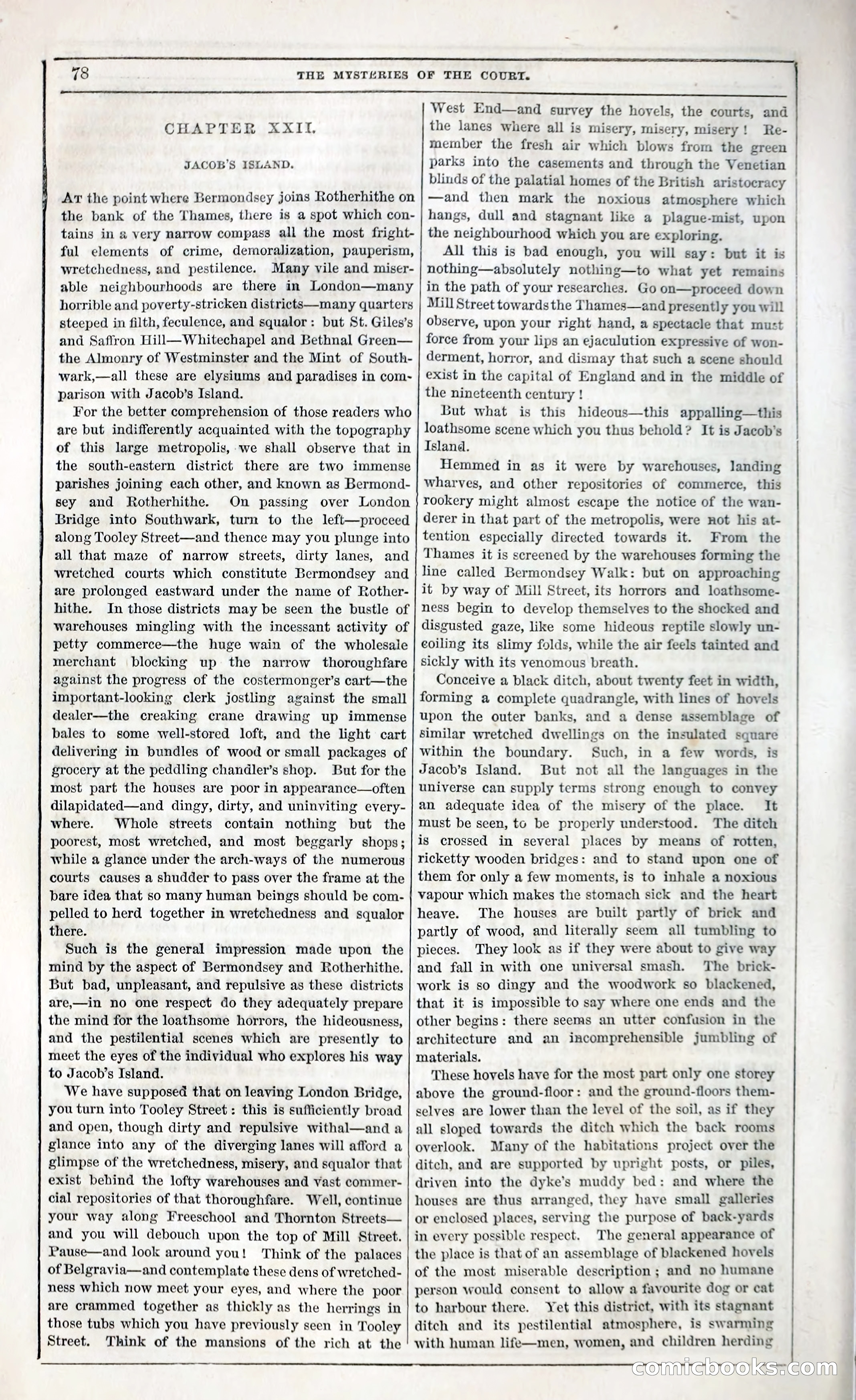
A restored page from Penny Dreadfuls, 1849. Page through the whole issue in the reader above.
📄 Transcribed text from this page (OCR, searchable)
Machine-transcribed from the original scan — historical spelling and the odd misread are preserved.
78 CHAPTER XXII. JACOB’S ISLAND. AT the point where Bermondsey joins Rotherhithe on the bank of the Thames, there is a spot which con- tains in a very narrow compass all the most fright- ful elements of crime, demoralization, pauperism, Many vile and miser- able neighbourhoods are there in London—many horrible and poverty-stricken districts—many quarters steeped in filth, feculence, and squalor: but St. Giles’s and Saffron Hill—Whitechapel and Bethnal Green— the Almonry of Westminster and the Mint of South- wark,—all these are elysiums and paradises in com-~- wretchedness, and pestilence. parison with Jacob’s Island. For the better comprehension of those readers who are but indifferently acquainted with the topography of this large metropolis, we shall observe that in the south-eastern district there are two immense parishes joining each other, and known as Bermond- sey and Rotherhithe. On passing over London Bridge into Southwark, turn to the left—proceed along Tooley Street—and thence may you plunge into all that maze of narrow streets, dirty lanes, and wretched courts which constitute Bermondsey and are prolonged eastward under the name of Rother- hithe. petty commerce—the huge wain of the wholesale merchant blocking up the narrow thoroughfare against the progress of the costermonger’s cart—the important-looking clerk jostling against the small dealer—the creaking crane drawing up immense bales to some well-stored loft, and the light cart delivering in bundles of wood or small packages of grocery at the peddling chandler’s shop. But for the most part the houses are poor in appearance—often dilapidated—and dingy, dirty, and uninviting every- where. Whole streets contain nothing but the poorest, most wretched, and most beggarly shops; while a glance under the arch-ways of the numerous courts causes a shudder to pass over the frame at the bare idea that so many human beings should be com- pelled to herd together in wretchedness and squalor there. Such is the general impression made upon the mind by the aspect of Bermondsey and Rotherhithe. But bad, unpleasant, and repulsive as these districts are,—in no one respect do they adequately prepare the mind for the loathsome horrors, the hideousness, and the pestilential scenes which are presently to meet the eyes of the individual who explores his way to Jacob’s Island. We have supposed that on leaving London Bridge, you turn into Tooley Street: this is sufficiently broad and open, though dirty and repulsive withal—and a glance into any of the diverging lanes will afford a glimpse of the wretchedness, misery, and squalor that exist behind the lofty warehouses and Vast commer- cial repositories of that thoroughfare. Well, continue your way along Freeschool and Thornton Streets— and you will debouch upon the top of Mill Street. Pause—and look around you! Think of the palaces of Belgravia—and contemplate these dens of wretched- ness which now meet your eyes, and where the poor are crammed together as thickly as the herrings in those tubs which you have previously seen in Tooley Street. Think of the mansions of the rich at the in ra nme ert me were er OITMLC THE MYST“LRIES OF THE COURT. a a a a am a I a In those districts may be seen the bustle of warehouses mingling with the incessant activity of West End—and survey the hoyels, the courts, and the lanes where all is misery, misery, misery! Re- member the fresh air which blows from the green parks into the casements and through the Venetian blinds of the palatial homes of the British aristocracy —and then mark the noxious atmosphere which hangs, dull and stagnant like a plague-mist, upon | the neighbourhood which you are exploring. All this is bad enough, you will say: but it is | nothing—absolutely nothing—to what yet remains | in the path of your researches. Go on—proceed down | Mill Street towards the Thames—and present] y youwill | observe, upon your right hand, a spectacle that must | force from your lips an ejaculution expressive of won- | | derment, horror, and dismay that such a scene should exist in the capital of England and in the middle of the nineteenth century ! But what is this hideous—this appalling—this loathsome scene which you thus behold? It is Jacob’s Island. Hemmed in as it were by warehouses, landing wharves, and other repositories of commerce, this rookery might almost escape the notice of the wan- derer in that part of the metropolis, were not his at- tention especially directed towards it. From the Thames it is screened by the warehouses forming the line called Bermondsey Walk: but on approaching it by way of Mill Street, its horrors and loathsome- ness begin to develop themselves to the shocked and disgusted gaze, like some hideous reptile slowly un- coiling its slimy folds, while the air feels tainted and sickly with its venomous breath. Conceive a black ditch, about twenty feet in width, forming a complete quadrangle, with lines of hovels upon the outer banks, and a dense assemblage of similar wretched dwellings on the insulated square within the boundary. Such, in a few words, is Jacob’s Island. But not all the languages in the universe can supply terms strong enough to convey an adequate idea of the misery of the place. It must be seen, to be properly understood. The ditch is crossed in several places by means of rotten, ricketty wooden bridges: and to stand upon one of them for only a few moments, is to inhale a noxious vapour which makes the stomach sick and the heart heave. The houses are built partly of brick and partly of wood, and literally seem all tumbling to pieces. They look as if they were about to give way and fall in with one universal smash. The brick- work is so dingy and the woodwork so blackened, that it is impossible to say where one ends and the other begins: there seems an utter confusion in the architecture and an incomprehensible jumbling of materials. These hovels have for the most part only one storey above the ground-floor: and the ground-floors them- selves are lower than the level of the soil, as if they all sloped towards the ditch which the back rooms overlook. Many of the habitations project over the ditch, and are supported by upright posts, or piles, driven into the dyke’s muddy bed: and where the houses are thus arranged, they have small galleries or enclosed places, serving the purpose of back-yards in every possible respect. The general appearance of the place is that of an assemblage of blackened hovels of the most miserable description; and no humane person would consent to allow a favourite dog or cat to harbour there. Yet this district, with its stagnant ditch and its pestilential atmosphere, is swarming with human life—men, women, and children herding — VOORKS: E(0)