
Penny Dreadfuls, 1849 · page 78 of 394
The Mysteries of the Court of London — page 78: what you’re looking at
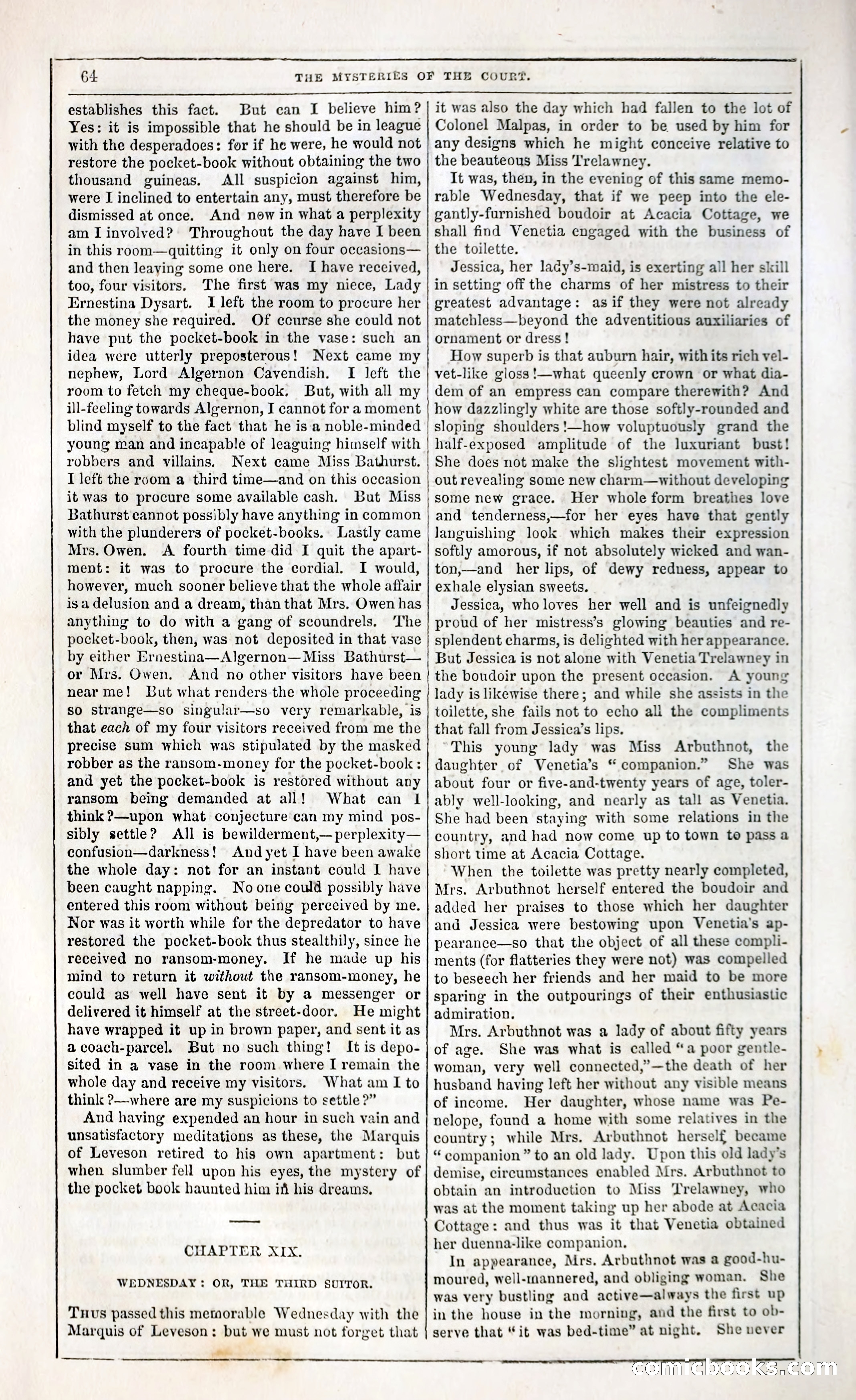
A restored page from Penny Dreadfuls, 1849. Page through the whole issue in the reader above.
📄 Transcribed text from this page (OCR, searchable)
Machine-transcribed from the original scan — historical spelling and the odd misread are preserved.
——— + 64 THE MYSTERIES OF THE COURT. establishes this fact. But can I believe him? Yes: it is impossible that he should be in league with the desperadoes: for if he were, he would not restore the pocket-book without obtaining the two thousand guineas. All suspicion against him, were I inclined to entertain any, must therefore be dismissed at once. And now in what a perplexity am I involved? Throughout the day have I been in this room—quitting it only on four occasions— and then leaving some one here. I have received, too, four visitors, The first was my niece, Lady Ernestina Dysart. I left the room to procure her the money she required. Of ccurse she could not have put the pocket-book in the vase: such an idea were utterly preposterous! Next came my nephew, Lord Algernon Cavendish. [I left the room to fetch my cheque-book. But, with all my ill-feeling towards Algernon, I cannot for a moment blind myself to the fact that he is a noble-minded young man and incapable of leaguing himself with robbers and villains. Next came Miss Bathurst. I left the room a third time—and on this occasion it was to procure some available cash. But Miss Bathurst cannot possibly have anything in common with the plunderers of pocket-books. Lastly came Mrs. Owen. A fourth time did I quit the apart- ment: it was to procure the cordial. I would, however, much sooner believe that the whole affair isa delusion and a dream, than that Mrs. Owen has anything to do with a gang of scoundrels. ‘The pocket-book, then, was not deposited in that vase by either Ernestina—Algernon— Miss Bathurst— or Mrs. Owen. And no other visitors have been nearme! But what renders the whole proceeding so strange—so singular—so very remarkable, is that each of my four visitors received from me the precise sum which was stipulated by the masked robber as the ransom-money for the pocket-book : and yet the pocket-book is restored without any ransom being demanded at all! What can I think ?—upon what conjecture can my mind pos- sibly settle? All is bewilderment,— perplexity— confusion—darkness! And yet I have been awake the whole day: not for an instant could I have been caught napping. Noone could possibly have entered this room without being perceived by me. Nor was it worth while for the depredator to have restored the pocket-book thus stealthily, since he received no ransom-money. If he made up his mind to return it wethout the ransom-money, he could as well have sent it by a messenger or delivered it himself at the street-door. He might have wrapped it up in brown paper, and sent it as a coach-parcel. But no such thing! It is depo- sited in a vase in the room where I remain the whole day and receive my visitors. What am I to think ?—where are my suspicions to settle?” And having expended an hour in such vain and unsatisfactory meditations as these, the Marquis of Leveson retired to his own apartment: but when slumber fell upon his eyes, the mystery of the pocket book haunted him if his dreams. CHAPTER XIX. WEDNESDAY : OR, THE THIRD SUITOR. Tuus passed this memorable Wednesday with the Marquis of Leveson: but we must not forget that Solel _—__ —___ A it was also the day which had fallen to the lot of Colonel Malpas, in order to be used by him for any designs which he might conceive relative to the beauteous Miss Trelawney. It was, then, in the evening of this same memo- rable Wednesday, that if we peep into the ele- gantly-furnished boudoir at Acacia Cottage, we shall find Venetia engaged with the business of the toilette. Jessica, her lady’s-maid, is exerting all her skill in setting off the charms of her mistress to their greatest advantage: as if they were not already matchless—beyond the adventitious auxiliaries of ornament or dress! How superb is that auburn hair, with its rich vel- vet-like gloss !—what queenly crown or what dia- dem of an empress can compare therewith? And how dazzlingly white are those softly-rounded and sloping shoulders !—how voluptuously grand the half-exposed amplitude of the luxuriant bust! She does not make the slightest movement with- out revealing some new charm—without developing some new grace. Her whole form breathes love and tenderness,—for her eyes have that gently languishing look which makes their expression softly amorous, if not absolutely wicked and wan- ton,—and her lips, of dewy redness, appear to exhale elysian sweets. Jessica, wholoves her well and is unfeignedly proud of her mistress’s glowing beauties and re- splendent charms, is delighted with her appearance. But Jessica is not alone with Venetia Trelawney in the boudoir upon the present occasion. A young lady is likewise there; and while she assists in the toilette, she fails not to echo all the compliments that fall from Jessica’s lips. This young lady was Miss Arbuthnot, the daughter of Venetia’s “ companion.” She was about four or five-and-twenty years of age, toler- ably well-looking, and nearly as tall as Venetia. She had been staying with some relations in the country, and had now come up to town toe passa short time at Acacia Cottage. When the toilette was pretty nearly completed, Mrs. Arbuthnot herself entered the boudoir and added her praises to those which her daughter and Jessica were bestowing upon Venetia’s ap- pearance—so that the object of all these compli- ments (for flatteries they were not) was compelled to beseech her friends and her maid to be more sparing in the outpourings of their enthusiastic admiration. Mrs. Arbuthnot was a lady of about fifty years of age. She was what is called “a poor gentle- woman, very well connected,’—the death of her husband having left her without any visible means of income. Her daughter, whose name was Pe- nelope, found a home with some relatives in the country; while Mrs. Arbuthnot herself became “ companion ” to an old lady. Upon this old lady's demise, circumstances enabled Mrs. Arbuthnot to obtain an introduction to Miss Trelawney, who was at the moment taking up her abode at Acacia Cottage: and thus was it that Venetia obtained her duenna-like companion, In appearance, Mrs. Arbuthnot was a good-hu- moured, well-mannered, and obliging woman. She was very bustling and active—always the first up in the house in the morning, and the first to ob- serve that “it was bed-time” at night. She uever OIL! MOONS 5 (EO)