
Penny Dreadfuls, 1849 · page 54 of 394
The Mysteries of the Court of London — page 54: what you’re looking at
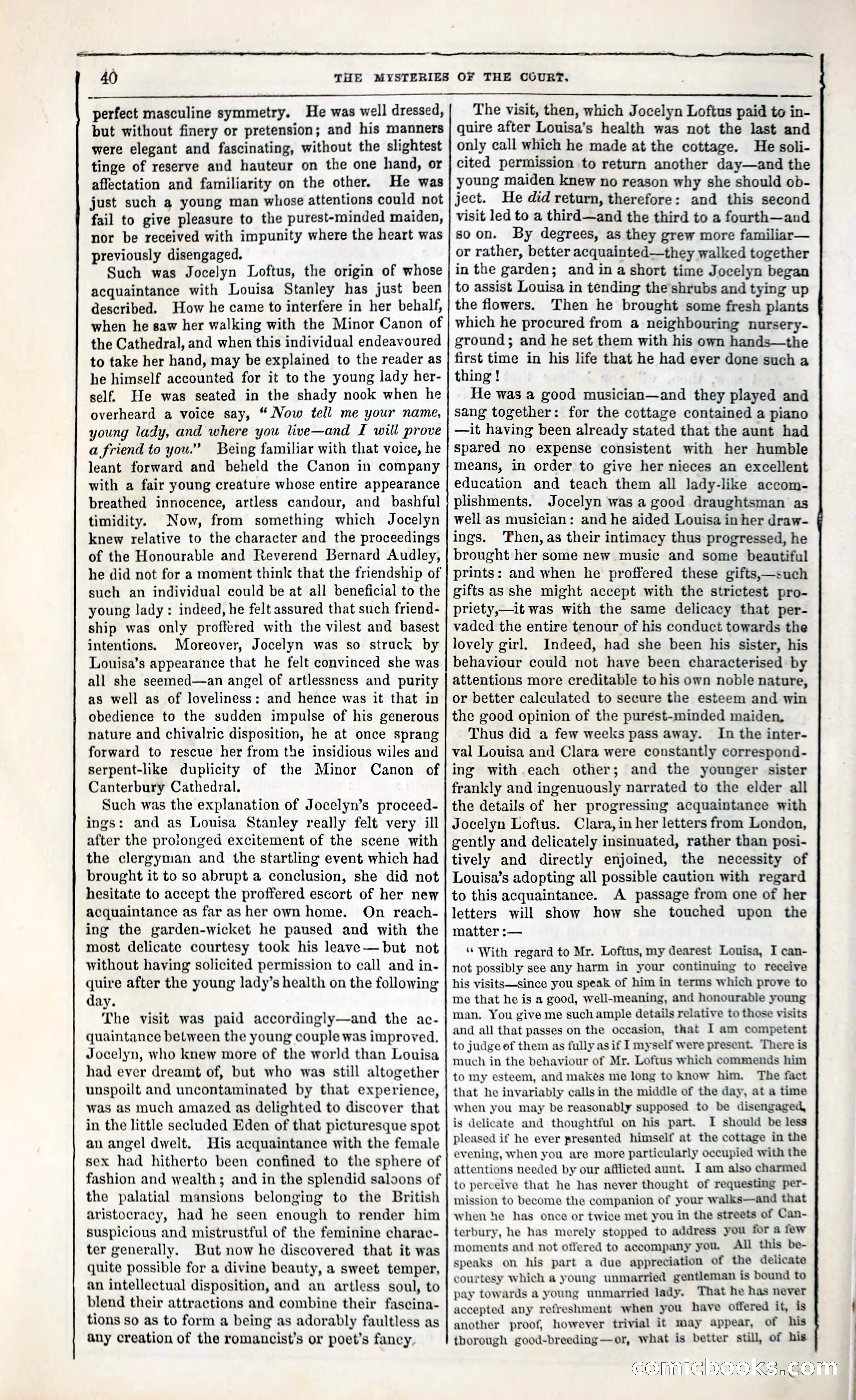
A restored page from Penny Dreadfuls, 1849. Page through the whole issue in the reader above.
📄 Transcribed text from this page (OCR, searchable)
Machine-transcribed from the original scan — historical spelling and the odd misread are preserved.
A perfect masculine symmetry. He was well dressed, but without finery or pretension; and his manners were elegant and fascinating, without the slightest tinge of reserve and hauteur on the one hand, or affectation and familiarity on the other. He was just such a young man whose attentions could not fail to give pleasure to the purest-minded maiden, nor be received with impunity where the heart was previously disengaged. Such was Jocelyn Loftus, the origin of whose acquaintance with Louisa Stanley has just been described. How he came to interfere in her behalf, when he saw her walking with the Minor Canon of the Cathedral, and when this individual endeavoured to take her hand, may be explained to the reader as he himself accounted for it to the young lady her- self. He was seated in the shady nook when he overheard a voice say, “Now tell me your name, young lady, and where you live—and I will prove a friend to you.” Being familiar with that voice, he leant forward and beheld the Canon in company with a fair young creature whose entire appearance breathed innocence, artless candour, and bashful timidity. Now, from something which Jocelyn knew relative to the character and the proceedings of the Honourable and Reverend Bernard Audley, he did not for a moment think that the friendship of such an individual could be at all beneficial to the young lady: indeed, he felt assured that such friend- ship was only proffered with the vilest and basest intentions. Moreover, Jocelyn was so struck by Louisa’s appearance that he felt convinced she was all she seemed—an angel of artlessness and purity as well as of loveliness: and hence was it that in obedience to the sudden impulse of his generous nature and chivalric disposition, he at once sprang forward to rescue her from the insidious wiles and serpent-like duplicity of the Minor Canon of Canterbury Cathedral. Such was the explanation of Jocelyn’s proceed- ings: and as Louisa Stanley really felt very ill after the prolonged excitement of the scene with the clergyman and the startling event which had brought it to so abrupt a conclusion, she did not hesitate to accept the proffered escort of her new acquaintance as far as her own home. On reach- ing the garden-wicket he paused and with the most delicate courtesy took his leave— but not without having solicited permission to call and in- quire after the young lady’s health on the following day. The visit was paid accordingly—and the ac- quaintance between the young couple was improved, Jocelyn, who knew more of the world than Louisa had ever dreamt of, but who was still altogether unspoilt and uncontaminated by that experience, was as much amazed as delighted to discover that in the little secluded Eden of that picturesque spot an angel dwelt. His acquaintance with the female sex had hitherto been confined to the sphere of fashion and wealth; and in the splendid saloons of the palatial mansions belonging to the British aristocracy, had he seen enough to render him suspicious and mistrustful of the feminine charac- ter generally. But now he discovered that it was quite possible for a divine beauty, a sweet temper, an intellectual disposition, and an artless soul, to blend their attractions and combine their fascina- tions so as to form a being as adorably faultless as any creation of the romancist’s or poet’s fancy. THE MYSTERIES OF THE COURT. —_—_—_—_ The visit, then, which Jocelyn Loftus paid to in- quire after Louisa’s health was not the last and only call which he made at the cottage. He soli- cited permission to return another day—and the young maiden knew no reason why she should ob- ject. He did return, therefore: and this second visit led to a third—and the third to a fourth—and soon. By degrees, as they grew more familiar— or rather, better acquainted—they walked together in the garden; and ina short time Jocelyn began to assist Louisa in tending the’shrubs and tying up the flowers. Then he brought some fresh plants which he procured from a neighbouring nursery- ground; and he set them with his own hands—the first time in his life that he had ever done such a thing! | He was a good musician—and they played and sang together: for the cottage contained a piano —it having been already stated that the aunt had spared no expense consistent with her humble means, in order to give her nieces an excellent education and teach them all lady-like accom- plishments. Jocelyn was a good draughtsman as well as musician: and he aided Louisa in her draw- ings. ‘Then, as their intimacy thus progressed, he brought her some new music and some beautiful prints: and when he proffered these gifts,—such gifts as she might accept with the strictest pro- priety,—it was with the same delicacy that per- vaded the entire tenour of his conduct towards the lovely girl. Indeed, had she been his sister, his behaviour could not have been characterised by attentions more creditable to his own noble nature, or better calculated to secure the esteem and win the good opinion of the purést-minded maiden, Thus did a few weeks pass away. In the inter- val Louisa and Clara were constantly correspond- ing with each other; and the younger sister frankly and ingenuously narrated to the elder all the details of her progressing acquaintance with Jocelyn Loftus. Clara, in her letters from London, gently and delicately insinuated, rather than posi- tively and directly enjoined, the necessity of Louisa’s adopting all possible caution with regard to this acquaintance. A passage from one of her letters will show how she touched upon the matter :-— ‘‘ With regard to Mr. Loftus, my dearest Louisa, I can- not possibly see any harm in your continuing to receive his visits—since you speak of him in terms which prove to me that he is a good, well-meaning, and honourable young man. You give me such ample details relative to those visits and all that passes on the occasion, that I am competent to judge of them as fully asif I myself were present. There is much in the behaviour of Mr. Loftus which commends him to my esteem, and makes me long to know him. The fact that he invariably calls in the middle of the day, at a time when you may be reasonably supposed to be disengaged, is delicate and thoughtful on his part. I should be less pleased if he ever presented himself at the cottage in the evening, when you are more particularly occupied with the attentions needed by our afflicted aunt. I am also charmed to perceive that he has never thought of requesting per- mission to become the companion of your walks—and that when he has once or twice met you in the streets of Can- terbury, he has merely stopped to address you for a few moments and not offered to accompany you. All this be- speaks on his part a due appreciation of the delicate courtesy which a young unmarried gentleman is bound to pay towards a young unmarried lady. That he has never accepted any refreshment when you have offered it, is another proof, however trivial it may appear, of his thorough good-breeding—or, what is better still, of his CONnNIECLOOOKS (E(0)