
Penny Dreadfuls, 1849 · page 51 of 394
The Mysteries of the Court of London — page 51: what you’re looking at
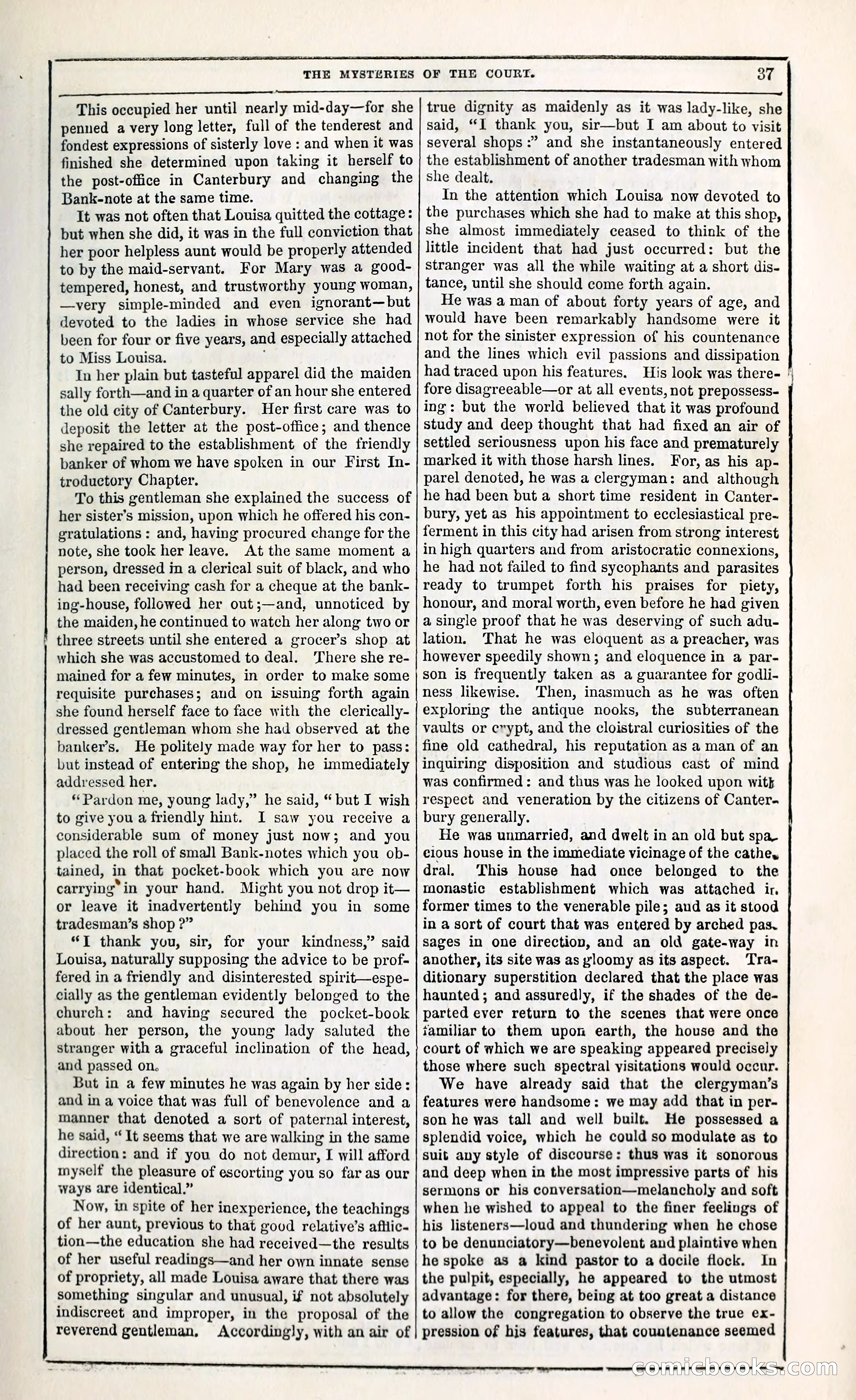
A restored page from Penny Dreadfuls, 1849. Page through the whole issue in the reader above.
📄 Transcribed text from this page (OCR, searchable)
Machine-transcribed from the original scan — historical spelling and the odd misread are preserved.
THE MYSTERIES OF THE This occupied her until nearly mid-day—for she penned a very long letter, full of the tenderest and fondest expressions of sisterly love : and when it was finished she determined upon taking it herself to the post-office in Canterbury and changing the Bank-note at the same time. It was not often that Louisa quitted the cottage: but when she did, it was in the full conviction that her poor helpless aunt would be properly attended to by the maid-servant. For Mary was a good- tempered, honest, and trustworthy young woman, —vyery simple-minded and even ignorant—but devoted to the ladies in whose service she had been for four or five years, and especially attached to Miss Louisa. In her plain but tasteful apparel did the maiden sally forth—and in a quarter of an hour she entered the old city of Canterbury. Her first care was to deposit the letter at the post-office; and thence she repaired to the establishment of the friendly banker of whom we have spoken in our First In- troductory Chapter. To this gentleman she explained the success of her sister’s mission, upon which he offered his con- eratulations : and, having procured change for the note, she took her leave. At the same moment a person, dressed m a clerical suit of black, and who had been receiving cash for a cheque at the bank- ing-house, followed her out;—and, unnoticed by the maiden, he continued to watch her along two or three streets until she entered a grocer’s shop at which she was accustomed to deal. ‘There she re- mained for a few minutes, in order to make some requisite purchases; aud on issuing forth again she found herself face to face with the clerically- dressed gentleman whom she had observed at the banker’s. He politely made way for her to pass: but instead of entering the shop, he immediately addressed her. * Pardon me, young lady,” he said, “ but I wish to give you afriendly hint. I saw you receive a considerable sum of money just now; and you placed the roll of small Bank-notes which you ob- tained, in that pocket-book which you are now carrying’in your hand. Might you not drop it— or leave it inadvertently behind you in some tradesman’s shop ?” “JT thank you, sir, for your kindness,” said Louisa, naturally supposing the advice to be prof- fered in a friendly and disinterested spirit—espe- cially as the gentleman evidently belonged to the church: and having secured the pocket-book about her person, the young lady saluted the stranger with a graceful inclination of the head, and passed on. But in a few minutes he was again by her side: and in a voice that was full of benevolence and a manner that denoted a sort of paternal interest, he said, “ It seems that we are walking in the same direction: and if you do not demur, I will afford myself the pleasure of escorting you so far as our ways are identical.” Now, in spite of her inexperience, the teachings of her aunt, previous to that good relative’s aftlic- tion—the education she had received—the results of her useful readings—and her own innate sense of propriety, all made Louisa aware that there was something singular and unusual, if not absolutely indiscreet and improper, in the proposal of the reverend gentleman, eran ee Eee Accordingly, with an air of COURT. 37 true dignity as maidenly as it was lady-like, she said, “I thank you, sir—but I am about to visit several shops :” and she instantaneously entered the establishment of another tradesman with whom she dealt. In the attention which Louisa now devoted to the purchases which she had to make at this shop, she almost immediately ceased to think of the little incident that had just occurred: but the Stranger was all the while waiting at a short dis- tance, until she should come forth again. He was a man of about forty years of age, and would have been remarkably handsome were it not for the sinister expression of his countenance and the lines which evil passions and dissipation had traced upon his features. fore disagreeable—or at all events, not prepossess- ing: but the world believed that it was profound study and deep thought that had fixed an air of settled seriousness upon his face and prematurely marked it with those harsh lines. For, as his ap- parel denoted, he was a clergyman: and although he had been but a short time resident in Canter- bury, yet as his appointment to ecclesiastical pre- ferment in this city had arisen from strong interest in high quarters and from aristocratic connexions, he had not failed to find sycophants and parasites ready to trumpet forth his praises for piety, honour, and moral worth, even before he had given a single proof that he was deserving of such adu- lation, That he was eloquent as a preacher, was however speedily shown; and eloquence in a par- son is frequently taken as a guarantee for godli- ness likewise. Then, inasmuch as he was often exploring the antique nooks, the subterranean vaults or crypt, and the cloistral curiosities of the fine old cathedral, his reputation as a man of an inquiring disposition and studious cast of mind was confirmed: and thus was he looked upon with respect and veneration by the citizens of Canter. bury generally. He was unmarried, and dwelt in an old but spa. cious house in the immediate vicinage of the cathe, dral. This house had once belonged to the monastic establishment which was attached ir. former times to the venerable pile; and as it stood in a sort of court that was entered by arched pas. Sages in one direction, and an old gate-way in another, its site was as yloomy as its aspect. ‘Tra- ditionary superstition declared that the place was haunted; and assuredly, if the shades of the de- parted ever return to the scenes that were once iamiliar to them upon earth, the house and the court of which we are speaking appeared precisely those where such spectral yisitations would occur. We have already said that the clergyman’s features were handsome: we may add that in per- son he was tall and well built. He possessed a splendid voice, which he could so modulate as to suit any style of discourse: thus was it sonorous and deep when in the most impressive parts of his sermons or his conversation—melancholy and soft when he wished to appeal to the finer feelings of his listeners—loud and thundering when he chose to be denunciatory—benevolent and plaintive when he spoke as a kind pastor to a docile flock. In the pulpit, especially, he appeared to the utmost advantage: for there, being at too great a distance to allow the congregation to observe the true ex- pression of his features, that countenance seemed His look was there- ‘| —_ ——COhMLGCOOOKS1GO