
Penny Dreadfuls, 1849 · page 371 of 394
The Mysteries of the Court of London — page 371: what you’re looking at
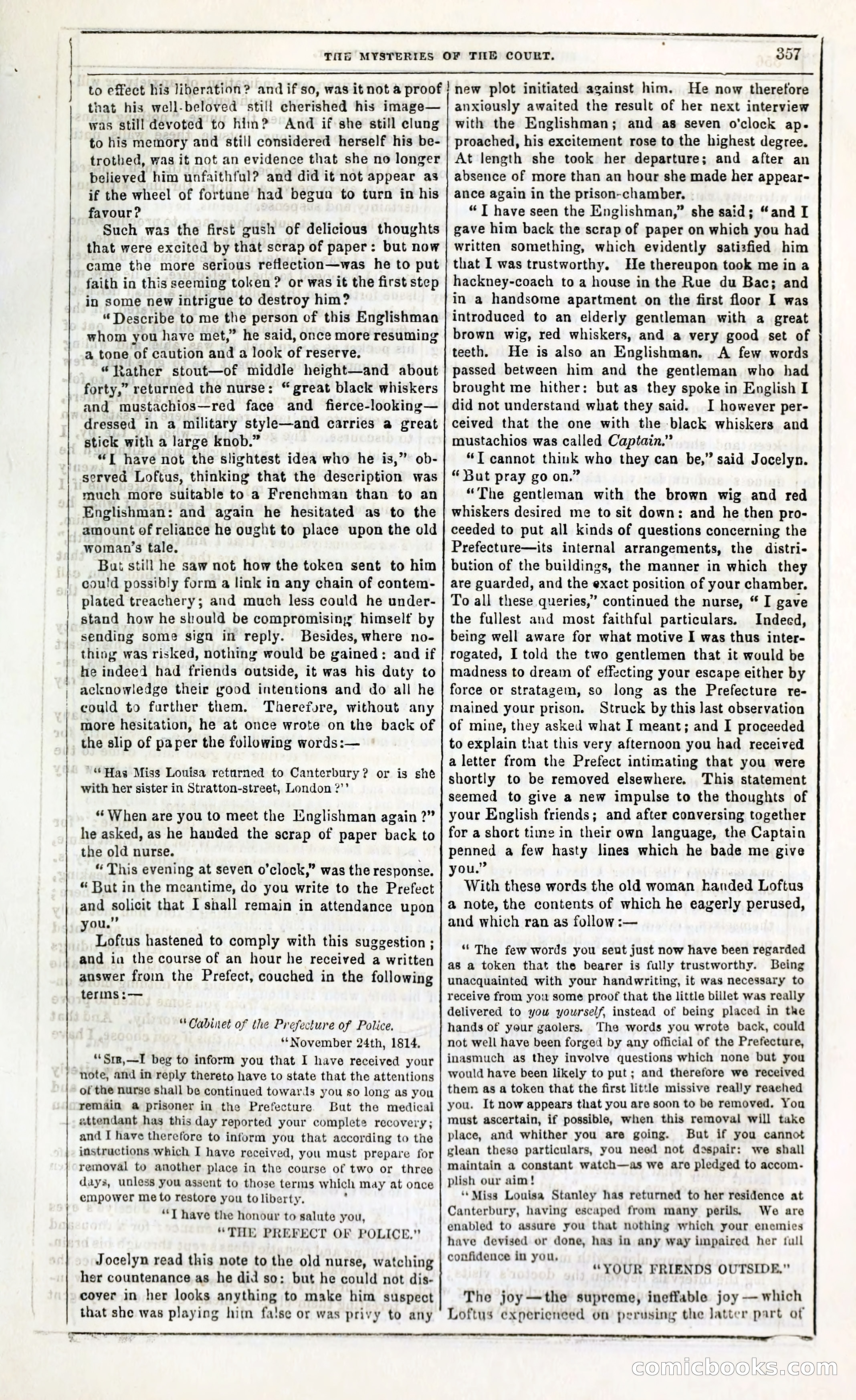
A restored page from Penny Dreadfuls, 1849. Page through the whole issue in the reader above.
📄 Transcribed text from this page (OCR, searchable)
Machine-transcribed from the original scan — historical spelling and the odd misread are preserved.
eas an see te 2 ee Renn nne ccc n ccc nc cn ccnncccecnnencccren ccc nn ccccncccccn rr nnn easing OF TILE COURT. THG MYSTERIES 307 to effect his liberation? and if so, was itnot a proof! new plot initiated against him. He now therefore that his well-beloved still cherished his image— was still devoted to him? And if she still clung to his memory and still considered herself his be- trothed, was it not an evidence that she no longer believed him unfaithful? and did it not appear as if the wheel of fortune had begun to turn in his favour? Such was the first gush of delicious thoughts that were excited by that scrap of paper: but now came the more serious reflection—was he to put faith in this seeming token ? or was it the first step in some new intrigue to destroy him? “Describe to me the person of this Englishman whom you have met,” he said, once more resuming a tone of caution and a look of reserve. “Rather stout—of middle height—and about forty,” returned the nurse: “ great black whiskers and mustachios—red face and fierce-looking— dressed in a military style—and carries a great stick with a large knob.” “T have not the slightest idea who he is,” ob- served Loftus, thinking that the description was much more suitable to a Frenchman than to an Englishman: and again he hesitated as to the amount of reliance he ought to place upon the old woman’s tale. But still he saw not how the token sent to him could possibly form a link in any chain of contem- plated treachery; and much less could he under- stand how he should be compromising himself by sending some sign in reply. Besides, where no- thing was risked, nothing would be gained: and if he indeed had friends outside, it was his duty to acknowledge their good intentions and do all he could to further them. Therefore, without any more hesitation, he at once wrote on the back of the slip of paper the following words:— “Hag Miss Louisa returned to Canterbury? or is she with her sister in Stratton-street, London ?’’ “When are you to meet the Englishman again ?” he asked, as he handed the scrap of paper back to the old nurse. “ This evening at seven o’clock,” was the response. “ But in the meantime, do you write to the Prefect and solicit that I shall remain in attendance upon you.” Loftus hastened to comply with this suggestion ; and ia the course of an hour he received a written answer from the Prefect, couched in the following terins:— “Cabinet of the Prefecture of Police. **November 24th, 1814. “‘Srr,—I beg to inform you that I have received your note, and in reply thereto have to state that the attentions of the nurse shall be continued towards you so long as you remain a prisoner in the Prefecture’ But the medical attendant has this day reported your complete recovery; and I have therefore to inform you that according to the instructions which I have received, you must prepare for removal to another place in the course of two or three days, unless you assent to those terms which may at once empower me to restore you to liberty. 7 “I have the honour to salute you, “THE PREFECT OF POLICE.” Jocelyn read this note to the old nurse, watching her countenance as he did so: but he could not dis- coyer in her looks anything to make him suspect that she was playing him fa!se or was privy to any anxiously awaited the result of her next interview with the Englishman; and as seven o'clock ap- proached, his excitement rose to the highest degree. At length she took her departure; and after an absence of more than an hour she made her appear- ance again in the prison-chamber, “ T have seen the Englishman,” she said; “and I gave him back the scrap of paper on which you had written something, which evidently satisfied him that I was trustworthy. He thereupon took me in a hackney-coach to a house in the Rue du Bac; and in a handsome apartment on the first floor I was introduced to an elderly gentleman with a great brown wig, red whiskers, and a very good set of teeth. He is also an Englishman. A few words passed between him and the gentleman who had brought me hither: but as they spoke in English I did not understand what they said. I however per- ceived that the one with the black whiskers and mustachios was called Captain.” “T cannot think who they can be,” said Jocelyn. “Dut pray go on.” “The gentleman with the brown wig and red whiskers desired me to sit down: and he then pro- ceeded to put all kinds of questions concerning the Prefecture—its internal arrangements, the distri- bution of the buildings, the manner in which they are guarded, and the exact position of your chamber. To all these queries,” continued the nurse, “ I gave the fullest aud most faithful particulars. Indeed, being well aware for what motive I was thus inter- rogated, I told the two gentlemen that it would be madness to dream of effecting your escape either by force or stratagem, so long as the Prefecture re- mained your prison. Struck by this last observation of mine, they asked what I meant; and I proceeded to explain that this very afternoon you had received a letter from the Prefect intimating that you were shortly to be removed elsewhere. This statement seemed to give a new impulse to the thoughts of your English friends; and after conversing together for a short time in their own language, the Captain penned a few hasty lines which he bade me give you.” With these words the old woman handed Loftus a note, the contents of which he eagerly perused, and which ran as follow :— ‘The few words you sent just now have been regarded as a token that the bearer is fully trustworthy. Being unacquainted with your handwriting, it was necessary to receive from you some proof that the little billet was really delivered to you yourself, instead of being placed in tke hands of your gaolers. The words you wrote back, could not well have been forged by any official of the Prefecture, inasmuch as they involve questions which none but you would have been likely to put; and therefore we received them as a token that the first little missive really reached you. It now appears that you are soon to be removed. You must ascertain, if possible, when this removal will take place, and whither you are going. But if you cannot glean these particulars, you need not despair: we shall maintain a constant watch—as we are pledged to accom- plish our aim! ‘*Miss Louisa Stanley has returned to her residence at Canterbury, having escaped from many perils, We are enabled to assure you that nothing which your enemies have devised or done, has in any way impaired her full confidence in you, “YOUR FRIENDS OUTSIDE," The joy—the supreme, ineffable joy — which Loftus expericneed on perusing the Jatter part of > ECOMICLMOOkKS (C(O)