
Penny Dreadfuls, 1849 · page 352 of 394
The Mysteries of the Court of London — page 352: what you’re looking at
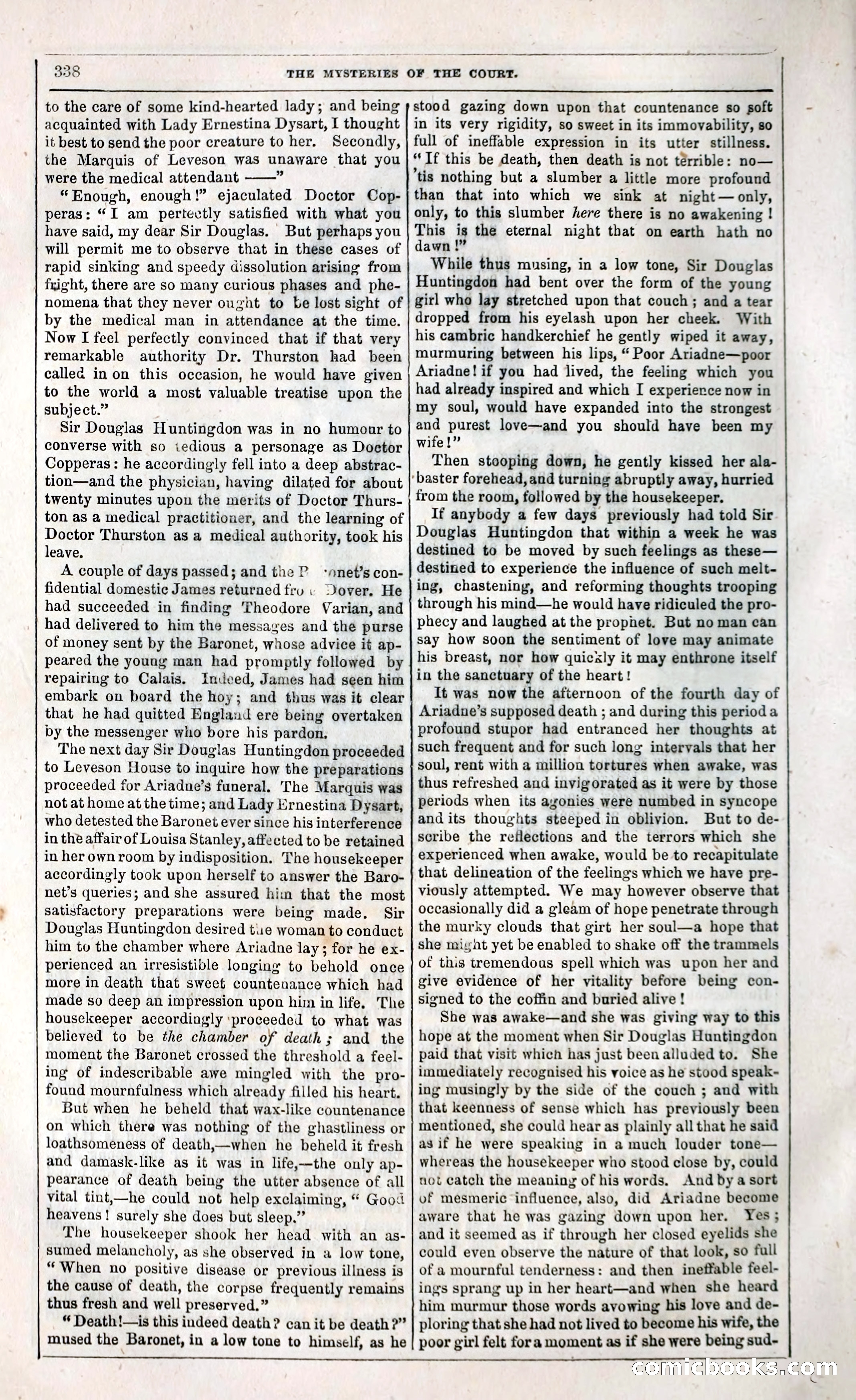
A restored page from Penny Dreadfuls, 1849. Page through the whole issue in the reader above.
📄 Transcribed text from this page (OCR, searchable)
Machine-transcribed from the original scan — historical spelling and the odd misread are preserved.
338 THE MYSTERIES OF THE COURT. ae ee eae —C — eee wer rw wren me eee eee to the care of some kind-hearted lady; and being acquainted with Lady Ernestina Dysart, I thought it best to send the poor creature to her. Secondly, the Marquis of Leveson was unaware that you were the medical attendant ———” “Enough, enough!” ejaculated Doctor Cop- peras: “I am pertectly satisfied with what you have said, my dear Sir Douglas. But perhaps you will permit me to observe that in these cases of rapid sinking and speedy dissolution arising from fright, there are so many curious phases and phe- nomena that they never ought to be lost sight of by the medical man in attendance at the time. Now I feel perfectly convinced that if that very remarkable authority Dr. Thurston had been called in on this occasion, he would have given to the world a most valuable treatise upon the subject.” Sir Douglas Huntingdon was in no humour to converse with so iedious a personage as Doctor Copperas: he accordingly fell into a deep abstrac- tion—and the physician, having dilated for about twenty minutes upon the merits of Doctor Thurs- ton as a medical practitioner, and the learning of Doctor Thurston as a medical authority, took his leave. A couple of days passed; and the P_ -nnet’s con- fidential domestic James returned fru . Dover. He had succeeded in finding Theodore Varian, and had delivered to him the messages and the purse of money sent by the Baronet, whose advice it ap- peared the young man had promptly followed by repairing to Calais. Indeed, James had seen him embark on board the hoy; and thus was it clear that he had quitted England ere being overtaken by the messenger who bore his pardon, The next day Sir Douglas Huntingdon proceeded to Leveson House to inquire how the preparations proceeded for Ariadne’s funeral. The Marquis was not at home at the time; and Lady Ernestina Dysart, who detested the Baronet ever since his interference in the affair of Louisa Stanley, affected to be retained in her own room by indisposition. The housekeeper accordingly took upon herself to answer the Baro- net’s queries; and she assured him that the most satisfactory preparations were being made. Sir Douglas Huntingdon desired tue woman to conduct him to the chamber where Ariadne lay; for he ex- perienced an irresistible longing to behold once more in death that sweet countenance which had made so deep an impression upon him in life. The housekeeper accordingly ‘proceeded to what was believed to be the chamber of death; and the moment the Baronet crossed the threshold a feel- ing of indescribable awe mingled with the pro- found mournfulness which already filled his heart. But when he beheld that wax-like countenance on which there was nothing of the ghastliness or loathsomeness of death,—when he beheld it fresh and damask.like as it was in life,—the only ap- pearance of death being the utter absence of all vital tint,—he could not help exclaiming, “ Good heavens! surely she does but sleep.” The housekeeper shook her head with an as- sumed melancholy, as she observed in a low tone, “When no positive disease or previous illness is the cause of death, the corpse frequently remains thus fresh and well preserved.” “ Death!—is this indeed death? can it be death ?” mused the Baronet, in a low tone to himself, as he stood gazing down upon that countenance so soft in its very rigidity, so sweet in its immovability, so full of ineffable expression in its utter stillness. “If this be death, then death is not térrible: no— tis nothing but a slumber a little more profound than that into which we sink at night—only, only, to this slumber here there is no awakening ! This ig the eternal night that on earth hath no dawn !” While thus musing, in a low tone, Sir Douglas Huntingdon had bent over the form of the young girl who lay stretched upon that couch; and a tear dropped from his eyelash upon her cheek. With his cambric handkerchief he gently wiped it away, murmuring between his lips, “ Poor Ariadne—poor Ariadne! if you had lived, the feeling which you had already inspired and which I experierce now in my soul, would have expanded into the strongest and purest love—and you should have been my wife!” Then stooping down, he gently kissed her ala- ‘baster forehead, and turning abruptly away, hurried from the room, followed by the housekeeper. If anybody a few days previously had told Sir Douglas Huntingdon that within a week he was destined to be moved by such feelings as these— destined to experience the influence of such melt- ing, chastening, and reforming thoughts trooping through his mind—he would have ridiculed the pro- phecy and laughed at the prophet. But no man can say how soon the sentiment of love may animate his breast, nor how quicxly it may enthrone itself in the sanctuary of the heart! It was now the afternoon of the fourth day of Ariadne’s supposed death ; and during this perioda profound stupor had entranced her thoughts at such frequent and for such lone intervals that her soul, rent with a million tortures when awake, was thus refreshed and invigorated as it were by those periods when its ayonies were numbed in syncope and its thoughts steeped in oblivion. But to de- scribe the reflections and the terrors which she experienced when awake, would be to recapitulate that delineation of the feelings which we have pre- viously attempted. We may however observe that occasionally did a gleam of hope penetrate through the murky clouds that girt her soul—a hope that she migat yet be enabled to shake off the trammels of this tremendous spell which was upon her and give evidence of her vitality before being con- signed to the coffin and buried alive! She was awake—and she was giving way to this hope at the moment when Sir Douglas Huntingdon paid that visit which has just been alluded to. She immediately recognised his yoice as he stood speak- ing musingly by the side of the couch ; and with that keenness of sense which has previously been mentioned, she could hear as plainly all that he said as if he were speaking in a much louder tone— whereas the housekeeper who stood close by, could not catch the meaning of his words. And bya sort of mesmeric influence, also, did Ariadne become aware that he was gazing down upon her. Yes; and it seemed as if through her closed eyelids she could even observe the nature of that look, so full of a mournful tenderness: and then ineffable feel- ings sprang up in her heart—and when she heard him murmur those words avowing his love and de- ploring that she had not lived to become his wife, the poor girl felt fora moment as if she were being sud- (COMMUCLIOONSS (eo)