
Penny Dreadfuls, 1849 · page 350 of 394
The Mysteries of the Court of London — page 350: what you’re looking at
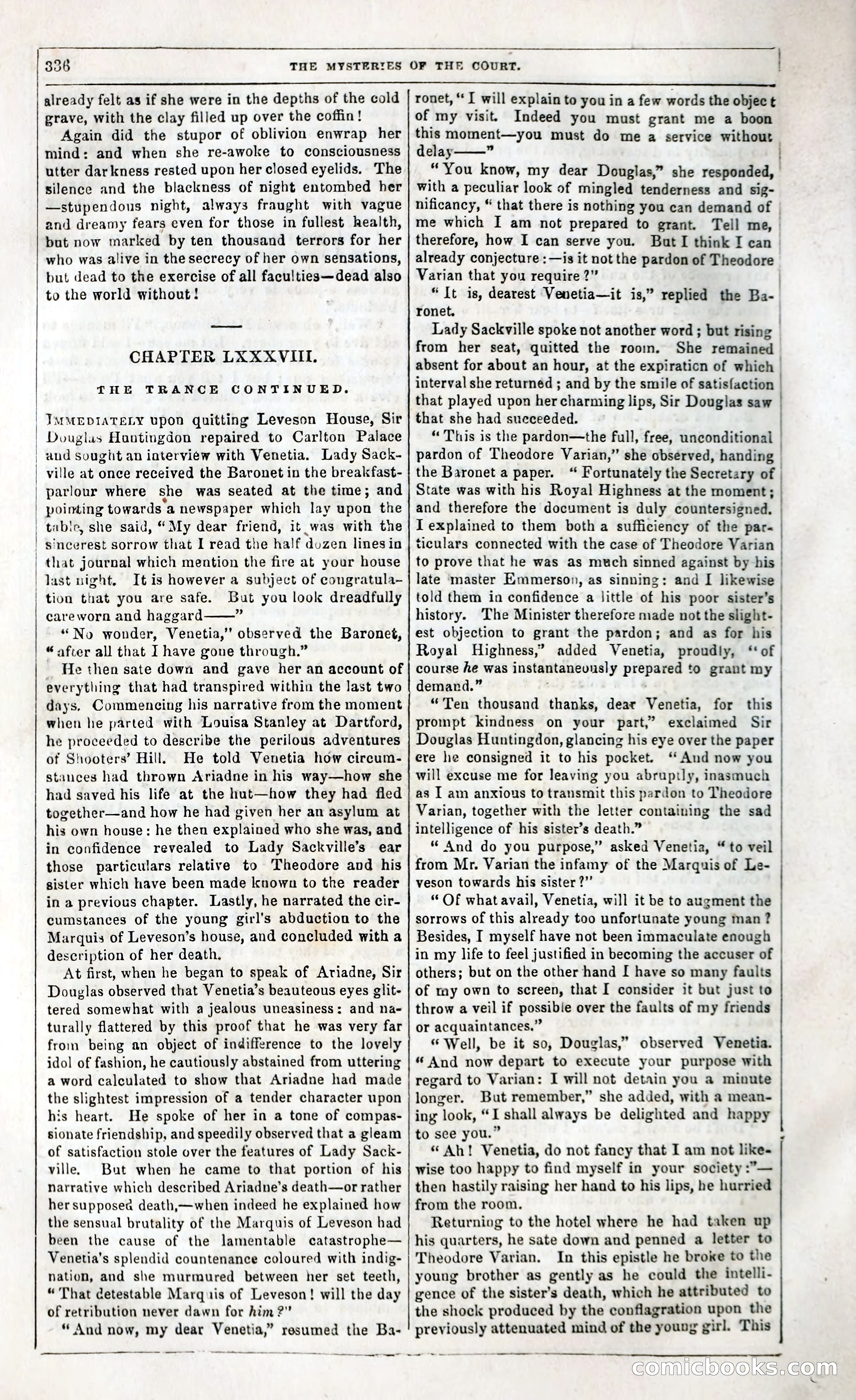
A restored page from Penny Dreadfuls, 1849. Page through the whole issue in the reader above.
📄 Transcribed text from this page (OCR, searchable)
Machine-transcribed from the original scan — historical spelling and the odd misread are preserved.
THE MYSTERIES OF THE COURT. already felt as if she were in the depths of the cold grave, with the clay filled up over the coffin! Again did the stupor of oblivion enwrap her mind: and when she re-awoke to consciousness utter darkness rested upon her closed eyelids. The silence and the blackness of night entombed her —stupendous night, always fraught with vague and dreamy fears even for those in fullest health, but now marked by ten thousand terrors for her who was alive in the secrecy of her own sensations, but dead to the exercise of all facu!ties—dead also to the world without! CHAPTER LXXXVIILI. THE TRANCE CONTINUED. YMMEDIATELY upon quitting Leveson House, Sir Douglas Hantingdon repaired to Carlton Palace and sought an interview with Venetia. Lady Sack- ville at once received the Baronet in the breakfast- parlour where she was seated at the time; and pointing towards a newspaper which lay upon the tubie, she said, “ My dear friend, it was with the sincerest sorrow that I read the half dozen linesin that journal which mention the fire at your house last night. It is however a subject of congratula- tion that you are safe. But you look dreadfully careworn and haggard o “No wonder, Venetia,’ observed the Baronet, “after all that I have gone through.” He then sate down and gave her an account of everything that had transpired within the last two days. Commencing his narrative from the moment when he parted with Louisa Stanley at Dartford, he proceeded to describe the perilous adventures of Shooters’ Hill. He told Venetia how circum- stances had thrown Ariadne in his way—how she had saved his life at the hut—how they had fled together—and how he had given her an asylum at his own house: he theu explained who she was, and in confidence revealed to Lady Sackville’s ear those particulars relative to Theodore and his sister which have been made known to the reader in a previous chapter. Lastly, he narrated the cir- cumstances of the young girl’s abduction to the Marquis of Leveson’s house, and concluded with a description of her death. At first, when he began to speak of Ariadne, Sir Douglas observed that Venetia’s beauteous eyes glit- tered somewhat with a jealous uneasiness: and na- turally flattered by this proof that he was very far from being an object of indifference to the lovely idol of fashion, he cautiously abstained from uttering a word calculated to show that Ariadne had made the slightest impression of a tender character upon his heart. He spoke of her in a tone of compas- sionate friendship, and speedily observed that a gleam of satisfaction stole over the features of Lady Sack- ville. But when he came to that portion of his narrative which described Ariadne’s death—or rather her supposea death,—when indeed he explained how the sensual brutality of the Marquis of Leveson had been the cause of the lamentable catastrophe— Venetia’s splendid countenance coloured with indig- nation, and she murmured between her set teeth, “That detestable Marquis of Leveson! will the day of retribution never dawn for him?" * And now, my dear Venetia,” resumed the Ba- ~~ ee a a - SS Se ~— ronet, “I will explain to you in a few words the object of my visit. Indeed you must grant me a boon this moment—you must do me a service without delay———” “You know, my dear Douglas,” she responded, with a peculiar look of mingled tenderness and sig- nificancy, “ that there is nothing you can demand of me which I am not prepared to grant. Tell me, therefore, how I can serve you. But I think I can already conjecture : —is it not the pardon of Theodore Varian that you require ?” ’ “It is, dearest Venetia—it is,” replied the Ba- ronet. Lady Sackville spoke not another word ; but rising from her seat, quitted the room. She remained absent for about an hour, at the expiration of which interval she returned ; and by the smile of satisfaction that played upon her charniing lips, Sir Douglas saw that she had succeeded. “This is the pardon—the full, free, unconditional pardon of Theodore Varian,” she obsérved, handing the Baronet a paper. “ Fortunately the Secretary of State was with his Royal Highness at the moment; and therefore the document is duly countersigned, I explained to them both a sufficiency of the par- ticulars connected with the case of Theodore Varian to prove that he was as much sinned against by his late ‘master Emmerson, as sinning: and I likewise told them in confidence a little of his poor sister’s history. The Minister therefore made not the slight- est objection to grant the pardon; and as for his Royal Highness,” added Venetia, proudly, ‘of course he was instantaneuusly prepared to grant my demand.” “Ten thousand thanks, deat Venetia, for this prompt kindness on your part,” exclaimed Sir Douglas Huntingdon, glancing his eye over the paper ere he consigned it to his pocket. ‘Aud now you will excuse me for leaving you abruptly, inasmuch as I am anxious to transmit this pardon to Theodore Varian, together with the letter containing the sad intelligence of his sister’s death.” “ And do you purpose,” asked Venetia, “ to veil from Mr. Varian the infamy of the Marquis of Le- veson towards his sister ?”’ “ Of what avail, Venetia, will it be to augment the sorrows of this already too unfortunate young man? Besides, I myself have not been immaculate enough in my life to feel justified in becoming the accuser of others; but on the other hand [ have so many faults of my own to screen, that I consider it but just to throw a veil if possible over the faults of my friends or acquaintances,” “ Well, be it so, Douglas,” observed Venetia. ‘“ And now depart to execute your purpose with regard to Varian: I will not detain you a minute longer. But remember,” she added, with a mean- ing look, “I shall always be delighted and happy to see you.” ‘Ah! Venetia, do not fancy that I am not like- wise too happy to find myself in your society :”"— then hastily raising her hand to his lips, he hurried from the room. Returniog to the hotel where he had taken up his quarters, he sate down and penned a letter to Theodore Varian. In this epistle he broke to the young brother as gently as he could the intelli- gence of the sister’s death, which he attributed to the shock produced by the conflagration upon the previously attenuated mind of the young girl. This —_— ee : a iN wee eee — ——— —_——-—- GOmiGcsdoo (C Ss) (E(0)