
Penny Dreadfuls, 1849 · page 347 of 394
The Mysteries of the Court of London — page 347: what you’re looking at
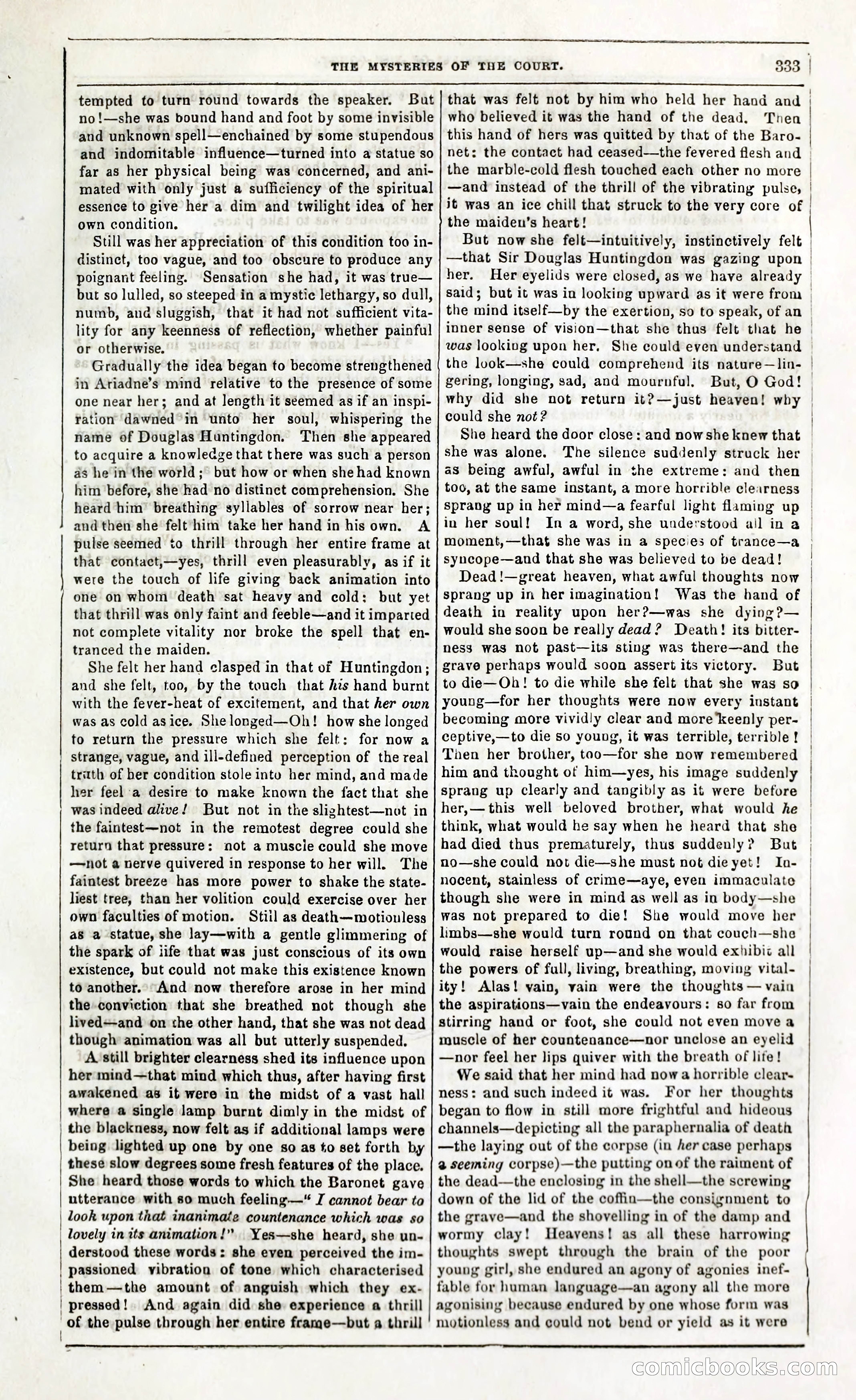
A restored page from Penny Dreadfuls, 1849. Page through the whole issue in the reader above.
📄 Transcribed text from this page (OCR, searchable)
Machine-transcribed from the original scan — historical spelling and the odd misread are preserved.
THE MYSTERIES OF THE COURT. 933, | tempted to turn round towards the speaker. But no!—she was bound hand and foot by some invisible and unknown spell—enchained by some stupendous and indomitable influence—turned into a statue so far as her physical being was concerned, and ani- mated with only just a sufficiency of the spiritual essence to give her a dim and twilight idea of her own condition. Still was her appreciation of this condition too in- distinct, too vague, and too obscure to produce any poignant feeling. Sensation she had, it was true— but so lulled, so steeped in a mystic lethargy, so dull, numb, and sluggish, that it had not sufficient vita- lity for any keenness of reflection, whether painful! or otherwise. Gradually the idea began to become strengthened in Ariadne’s mind relative to the presence of some one near her; and at length it seemed as if an inspi- ration dawned in unto her soul, whispering the name of Douglas Huntingdon. Then she appeared to acquire a knowledge that there was such a person as he in the world; but how or when she had known him before, she had no distinct comprehension. She heard him’ breathing syliables of sorrow near her; and then she felt him take her hand in his own. A pulse seemed to thrill through her entire frame at that contact,—yes, thrill even pleasurably, as if it were the touch of life giving back animation into one on whom death sat heavy and cold: but yet that thrill was only faint and feeble—and it imparted not complete vitality nor broke the spell that en- tranced the maiden. She felt her hand clasped in that of Huntingdon; and she felt, too, by the touch that his hand burnt with the fever-heat of excitement, and that her own was as cold asice. She longed—Oh! how she longed to return the pressure which she felt: for now a strange, vague, and ill-defined perception of the real trath of ber condition stole intu her mind, and made her feel a desire to make known the fact that she was indeed alive! But not in the slightest—not in the faintest—not in the remotest degree could she return that pressure: not a muscie could she move —not @ nerve quivered in response to her will. The faintest breeze has more power to shake the state- liest tree, than her volition could exercise over her own faculties of motion. Stiil as death—motiouless as a statue, she lay—with a gentle glimmering of the spark of iife that was just conscious of its own existence, but could not make this existence known to another. And now therefore arose in her mind the conviction that she breathed not though she livedand on the other hand, that she was not dead though animation was all but utterly suspended. A still brighter clearness shed its influence upon her mind—that mind which thus, after having first awakened as it were in the midst of a vast hall where a single lamp burnt dimly in the midst of | the blackness, now felt as if additional lamps were being lighted up one by one so as to set forth by | these slow degrees some fresh features of the place. She heard those words to which the Baronet gave utterance with so much feeling—" J cannot bear to | look upon that inanimate countenance which was so lovely in its animation!” Yes—she heard, she un- derstood these words: she even perceived the im- passioned vibration of tone which characterised | them—the amount of anguish which they ex- | pressed! And again did she experience a thrill ! of the pulse through her entire frame—but a thrill KS A IS - that was felt not by him who held her hand and | who believed it was the hand of the dead. Then this hand of hers was quitted by that of the Baro- | net: the contact had ceased—the fevered flesh and the marble-cold flesh touched each other no more | —and instead of the thrill of the vibrating pulse, | ijt was an ice chill that struck to the very core of | the maideu’s heart! | But now she felt—intuitively, instinctively felt | —that Sir Douglas Huntingdon was gazing upon | her. Her eyelids were closed, as we have already © said; but it was in looking upward as it were from the mind itself—by the exertion, so to speak, of an | inner sense of vision—that she thus felt that he | was looking upon her. She could even understand the look—she could comprehend its nature—lin- gering, longing, sad, and mournful. But, O God! why did she not return it?—just heaven! why could she not? She heard the door close: and now she knew that — she was alone. The silence suddenly struck her | aS being awful, awful in the extreme: and then | too, at the same instant, a more horrible clearness sprang up in her mind—a fearful light flaming up | in her soul! In a word, she understood all in a moment,—that she was in a species of trance—a syncope—and that she was believed to be dead! Dead !—great heaven, what awful thoughts now sprang up in her imagination! Was the hand of death in reality upon her?—was she dying ?— would she soon be really dead? Death! its bitter- ness was not past—its sting was there—and the grave perhaps would soon assert its victory. But to die—Onh! to die while she felt that she was so young—for her thoughts were now every instant becoming more vividly clear and more keenly per- ceptive,—to die so young, it was terrible, terrible ! Toen her brother, too—for she now remembered him and thought of him—yes, his image suddenly sprang up clearly and tangibly as it were before her,—this well beloved brother, what would he think, what would he say when he heard that she had died thus prematurely, thus suddenly? But | no—she could not die—she must not die yet! In- | nocent, stainless of crime—aye, even immaculate though she were in mind as well as in body—she was not prepared to die! She would move her | limbs—she would turn round on that couch—she would raise herself up—and she would exhibis all | the powers of fall, living, breathing, moving vital- | ity! Alas! vain, vain were the thoughts—vain | the aspirations—vain the endeavours: so far from stirring hand or foot, she could not even move a muscle of her countenance—nor unclose an eyelid —nor feel her lips quiver with the breath of life! We said that her mind had nowa horrible clear- ness: and such indeed it was. For her thoughts began to flow in still more frightful and hideous channels—depicting all the paraphernalia of death —the laying out of the corpse (in her case perhaps @ seeming corpse)—the putting onof the raiment of the dead—the enclosing in the shell—the screwing down of the lid of the coffin—the consignment to the grave—and the shovelling in of the damp and wormy clay! Heavens! as all these harrowing thoughts swept through the brain of the poor young girl, she endured an agony of agonies inef- fable for human language—an agony all the more agonising because endured by one whose form was motionless and could not bend or yield as it were GomiGsvooksteo