
Penny Dreadfuls, 1849 · page 344 of 394
The Mysteries of the Court of London — page 344: what you’re looking at
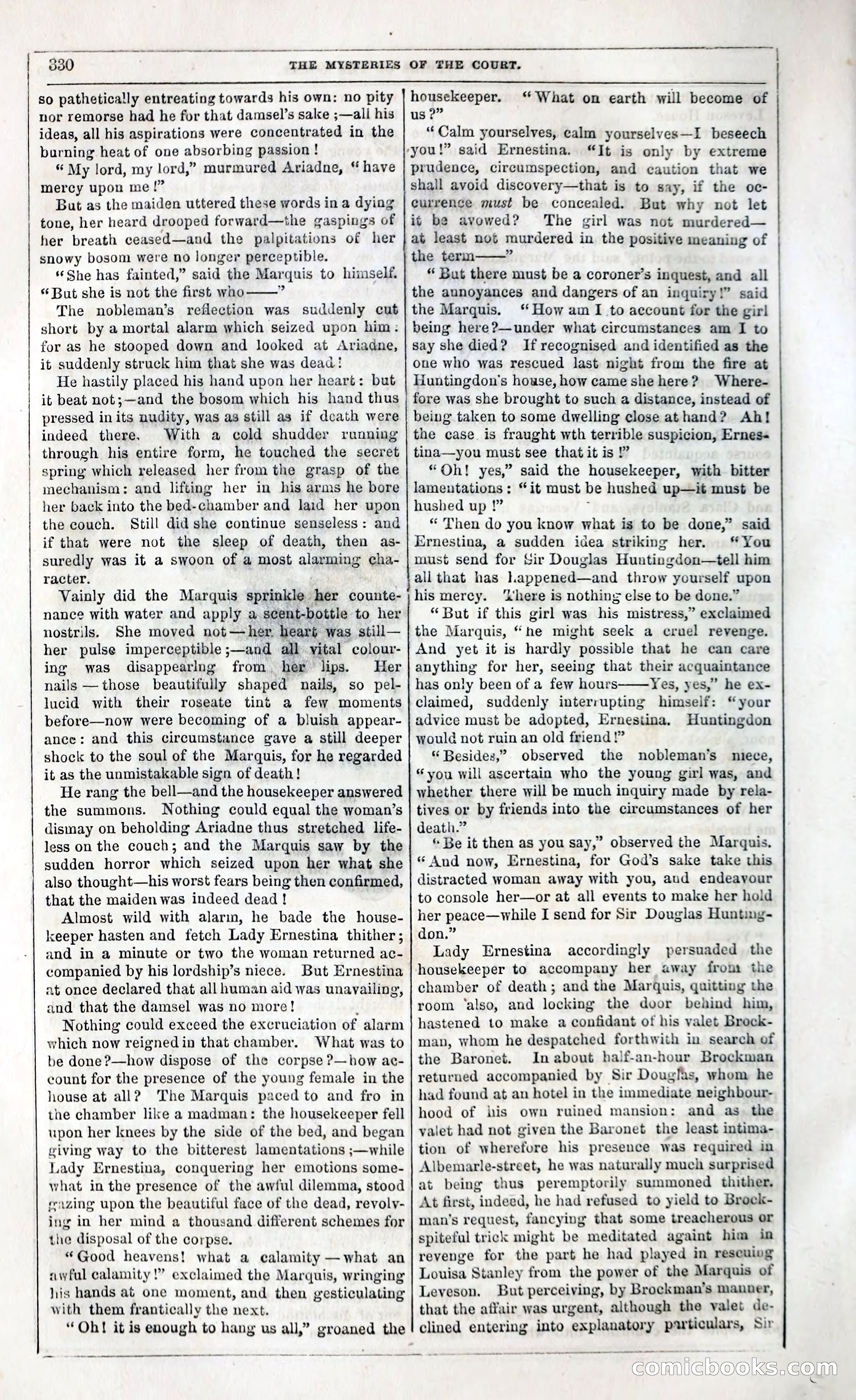
A restored page from Penny Dreadfuls, 1849. Page through the whole issue in the reader above.
📄 Transcribed text from this page (OCR, searchable)
Machine-transcribed from the original scan — historical spelling and the odd misread are preserved.
a 030 ——— tt i LL LO ELL LL LLL: A LAL LLL LLL LLL LLL LLL THE MYSTERIES OF THE COURT, so pathetically entreating towards his own: no pity nor remorse had he for that damsel’s sake ;—all his ideas, all his aspirations were concentrated in the burning heat of one absorbing passion ! “ My lord, my lord,” murmured Ariadne, “ have mercy upon me!” But as the maiden uttered these words ina dying tone, her heard drooped forward—the gaspings of her breath ceased—and the palpitations of her snowy bosom were no longer perceptible. ‘She has fainted,” said the Marquis to himself. “But she is not the first who , The nobleman’s reflection was suddenly cut short by a mortal alarm which seized upon him: for as he stooped down and looked at Ariadne, it suddenly struck him that she was dead! He hastily placed his hand upon her heart: but it beat not;—and the bosom which his hand thus pressed in its nudity, was as still as if death were indeed there, With a cold shudder running through his entire form, he touched the secret spring which released her from the grasp of the mechanism: and lifting her in his arms he bore her back into the bed-chamber and laid her upon the couch. Still did she continue senseless: and if that were not the sleep of death, then as- suredly was it a swoon of a most alarming cha- racter. Vainly did the Marquis sprinkle her counte- nanee with water and apply a scent-bottle to her nostrils. She moved not—heér hears was still— her pulse imperceptible ;—and all vital colour- ing was disappearlng from, her lips. Her nails —those beautifully shaped nails, so pel- lucid with their roseate tint a few moments before—now were becoming of a bluish appear- ance: and this circumstance gave a still deeper shock to the soul of the Marquis, for he regarded it as the unmistakable sign of death! He rang the bell—and the housekeeper answered the summons. Nothing could equal the woman’s dismay on beholding Ariadne thus stretched life- less on the couch; and the Marquis saw by the sudden horror which seized upon her what she also thought—his worst fears being then confirmed, that the maiden was indeed dead ! Almost wild with alarin, he bade the house- keeper hasten and fetch Lady Ernestina thither; and in a minute or two the woman returned ac- companied by his lordship’s niece. But Ernestina at once declared that all human aid was unavailing, and that the damsel was no more! Nothing could exceed the excruciation of alarm which now reignedin that chamber. What was to be done ?—how dispose of the corpse ?—how ac- count for the presence of the young female in the house at all? The Marquis paced to and fro in the chamber like a madman: the housekeeper fell upon her knees by the side of the bed, and began giving way to the bitterest lamentations ;—while Lady Ernestina, conquering her emotions some- what in the presence of the awful dilemma, stood crazing upon the beautiful face of the dead, revolvy- ing in her mind a thousand different schemes for the disposal of the corpse. “Good heavens! what a calamity —what an awful calamity!” exclaimed the Marquis, wringing his hands at one moment, and then gesticulating with them frantically the next. “Ohl! it is enough to hang us all,” groaned the housekeeper. us 2?” “Calm yourselves, calm yourselves—I beseech you!” said Ernestina. “It is only by extreme prudence, circumspection, and caution that we shall avoid discovery—that is to say, if the oc- currence must be concealed. But why not let ig be avowed? The girl was not murdered— at least not murdered in the positive meaning of the term——” “ But there must be a coroner’s inquest, and all the aunoyances and dangers of an inquiry!” said the Marquis. “How am I to account for the girl being here?—under what circumstances am I to say she died? If recognised and identified as the one who was rescued last night from the fire at Huntingdon’s house, how came she here? Where- fore was she brought to such a distance, instead of being taken to some dwelling close athand? Ah! the case is fraught wth terrible suspicion, Ernes- tina—you must see thatit is !” “Oh! yes,” said the housekeeper, with bitter lamentations: “it must be hushed up—it must be hushed up !” “Then do you know what is to be done,” said Ernestina, a sudden idea striking her. You must send for Sir Douglas Huntingdon—tell him all that has Lappened—and throw yourself upon his mercy. ‘here is nothing else to be done.” “But if this girl was his mistress,” exclaimed the Marquis, “he might seek a cruel revenge. And yet it is hardly possible that he can care anything for her, seeing that their acquaintance has only been of a few hours——Yes, yes,” he ex- claimed, suddenly interrupting himself: “your advice must be adopted, Ernestina. Huntingdon would not ruin an old friend!” “ Besides,” observed the nobleman’s niece, “you will ascertain who the young girl was, and whether there will be much inquiry made by rela- tives or by friends into the circumstances of her death.” « Be it then as you say,” observed the Marguis. “And now, Ernestina, for God’s sake take this distracted woman away with you, aud endeavour to console her—or at all events to make her hold her peace—while I send for Sir Douglas Huntimg- don.” Lady Ernestina accordingly persuaded the housekeeper to accompany her away from the chamber of death; and the Marquis, quitting the room ‘also, and locking the door behind him, hastened to make a confidant of his valet Brock- man, whom he despatched forthwith in search of the Baronet. In about half-an-hour Brockman returned accompanied by Sir Douglas, whom he had found at an hotel in the immediate neighbour- hood of his own ruined mansion: and as. the valet had not given the Baronet the least intima- tion of wherefore his presence was required in Albemarle-street, he was naturally much surprised at being thus peremptorily summoned thither. At first, indeed, he had refused to yield to Brock- man’s request, fancying that some treacherous or spiteful trick might be meditated againt him in revenge for the part he had play ed in rescuing Louisa Stanley from the power of the Marquis of Leveson. But perceiving, by Brockman’s manner, that the affair was urgent, although the valet de- clined entering into explanatory particulars, Sir ‘“ What on earth will become of | com (C VOOLKS ()