
Penny Dreadfuls, 1849 · page 332 of 394
The Mysteries of the Court of London — page 332: what you’re looking at
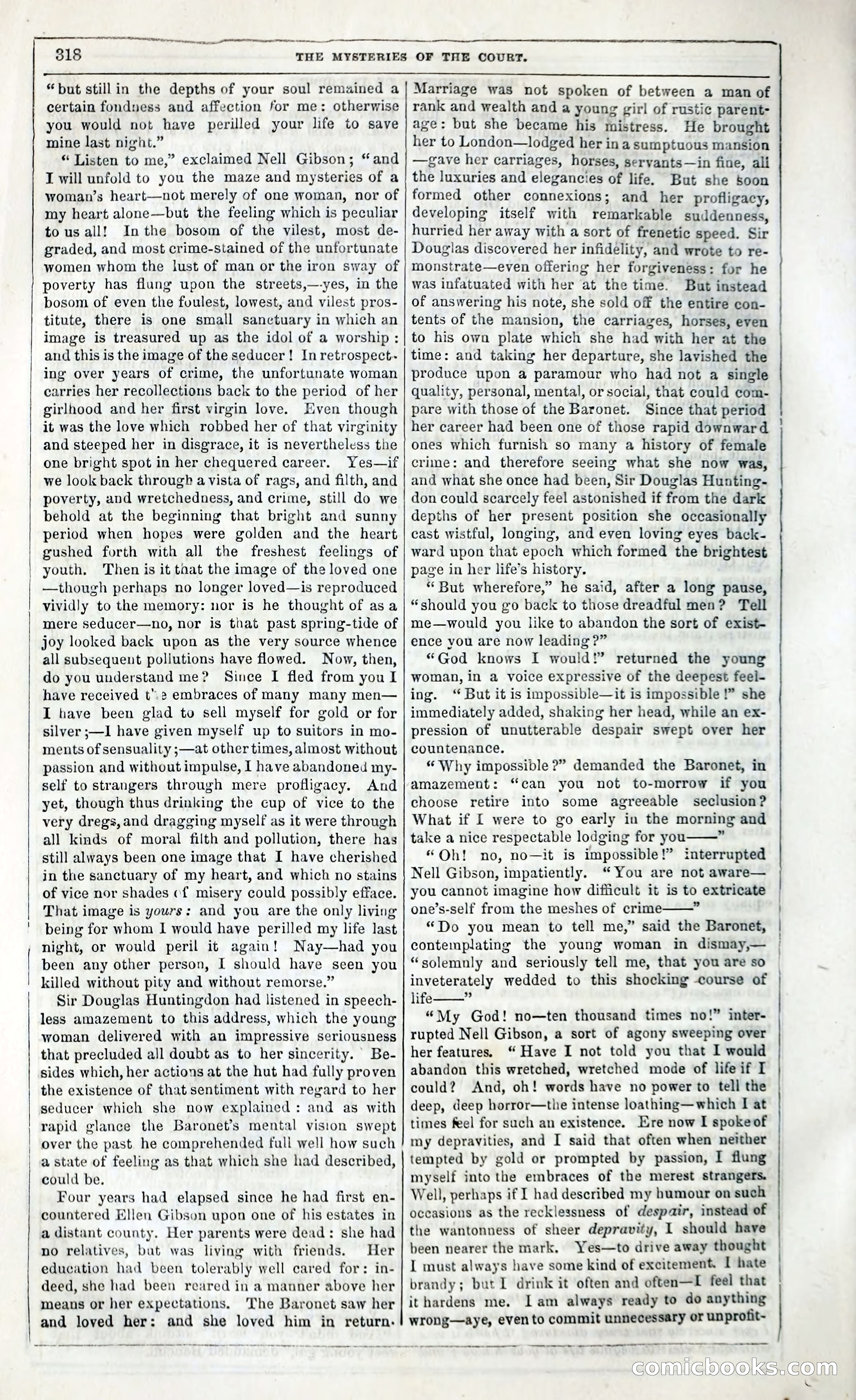
A restored page from Penny Dreadfuls, 1849. Page through the whole issue in the reader above.
📄 Transcribed text from this page (OCR, searchable)
Machine-transcribed from the original scan — historical spelling and the odd misread are preserved.
ee a er ee ———. 518 THE MYSTERIES OF THE COURT. “but stillin the depths of your soul remained a certain fondness and affection for me: otherwise you would not have perilled your life to save mine last night.” “ Listen to me,” exclaimed Nell Gibson; “and I will unfold to you the maze and mysteries of a woman’s heart—not merely of one woman, nor of my heart alone—but the feeling which is peculiar to us all! Inthe bosom of the vilest, most de- graded, and most crime-stained of the unfortunate women whom the lust of man or the iron sway of poverty has flung upon the streets,—-yes, in the bosom of even the foulest, lowest, and vilest pros- titute, there is one small sanctuary in which an image is treasured up as the idol of a worship: and this is the image of the seducer! In retrospect~ ing over years of crime, the unfortunate woman carries her recollections back to the period of her girlhood and her first virgin love. Even though it was the love which robbed her of that virginity and steeped her in disgrace, it is nevertheless the one bright spot in her chequered career. Yes—if we look back through a vista of rags, and filth, and poverty, and wretchedness, and crime, still do we behold at the beginning that bright and sunny period when hopes were golden and the heart gushed forth with all the freshest feelings of youth, Then is it taat the image of the loved one —though perhaps no longer loved—is reproduced vividly to the memory: nor is he thought of asa mere seducer—no, nor is that past spring-tide of joy looked back upon as the very source whence all subsequent pollutions have flowed. Now, then, do you understand me? Since I fled from you I have received t'.2 embraces of many many men— I have been glad to sell myself for gold or for silver ;—I1 have given myself up to suitors in mo- ments of sensuality ;—at other times, almost without passion and without impulse, I have abandoned my- self to strangers through mere profligacy. And yet, though thus drinking the cup of vice to the very dregs,and dragging myself as it were through all kinds of moral filth and pollution, there has still always been one image that I have cherished in the sanctuary of my heart, and which no stains of vice nor shades ¢f misery could possibly efface. That image is yours: and you are the only living being for whom I would have perilled my life last night, or would peril it again! Nay—had you been any other person, I should have seen you killed without pity and without remorse.” Sir Douglas Huntingdon had listened in speech- less amazement to this address, which the young woman delivered with an impressive seriousness that precluded all doubt as to her sincerity. Be- sides which, her actions at the hut had fully proven the existence of that sentiment with regard to her seducer which she now explained: and as with rapid glance the Baronet’s mental vision swept over the past. he comprehended full well how such a state of feeling as that which she had described, could be. Four years had elapsed since he had first en- countered Ellen Gibson upon one of his estates in a distant county. Her parents were dead: she had no relatives, but was living with friends. Her education had been tolerably well cared for: in- deed, she had been reared in a manner above her means or her expectations. The Baronet saw her and loved her: and she loved him in return. mee ee eee --_—- SS SE St ESTES we 5 ee o6 oe wee +. we ee ee Marriage was not spoken of between a man of rank and wealth and a young girl of rustic parent- age: but she became his mistress. He brought her to London—lodged her in a sumptuous mansion —gave her carriages, horses, seryants—in fine, ali the luxuries and elegancies of life. But she soon formed other connexions; and her profligacy, developing itself with remarkable suddenness, hurried her away with a sort of frenetic speed. Sir Douglas discovered her infidelity, and wrote to re- monstrate—even offering her forgiveness: for he was infatuated with her at the time. But instead of answering his note, she sold off the entire con- tents of the mansion, the carriages, horses, even to his own plate which she had with her at the time: and taking her departure, she lavished the produce upon a paramour who had not a single quality, personal, mental, or social, that could com- pare with those of the Baronet. Since that period her career had been one of those rapid downward ones which furnish so many a history of female crime: and therefore seeing what she now was, and what she once had been, Sir Douglas Hunting- don could searcely feel astonished if from the dark depths of her present position she occasionally cast wistful, longing, and even loving eyes back- ward upon that epoch which formed the brightest page in her life’s history. “But wherefore,” he said, after a long pause, “should you go back to those dreadful men? Tell me—would you like to abandon the sort of exist- ence vou are now leading ?” “God knows I would!” returned the young woman, in a voice expressive of the deepest feel- ing. ‘ But it is impossible—it is impossible !” she immediately added, shaking her head, while an ex- pression of unutterable despair swept over her countenance. “ Why impossible ?” demanded the Baronet, in amazement: “can you not to-morrow if you choose retire into some agreeable seclusion? What if I were to go early in the morning and take a nice respectable lodging for you——” “Oh! no, no—it is impossible!” interrupted Nell Gibson, impatiently. “ You are not aware— you cannot imagine how difficult it is to extricate one’s-self from the meshes of crime e “Do you mean to tell me,” said the Baronet, contemplating the young woman in dismay,— “solemnly and seriously tell me, that you are so inveterately wedded to this shocking -course of life-——” “My God! no—ten thousand times no!” inter- rupted Nell Gibson, a sort of agony sweeping over her features. “ Have I not told you that I would abandon this wretched, wretched mode of life if I could? And, oh! words have no power to tell the deep, deep horror—the intense loathing—which I at times feel for such an existence. Ere now I spokeof my depravities, and I said that often when neither tempted by gold or prompted by passion, I flung myself into the embraces of the merest strangers. Well, perhaps if I had described my humour on such occasions as the recklessness of despair, instead of the wantonness of sheer depravity, I should have been nearer the mark. Yes—to drive away thought I must always have some kind of excitement. I hate brandy; but I drink it often and often—I feel that it hardens me. Iam always ready to do anything wrong—aye, even to commit unnecessary or unprofit- ——— ee eee oe ee ee eee ee SE = CORNICLOO® Ss (€()