
Penny Dreadfuls, 1849 · page 32 of 394
The Mysteries of the Court of London — page 32: what you’re looking at
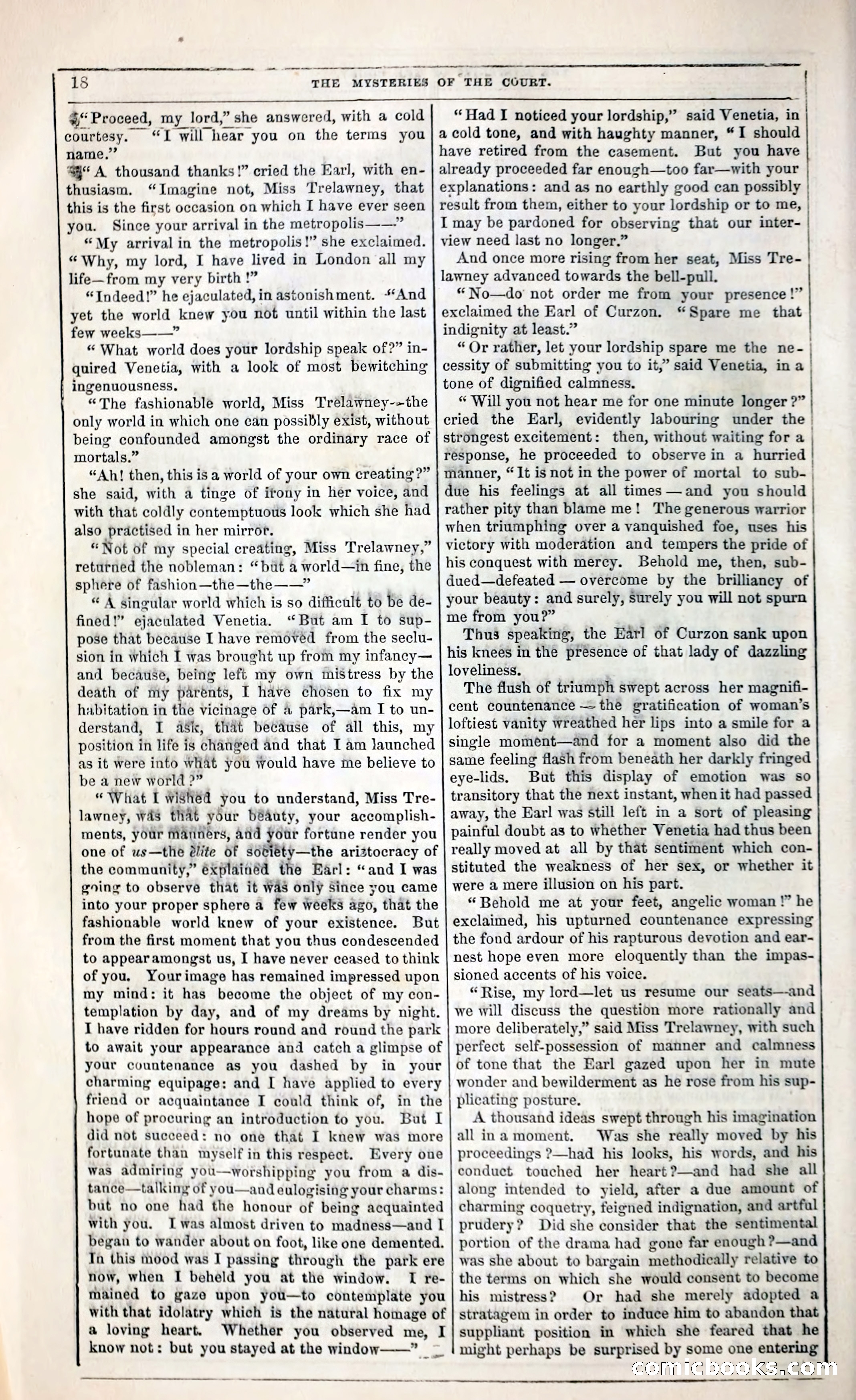
A restored page from Penny Dreadfuls, 1849. Page through the whole issue in the reader above.
📄 Transcribed text from this page (OCR, searchable)
Machine-transcribed from the original scan — historical spelling and the odd misread are preserved.
Altay — owas ene ewe ee ewes oe ee 15 % Proceed, my lord,” she answered, with a cold courtesy. “I will hear you on the terms you name,” $4 A thousand thanks!” cried the Earl, with en- thusiasm. “Imagine not, Miss Trelawney, that this is the first occasion on which I have ever seen you. Since your arrival in the metropolis——” “ My arrival in the metropolis!” she exclaimed. “Why, my lord, I have lived in London all my life—from my very birth !” “Indeed!” he ejaculated, in astonishment. ‘And yet the world knew you not until within the last few weeks——” “ What world does your lordship speak of?” in- quired Venetia, with a look of most bewitching ingenuousness, “The fashionable world, Miss Trélawney-~the only world in which one can possibly exist, without being confounded amongst the ordinary race of mortals.” “Ah! then, this is a world of your own creating?” she said, with a tinge of itony in her voice, and with that coldly contemptuous look which she had also practised in her mirror. “Not of my special creating, Miss Trelawney,” returned the nobleman: “but a world—in fine, the sphere of fashion—the—the——” « A singular world which is so difficult to be de- fined!” ejaculated Venetia. “But am I to sup- pose that because I have removed from the seclu- sion in which I was brought up from my infancy— and because, being left my own mistress by the death of my parents, I have chosen to fix my habitation in the vicinage of 4 park,—am I to un- derstand, I asic, that because of all this, my position in life is changed and that I am launched as it were into what you would have me believe to be a new world ?” “What [ wished you to understand, Miss Tre- lawney, W48 that your beauty, your accomplish- ments, your mariners, and your fortune render you one of us—the elite of sotiéty—the ariztocracy of the community,” éxplainéd the Earl: “and I was going to observe that it was only Since you came into your proper sphere a few weeks ago, that the fashionable world knew of your existence. But from the first moment that you thus condescended to appearamongst us, I have never ceased to think of you. Yourimage has remained impressed upon my mind: it has become the object of my con- templation by day, and of my dreams by night. I have ridden for hours round and round the park to await your appearance and catch a glimpse of your countenance as you dashed by in your charming equipage: and I have applied to every friend or acquaintance I could think of, in the hope of procuring an introduction to you. But I did not succeed: no one that I knew was more fortunate than myself in this respect. Every one was admiring you—worshipping you from a dis- tance—talking of you—and eulogising your charms: but no one had the honour of being acquainted with you. Iwas almost driven to madness—and I began to wander about on foot, like one demented. Tn this mood was I passing through the park ere now, when I beheld you at the window. I re- mained to gaze upon you—to contemplate you with that idolatry which is the natural homage of a loving heart. Whether you observed me, I know not: but you stayed at the window——” - _ ae —eC te eee exclaimed the Earl of Curzon. indignity at least.” cried the Earl, evidently labouring under the | strongest excitement: then, without waiting for a | might perhaps be surprised by THE MYSTERIES OF THE COURT. “Had I noticed your lordship,” said Venetia, in ; ‘ a cold tone, and with haughty manner, “I should have retired from the casement. already proceeded far enough—too far—with your explanations: and as no earthly good can possibly result from them, either to your lordship or to me, I may be pardoned for observing that our inter- view need last no longer.” But you have And once more rising from her seat, Miss Tre- | lawney advanced towards the bell-pull. * No—do not order me from your presence!” “Spare me that “ Or rather, let your lordship spare me the ne- | cessity of submitting you to it,’ said Venetia, ina tone of dignified calmness. “ Will you not hear me for one minute longer ?” response, he proceeded to observe in a hurried manner, “It is not in the power of mortal to sub- | due his feelings at all times—and you should rather pity than blame me! The generous warrior when triumphing over a vanquished foe, uses his victory with moderation and tempers the pride of his conquest with mercy. Behold me, then, sub- dued—defeated — overcome by the brillianey of your beauty: and surely, surely you will not spurn me from you?” Thus speaking, the Earl of Curzon sank upon his knees in the présence of that lady of dazzling loveliness. The flush of triumph swept across her magnifi- cent countenance — the gratification of woman’s loftiest vanity wreathed her lips into a smile for a single moment—and for a moment also did the same feeling flash from beneath her darkly fringed eye-lids. transitory that the next instant, when it had passed away, the Earl was still left in a sort of pleasing painful doubt as to whether Venetia had thus been really moved at all by that sentiment which con- stituted the weakness of her sex, or whether it were a mere illusion on his part. But this display of emotion was so “Behold me at your feet, angelic woman !” he exclaimed, his upturned countenance expressing the fond ardour of his rapturous devotion and ear- nest hope even more eloquently than the impas- sioned accents of his voice. “Rise, my lord—let us resume our seats—and we will discuss the question more rationally and more deliberately,” said Miss Trelawney, with such perfect self-possession of manner and calmness of tone that the Earl gazed upon her in mute wonder and bewilderment as he rose from his sup- plicating posture. A thousand ideas swept through his imagination all ina moment. Was she really moved by his proceedings ?—had his looks, his words, and his conduct touched her heart ?—and had she all along intended to yield, after a due amount of charming coquetry, feigned indignation, and artful prudery? Did she consider that the sentimental portion of the drama had gone far enough ?—and was she about to bargain methodically relative to the terms on which she would consent to become his mistress? Or had she merely adopted a stratagem in order to induce him to abandon that suppliant position in which she feared that he some one entering Ghooks. com eGom