
Penny Dreadfuls, 1849 · page 300 of 394
The Mysteries of the Court of London — page 300: what you’re looking at
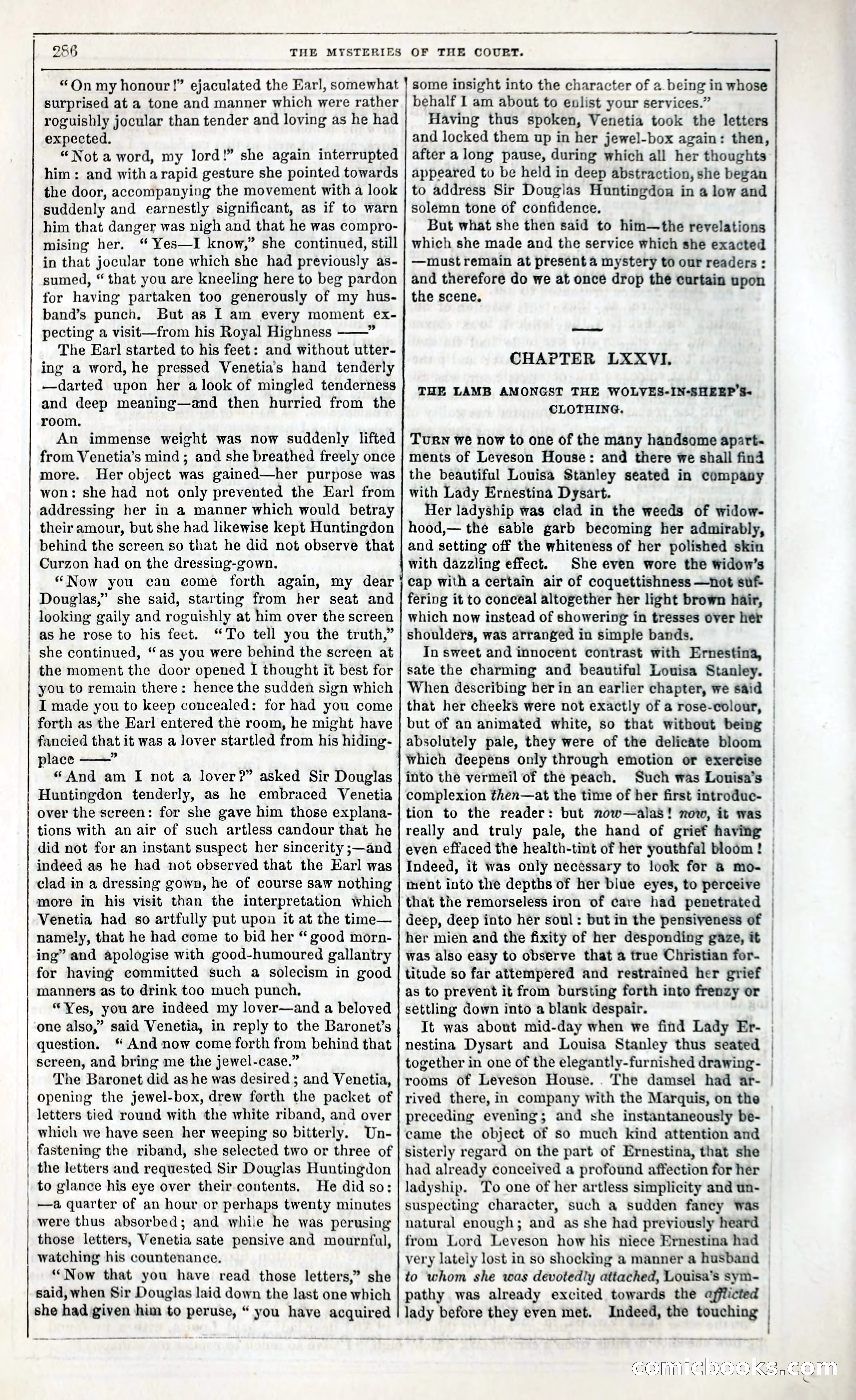
A restored page from Penny Dreadfuls, 1849. Page through the whole issue in the reader above.
📄 Transcribed text from this page (OCR, searchable)
Machine-transcribed from the original scan — historical spelling and the odd misread are preserved.
256 THE MYSTERIES OF THE COURT. “On my honour!” ejaculated the Earl, somewhat surprised at a tone and manner which were rather roguishly jocular than tender and loving as he had expected. “Not a word, my lord!” she again interrupted him: and witharapid gesture she pointed towards the door, accompanying the movement with a look suddenly and earnestly significant, as if to warn him that danger was nigh and that he was compro- mising her. ‘“ Yes—I know,” she continued, still in that jocular tone which she had previously as- sumed, “ that you are kneeling here to beg pardon for having partaken too generously of my hus- band’s punch. But as I am every moment ex- pecting a visit—from his Royal Highness ——” The Earl started to his feet: and without utter- ing a word, he pressed Venetias hand tenderly —darted upon her a look of mingled tenderness and deep meaning—and then hurried from the room. An immense weight was now suddenly lifted from Venetia’s mind; and she breathed freely once more. Her object was gained—her purpose was won: she had not only prevented the Earl from addressing her in a manner which would betray their amour, but she had likewise kept Huntingdon behind the screen so that he did not observe that Curzon had on the dressing-gown. * Now you can come forth again, my dear Douglas,” she said, starting from her seat and looking gaily and roguishly at him over the screen as he rose to his feet. “To tell you the truth,” she continued, “as you were behind the screen at the moment the door opened I thought it best for you to remain there: hence the sudden sign which I made you to keep concealed: for had you come forth as the Earl entered the room, he might have fancied that it was a lover startled from his hiding- place ——” “And am I not a lover?” asked Sir Douglas Huntingdon tenderly, as he embraced Venetia over the sereen: for she gave him those explana- tions with an air of such artless candour that he did not for an instant suspect her sincerity ;—and indeed as he had not observed that the Earl was clad in a dressing gown, he of course saw nothing more in his visit than the interpretation which Venetia had so artfully put upon it at the time— namely, that he had come to bid her “ good morn- ing” and apologise with good-humoured gallantry for having committed such a solecism in good manners as to drink too much punch. “Yes, you are indeed my lover—and a beloved one also,” said Venetia, in reply to the Baronet’s question. And now come forth from behind that screen, and bring me the jewel-case.” The Baronet did as he was desired ; and Venetia, opening the jewel-box, drew forth the packet of letters tied round with the white riband, and over which we have seen her weeping so bitterly. Un- fastening the riband, she selected two or three of the letters and requested Sir Douglas Huntingdon to glance his eye over their contents. He did so: —a quarter of an hour or perhaps twenty minutes were thus absorbed; and while he was perusing those letters, Venetia sate pensive and mournful, watching his countenance. “Now that you have read those letters,” she said, when Sir Douglas laid down the last one which she had given him to peruse, “ you have acquired some insight into the character of a. being in whose behalf I am about to enlist your services.” Having thus spoken, Venetia took the letters and locked them up in her jewel-box again: then, after a long pause, during which all her thoughts appeared to be held in deep abstraction, she began to address Sir Douglas Huntingdon in a low and solemn tone of confidence, But what she then said to him—the revelations which she made and the service which she exacted —must remain at present a mystery to our readers : and therefore do we at once drop thé curtain upon the scene. CHAPTER LXXVI. THE LAMB AMONGST THE WOLVES-IN-SHEEP’S- CLOTHING. Turn we now to one of the many handsome apart- ments of Leveson House: and there we shall find the beautiful Louisa Stanley seated in company with Lady Ernestina Dysart. Her ladyship was clad in the weeds of widow- hood,— the sable garb becoming her admirably, and setting off the whiteness of her polished skin with dazzling effect. She even wore the widow’s cap with a certain air of coquettishness —not suf- fering it to conceal altogether her light brown hair, which now instead of showering in tresses over her shoulders, was arranged in simple bands. In sweet and innocent contrast with Ernestina, sate the charming and beautiful Louisa Stanley. —_ - ee a ee ee When describing her in an earlier chapter, we said © that her cheeks were not exactly of a rose-colour, | but of an animated white, so that without being | absolutely pale, they were of the delicate bloom — Which deepens only through emotion or exereise © into the vermeil of the peach. Such was Lonisa’s | complexion then—at the time of her first introduc- — tion to the reader: but now—alaS! mow, it was | really and truly pale, the hand of grief having even effaced the health-tint of her youthfal bloom! | Indeed, it was only necéssary to look for & mo- | ment into the depths of her blue eyes, to perceive © that the remorseless iron of care had penetrated deep, deep into her soul: but in the pensiveness of her mien and the fixity of her desponding gaze, it was also easy to observe that a true Christian for- titude so far attempered and restrained her grief as to prevent it from bursting forth into frenzy or | settling down into a blank despair. It was about mid-day when we find Lady Er- nestina Dysart and Louisa Stanley thus seated together in one of the elegantly-furnished drawing- rooms of Leveson House. . The damsel had ar- rived there, in company with the Marquis, on the preceding evening; and she instantaneously be- came the object of so much kind attention and sisterly regard on the part of Ernestina, that she had already conceived a profound affection for her ladyship. To one of her artless simplicity and un- suspecting character, such a sudden fancy Was natural enough; and as she had previously heard from Lord Leveson how his niece Ernestina had very lately lost in so shocking a manner a husband to whom she was devotedly attached, Louisa’s sym- pathy was already excited towards the afflicted lady before they even met. Indeed, the touching —--—— — CORMNICLOO S ©