
Penny Dreadfuls, 1849 · page 30 of 394
The Mysteries of the Court of London — page 30: what you’re looking at
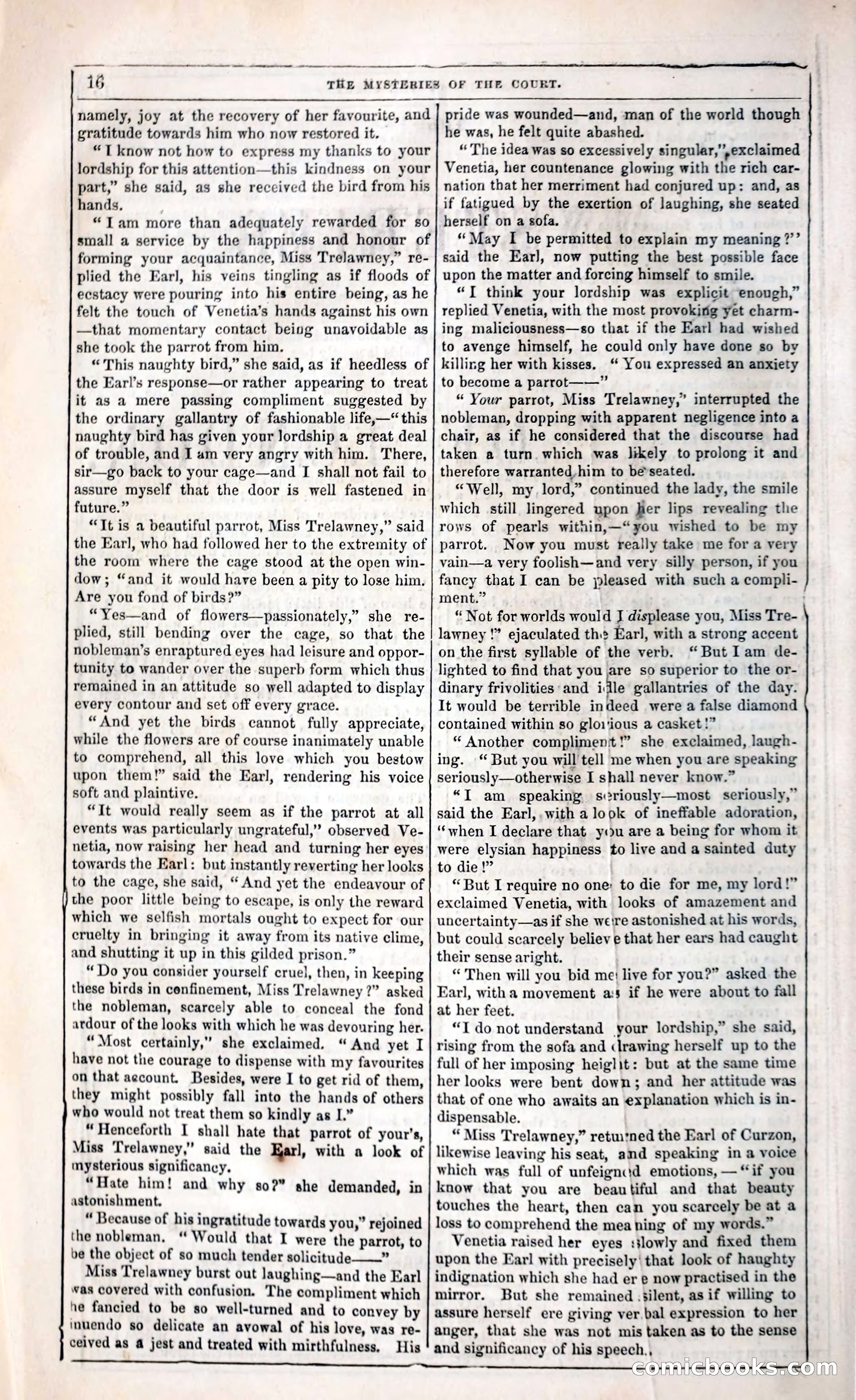
A restored page from Penny Dreadfuls, 1849. Page through the whole issue in the reader above.
📄 Transcribed text from this page (OCR, searchable)
Machine-transcribed from the original scan — historical spelling and the odd misread are preserved.
16 namely, joy at the recovery of her favourite, and gratitude towards him who now restored it. “1 know not how to express my thanks to your lordship for this attention—this kindness on your part,” she said, as she received the bird from his hands, ) “Tam more than adequately rewarded for so small a service by the happiness and honour of forming your acquaintance, Miss Trelawney,” re- plied the Earl, his veins tingling as if floods of ecstacy were pouring into his entire being, as he felt the touch of Venetia’s hands against his own —that momentary contact being unavoidable as she took the parrot from him. “This naughty bird,” she said, as if heedless of the Earl’s response—or rather appearing to treat it as a mere passing compliment suggested by the ordinary gallantry of fashionable life,—“ this naughty bird has given your lordship a great deal of trouble, and I am very angry with him. There, sir—go back to your cage—and I shall not fail to assure myself that the door is well fastened in future.” “Tt is a beautiful parrot, Miss Trelawney,” said the Earl, who had followed her to the extremity of the room where the cage stood at the open win- dow; “and it would have been a pity to lose him. Are you fond of birds?” “Yes—and of flowers—passionately,” she re- plied, still bending over the cage, so that the nobleman’s enraptured eyes had leisure and oppor- tunity to wander over the superb form which thus remained in an attitude so well adapted to display every contour and set off every grace. “And yet the birds cannot fully appreciate, while the flowers are of course inanimately unable to comprehend, all this love which you bestow upon them!” said the Earl, rendering his voice soft and plaintive. “It would really seem as if the parrot at all events was particularly ungrateful,” observed Ve- netia, now raising her head and turning her eyes towards the Earl: but instantly reverting her looks to the cage, she said, “ And yet the endeavour of the poor little being to escape, is only the reward which we selfish mortals ought to expect for our cruelty in bringing it away from its native clime, and shutting it up in this gilded prison.” “Do you consider yourself cruel, then, in keeping these birds in confinement, Miss Trelawney ?” asked the nobleman, scarcely able to conceal the fond ardour of the looks with which he was devouring her. “Most certainly,” she exclaimed. “And yet I have not the courage to dispense with my favourites on that aecount, Besides, were I to get rid of them, they might possibly fall into the hands of others who would not treat them so kindly as I.” “Henceforth I shall hate that parrot of your's, Miss Trelawney,” said the Karl, with a look of mysterious significancy, “Hate him! and why so?” she demanded, in astonishment. “ Because of his ingratitude towards you,” rejoined the nobleman. “ Would that I were the parrot, to ve the object of so much tender solicitude———” Miss Trelawney burst out laughing—and the Earl was covered with confusion. The compliment which he fancied to be so well-turned and to convey by inuendo so delicate an avowal of his love, was re- ceived as @ jest and treated with mirthfulness, His —————— eee ee THE MYSTERIES OF THE COURT. ; pride was wounded—and, man of the world though he was, he felt quite abashed. “The idea was so excessively singular,’,exclaimed Venetia, her countenance glowing with the rich car- nation that her merriment had conjured up: and, as if fatigued by the exertion of laughing, she seated herself on a sofa. “ May I be permitted to explain my meaning ?’’ said the Ear], now putting the best possible face upon the matter and forcing himself to smile. “JT think your lordship was explicit enough,” replied Venetia, with the most provoking yet charm- ing maliciousness—so that if the Earl had wished to avenge himself, he could only have done so by killing her with kisses. “ You expressed an anxiety to become a parrot——” “ Your parrot, Miss Trelawney,” interrupted the nobleman, dropping with apparent negligence into a chair, as if he considered that the discourse had taken a turn. which was likely to prolong it and therefore warranted, him to be’seated. “Well, my, lord,” continued the lady, the smile which still lingered upon fier lips revealing the rows of pearls within,—“you wished to be my parrot. Now you must really take me for a very vain—a very foolish—and very silly person, if you fancy that I can be pleased with such a compli- ment.” “ Not for worlds would J displease you, Miss Tre- lawney !” ejaculated th Earl, with a strong accent on the first syllable of the verb. “But Iam de- lighted to find that you are so superior to the or- dinary frivolities' and idle gallantries of the day. It would be terrible indeed were a false diamond contained within so gloitious a casket!” “ Another compliment!” she exclaimed, laugh- ing. “ But you will tell me when you are speaking serious] y—otherwise I shall never know.” “IT am _ speaking s:2riously—most seriously,” said the Earl, with a look of ineffable adoration, ‘‘when I declare that you are a being for whom it were elysian happiness to live anda sainted duty to die !” “But I require no one: to die for me, my lord!” exclaimed Venetia, with looks of amazement and uncertainty—as if she weire astonished at his words, but could scarcely believe that her ears had caught their sense aright. “ Then will you bid me: live for you?” asked the Earl, witha movement a:s if he were about to fall at her feet. “T do not understand your lordship,” she said, rising from the sofa and clrawing herself up to the full of her imposing heiglit: but at the same time her looks were bent down; and her attitude was that of one who awaits an explanation which is in- dispensable. “Miss Trelawney,” retuned the Earl of Curzon, likewise leaving his seat, and speaking in a voice which was full of unfeignad emotions, — “if you know that you are beautiful and that beauty touches the heart, then ean you scarcely be at a loss to comprehend the mea ning of my words.” Venetia raised her eyes sjlowly and fixed them upon the Earl with precisely’ that look of haughty indignation which she had er e now practised in the mirror. But she remained .3ilent, as if willing to assure herself ere giving ver.bal expression to her anger, that she was not mis taken as to the sense and significancy of his speech., COMLCIOO