
Penny Dreadfuls, 1849 · page 297 of 394
The Mysteries of the Court of London — page 297: what you’re looking at
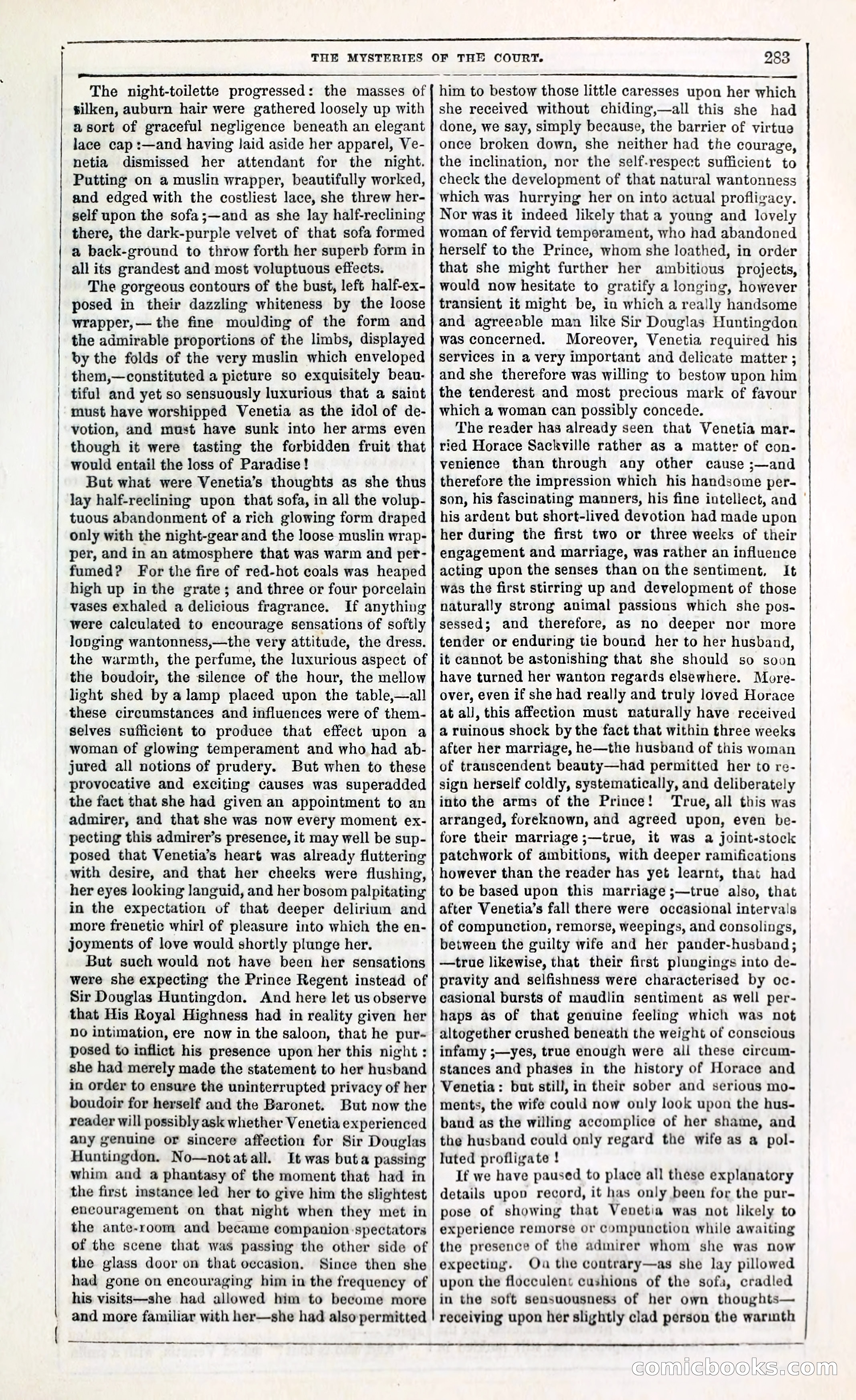
A restored page from Penny Dreadfuls, 1849. Page through the whole issue in the reader above.
📄 Transcribed text from this page (OCR, searchable)
Machine-transcribed from the original scan — historical spelling and the odd misread are preserved.
teens aemeeeaemene ee aaa aaa el THE MYSTERIES The night-toilette progressed: the masses of silken, auburn hair were gathered loosely up with asort of graceful negligence beneath an elegant lace cap :—and having laid aside her apparel, Ve- netia dismissed her attendant for the night. Putting on a muslin wrapper, beautifully worked, and edged with the costliest lace, she threw her- self upon the sofa;—and as she lay half-reclining there, the dark-purple velvet of that sofa formed a back-ground to throw forth her superb form in all its grandest and most voluptuous effects. The gorgeous contours of the bust, left half-ex- posed in their dazzling whiteness by the loose wrapper, — the fine moulding of the form and the admirable proportions of the limbs, displayed by the folds of the very muslin which enveloped them,—constituted a picture so exquisitely beau- tiful and yet so sensuously luxurious that a saint must have worshipped Venetia as the idol of de- votion, and must have sunk into her arms even though it were tasting the forbidden fruit that would entail the loss of Paradise! But what were Venetia’s thoughts as she thus lay half-reclining upon that sofa, in all the volup- tuous abandonment of a rich glowing form draped only with the night-gear and the loose muslin wrap- per, and in an atmosphere that was warm and per- fumed? For the fire of red-hot coals was heaped high up in the grate; and three or four porcelain vases exhaled a delicious fragrance. If anything were calculated to encourage sensations of softly longing wantonness,—the very attitude, the dress. the warmth, the perfume, the luxurious aspect of the boudoir, the silence of the hour, the mellow light shed by a lamp placed upon the table,—all these circumstances and influences were of them- selves sufficient to produce that effect upon a woman of glowing temperament and who had ab- jured all notions of prudery. But when to these provocative and exciting causes was superadded the fact that she had given an appointment to an admirer, and that she was now every moment ex- pecting this admirer’s presence, it may well be sup- posed that Venetia’s heart was already fluttering with desire, and that her cheeks were flushing, her eyes looking languid, and her bosom palpitating in the expectation of that deeper delirium and more frenetic whirl of pleasure into which the en- joyments of love would shortly plunge her. But such would not have been her sensations were she expecting the Prince Regent instead of Sir Douglas Huntingdon. And here let us observe that His Royal Highness had in reality given her no intimation, ere now in the saloon, that he pur- posed to inflict his presence upon her this night : she had merely made the statement to her husband in order to ensure the uninterrupted privacy of her boudoir for herself and the Baronet. But now the reader will possibly ask whether Venetia experienced any genuine or sincere affection for Sir Douglas Huntingdon. No—notatall. It was buta passing whim and a phantasy of the moment that had in the first instance led her to give him the slightest encouragement on that night when they met in the ante-room and became companion-spectators of the scene that was passing the other side of the glass door on that occasion. Since then she had gone on encouraging him in the frequency of his visits—she had allowed him to become more and more familiar with her—she had also permitted ere eee — ee eee ee ee ee OF THE 283 same him to bestow those little caresses upon her which she received without chiding,—all this she had done, we say, simply because, the barrier of virtue once broken down, she neither had the courage, the inclination, nor the self-respect sufficient to check the development of that natural wantonness which was hurrying her on into actual proflizacy. Nor was it indeed likely that a young and lovely woman of fervid temperament, who had abandoned herself to the Prince, whom she loathed, in order that she might further her ambitious projects, would now hesitate to gratify a longing, however transient it might be, in which a really handsome and agreeable man like Sir Douglas Huntingdon was concerned. Moreover, Venetia required his services in a very important and delicate matter ; and she therefore was willing to bestow upon him the tenderest and most precious mark of favour which a woman can possibly concede. The reader has already seen that Venetia mar- ried Horace Sackville rather as a matter of con- venience than through any other cause ;—and therefore the impression which his handsome per- son, his fascinating manners, his fine intellect, and his ardent but short-lived devotion had made upon her during the first two or three weeks of their engagement and marriage, was rather an influence acting upon the senses than on the sentiment, It was the first stirring up and development of those naturally strong animal passions which she pos- sessed; and therefore, as no deeper nor more tender or enduring tie bound her to her husband, it cannot be astonishing that she should so soon have turned her wanton regards elsewhere. More- over, even if she had really and truly loved Horace at all, this affection must naturally have received a ruinous shock by the fact that within three weeks after her marriage, he—the husband of this woman of trauscendent beauty—had permitted her to re- sign herself coldly, systematically, and deliberately into the arms of the Prince! True, all this was arranged, foreknown, and agreed upon, even be- fore their marriage ;—true, it was a joint-stock patchwork of ambitions, with deeper ramifications however than the reader has yet learnt, that had to be based upon this marriage ;—true also, that after Venetia’s fall there were occasional intervals of compunction, remorse, weepings, and consolings, between the guilty wife and her pander-husband; —true likewise, that their first plungings into de- pravity and selfishness were characterised by oc- casional bursts of maudlin sentiment as well per- haps as of that genuine feeling which was not altogether crushed beneath the weight of conscious infamy ;—yes, true enough were all these circum- stances and phases in the history of Horace and Venetia: but still, in their sober and serious mo- ments, the wife could now only look upon the hus- band as the willing accomplice of her shame, and the husband could only regard the wife as a pol- luted profligate ! If we have paused to place all these explanatory details upon record, it has only been for the pur- pose of showing that Venetia was not likely to experience remorse or Compunction while awaiting the presence of the admirer whom she was now expecting. On the contrary—as she lay pillowed upon the flocculent cushions of the sofa, cradled in the soft sensuousness of her own thoughts— receiving upon her slightly clad person the warmth COURT. — ECOMMICLOOKS (C (CO)