
Penny Dreadfuls, 1849 · page 283 of 394
The Mysteries of the Court of London — page 283: what you’re looking at
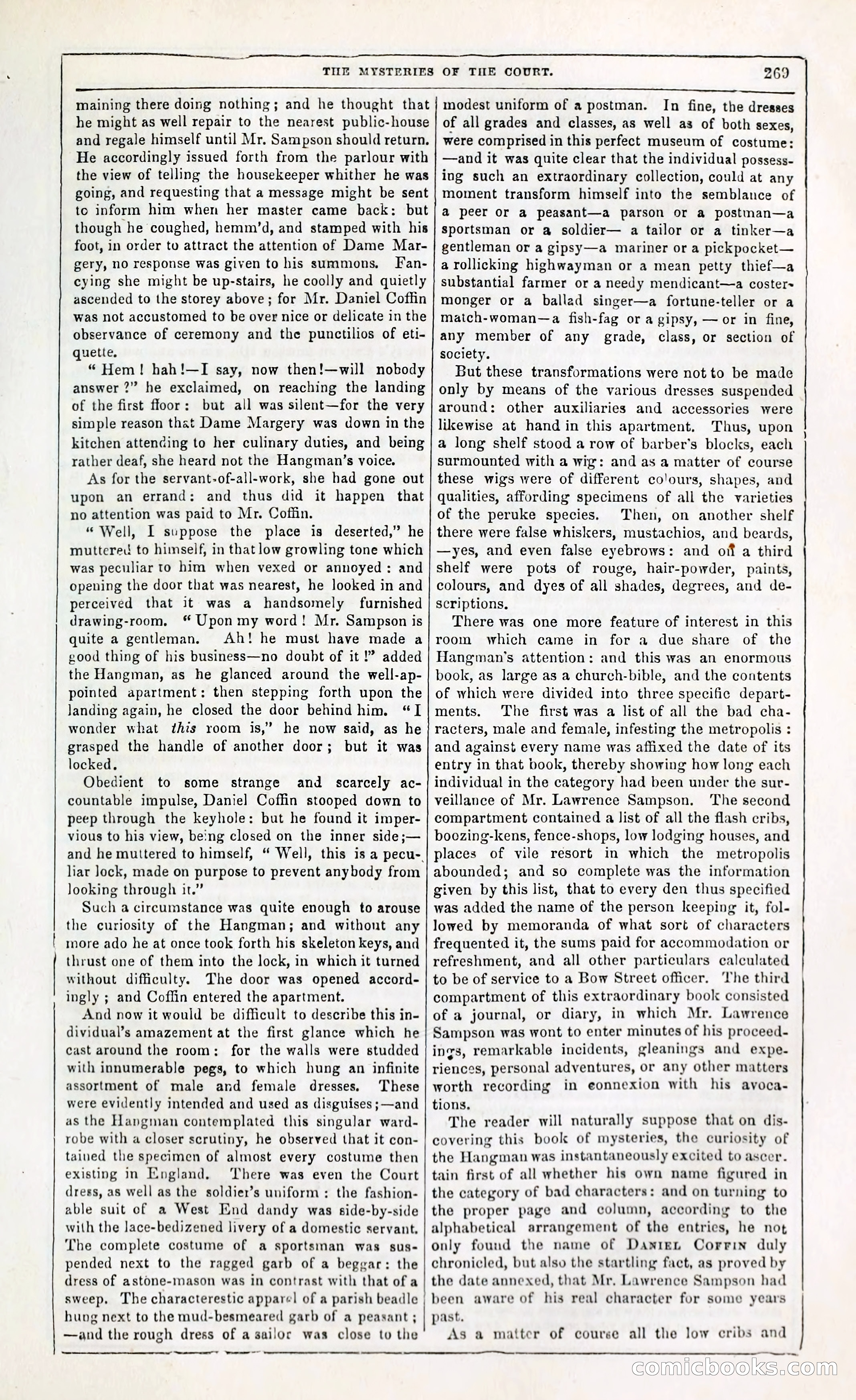
A restored page from Penny Dreadfuls, 1849. Page through the whole issue in the reader above.
📄 Transcribed text from this page (OCR, searchable)
Machine-transcribed from the original scan — historical spelling and the odd misread are preserved.
Neen SSS eet Oe THE MYSTERIES OF TILE COURT. maining there doing nothing; and he thought that he might as well repair to the nearest public-house and regale himself until Mr. Sampson should return. He accordingly issued forth from the parlour with the view of telling the housekeeper whither he was going, and requesting that a message might be sent to inform him when her master came back: but though he coughed, hemm’d, and stamped with his foot, in order to attract the attention of Dame Mar- gery, no response was given to his summons, Fan- cying she might be up-stairs, he coolly and quietly ascended to the storey above; for Mr. Daniel Coffin was not accustomed to be over nice or delicate in the observance of ceremony and the punctilios of eti- quette. “ Hem! hah!—I say, now then!—will nobody answer ?” he exclaimed, on reaching the landing of the first ffoor: but all was silent—for the very simple reason that Dame Margery was down in the kitchen attending to her culinary duties, and being rather deaf, she heard not the Hangman’s voice. As for the servant-of-all-work, she had gone out upon an errand: and thus did it happen that no attention was paid to Mr. Coffin. “Well, I suppose the place is deserted,” he muttered to himself, in that low growling tone which was peculiar to him when vexed or annoyed: and opening the door that was nearest, he looked in and perceived that it was a handsomely furnished drawing-room. ™ Uponmy word! Mr. Sampson is quite a gentleman. Ah! he must have made a good thing of his business—no douht of it !” added the Hangman, as he glanced around the well-ap- pointed apartment: then stepping forth upon the Janding again, he closed the door behind him. “I wonder what this room is,” he now said, as he grasped the handle of another door; but it was locked. Obedient to some strange and scarcely ac- countable impulse, Daniel Coffin stooped down to peep through the keyhole: but he found it imper- vious to his view, being closed on the inner side ;— and he muttered to himself, “ Well, this is a pecu-. liar Jock, made on purpose to prevent anybody from looking through it.” Such a circumstance was quite enough to arouse the curiosity of the Hangman; and withont any more ado he at once took forth his skeleton keys, and thrust one of them into the lock, in which it turned without difficulty. The door was opened accord- ingly ; and Coffin entered the apartment. And now it would be difficult to describe this in- dividual’s amazement at the first glance which he cast around the room: for the walls were studded with innumerable pegs, to which hung an infinite assortment of male and female dresses. These were evidently intended and used as disguises ;—and as the Hangman contemplated this singular ward- robe with a closer scrutiny, he observed that it con- tained the specimen of almost every costume then existing In England. ‘There was even the Court dress, as well as the soldier’s uniform: the fashion- able suit of a West Ind dandy was side-by-side with the lace-bedizened livery of a domestic servant. The complete costume of a sportsman was sus- pended next to the ragged garb of a beggar: the dress of astone-mason was in contrast with that ofa sweep, The characterestic apparel of a parish beadle hung next to the mud-besmeared garb of a peasant ; —and the rough dress of a sailor was close to the eee ‘mm cour ———~—~«OG) modest uniform of a postman. In fine, the dresses of all grades and classes, as well as of both sexes, were comprised in this perfect museum of costume: —and it was quite clear that the individual possess- ing such an extraordinary collection, could at any moment transform himself into the ‘bea of a peer or a peasant—a parson or a postman—a Sportsman or a soldier— a tailor or a tinker—a gentleman or a gipsy—a mariner or a pickpocket— a rollicking highwayman or a mean petty thief—a substantial farmer or a needy mendicant—a coster~ monger or a ballad singer—a fortune-teller or a match-woman—a fish- faz or a gipsy, — or in fine, any member of any grade, class, or section of society. But these transformations were not to be made only by means of the various dresses suspended around: other auxiliaries and accessories were likewise at hand in this apartment. Thus, upon a long shelf stood a row of barber's blocks, each surmounted with a wig: and as a matter of course these wigs were of different colours, shapes, and qualities, affording specimens of all ine varieties of the peruke species. Then, on another shelf there were false whiskers, mustachios, and beards, —yes, and even false eyebrows: and of a third shelf were pots of rouge, hair-powder, paints, colours, and dyes of all shades, degrees, and de- scriptions. There was one more feature of interest in this room which came in for a due share of the Hangman’s attention: and this was an enormous book, as large as a church-bible, and the contents of which were divided into three specific depart- ments. The first was a list of all the bad cha- racters, male and female, infesting the metropolis : and against every name was affixed the date of its entry in that book, thereby showing how long each individual in the category had been under the sur- veillance of Mr. Lawrence Sampson. ‘The second compartment contained a list of all the flash cribs, boozing-kens, fence- shops, low lodging houses, and places of vile resort in which the metropolis abounded; and so complete was the information given by this list, that to every den thus specified was added the name of the person keeping it, fol- lowed by memoranda of what sort of characters frequented it, the sums paid for accommodation or refreshment, and all other particulars calculated to be of service to a Bow Street officer. ‘The third compartment of this extraordinary book consisted of a journal, or diary, in which Mr. Lawrence Sampson was wont to enter minutes of his proceed- ings, remarkable incidents, gleanings and expe- riences, personal adventures, or any other matters worth recording in eonnexion with his avyoca- tions, The reader will naturally suppose that on dis- covering this book of mysteries, the curiosity of the Hangman was instantaneously excited to ascer. tain first of all whether his own name figured in the category of bad characters: and on turning to the proper page and column, according to the alphabetical arrangement of the entries, he not only found the name of Dawniet Corrin duly chronicled, but also the startling fact, as proved by the date annexed, that Mr. Lawrence Sampson had | been aware of his real character for some years past. As a matter of course all the low cribs and ct et ECOMICLHOOkKS (CO)