
Penny Dreadfuls, 1849 · page 267 of 394
The Mysteries of the Court of London — page 267: what you’re looking at
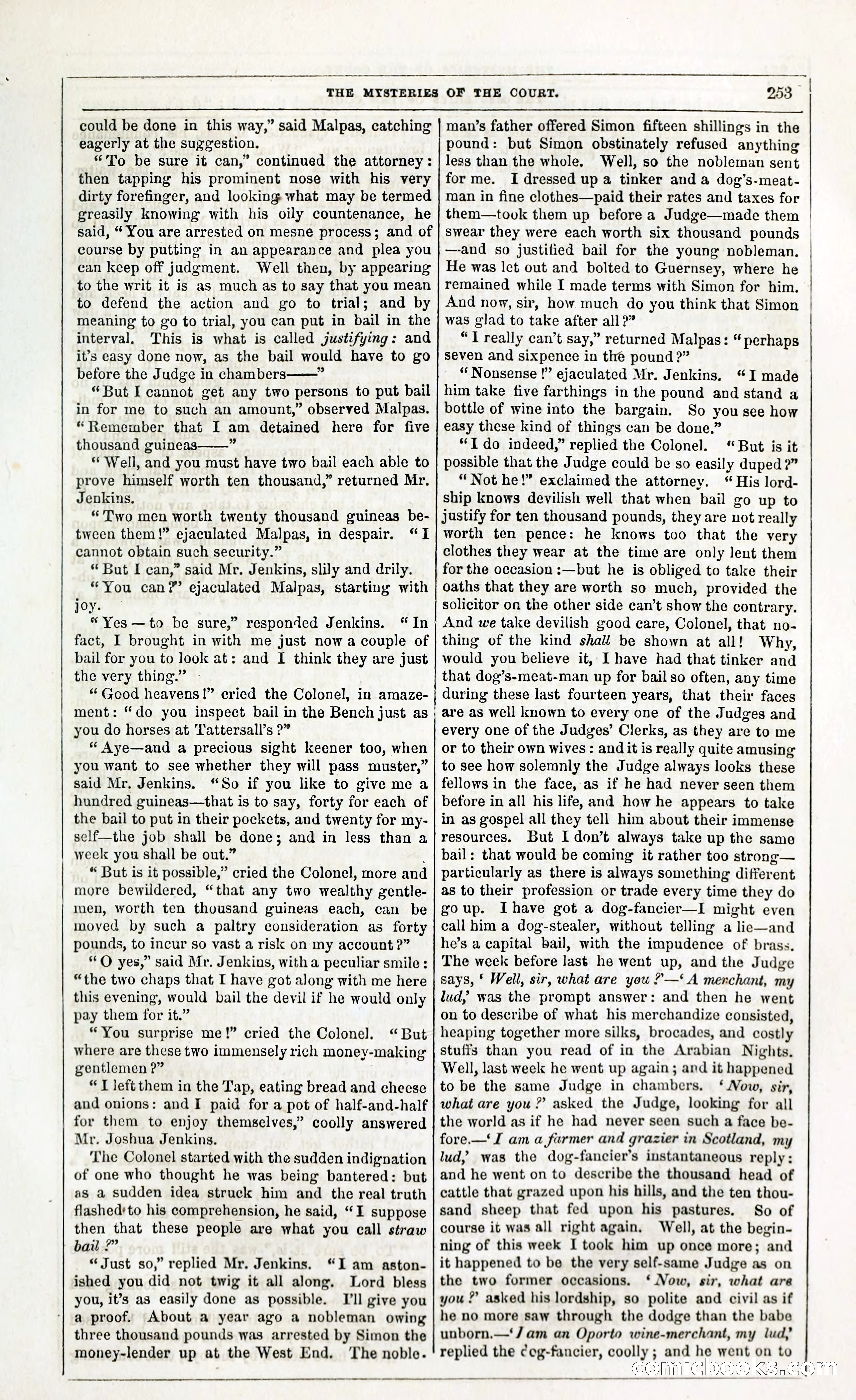
A restored page from Penny Dreadfuls, 1849. Page through the whole issue in the reader above.
📄 Transcribed text from this page (OCR, searchable)
Machine-transcribed from the original scan — historical spelling and the odd misread are preserved.
ee ee Se ae ne eee THE MYSTERIES OF THE COURT. 253 could be done in this way,” said Malpas, catching eagerly at the suggestion. “To be sure it can,” continued the attorney: then tapping his prominent nose with his very dirty forefinger, and looking what may be termed greasily knowing with his oily countenance, he said, “ You are arrested on mesne process; and of course by putting in an appearance and plea you can keep off judgment. Well then, by appearing to the writ it is as much as to say that you mean to defend the action and go to trial; and by meaning to go to trial, you can put in bail in the interval. This is what is called justifying: and it’s easy done now, as the bail would have to go before the Judge in chambers “But I cannot get any two persons to put bail in for me to such an amount,” observed Malpas. “Remember that I am detained here for five thousand guineas——” ** Well, and you must have two bail each able to prove himself worth ten thousand,” returned Mr. Jenkins. “Two men worth twenty thousand guineas be- tween them!” ejaculated Malpas, in despair. “I cannot obtain such security.” * But I can,” said Mr. Jenkins, slily and drily. “You can?’ ejaculated Malpas, starting with joy. * Yes —to be sure,” responded Jenkins. “In fact, I brought in with me just now a couple of bail for you to look at: and I think they are just the very thing.” - ‘“ Good heavens!” cried the Colonel, in amaze- ment: “do you inspect bail in the Bench just as you do horses at Tattersall’s ?” * Aye—and a precious sight keener too, when you want to see whether they will pass muster,” said Mr. Jenkins. “So if you like to give me a hundred guineas—that is to say, forty for each of the bail to put in their pockets, and twenty for my- self—the job shall be done; and in less than a week you shall be out.” “ But is it possible,” cried the Colonel, more and more bewildered, “that any two wealthy gentle- raen, worth ten thousand guineas each, can be moved by such a paltry consideration as forty pounds, to incur so vast a risk on my account ?” *O yes,” said Mr. Jenkins, with a peculiar smile: “the two chaps that I have got along with me here this evening, would bail the devil if he would only pay them for it.” “You surprise me!” cried the Colonel. “But where are these two immensely rich money-making gentlemen ?” “1 leftthem in the Tap, eating bread and cheese and onions: and I paid for a pot of half-and-half for them to enjoy themselves,” coolly answered Mr. Joshua Jenkins. ‘The Colonel started with the sudden indignation of one who thought he was being bantered: but as a sudden idea struck him and the real truth flashed'to his comprehension, he said, “I suppose then that these people are what you call straw bail ?” “Just so,” replied Mr, Jenkins. “I am aston- ished you did not twig it all along. Lord bless you, it’s as easily done as possible. I'll give you a proof. About a year ago a nobleman owing three thousand pounds was arrested by Simon the money-lender up at the West End. ‘The noble. man’s father offered Simon fifteen shillings in the pound: but Simon obstinately refused anything less than the whole. Well, so the nobleman sent forme. I dressed up a tinker and a dog’s-meat- man in fine clothes—paid their rates and taxes for them—tovuk them up before a Judge—made them swear they were each worth six thousand pounds —-and so justified bail for the young nobleman. He was let out and bolted to Guernsey, where he remained while I made terms with Simon for him. And now, sir, how much do you think that Simon was glad to take after all ?” “I really can’t say,” returned Malpas: “perhaps seven and sixpence in the pound 2?” “‘ Nonsense !” ejaculated Mr. Jenkins. “I made him take five farthings in the pound and stand a bottle of wine into the bargain. So you see how easy these kind of things can be done.” “I do indeed,” replied the Colonel. “But is it possible that the Judge could be so easily duped 2” “Not he!” exclaimed the attorney. “His lord- ship knows devilish well that when bail go up to Justify for ten thousand pounds, they are not really worth ten pence: he knows too that the very clothes they wear at the time are only lent them for the occasion :—but he is obliged to take their oaths that they are worth so much, provided the solicitor on the other side can’t show the contrary. And we take devilish good care, Colonel, that no- thing of the kind shall be shown at all! Why, would you believe it, I have had that tinker and that dog’s-meat-man up for bail so often, any time during these last fourteen years, that their faces are as well known to every one of the Judges and every one of the Judges’ Clerks, as they are to me or to their own wives: and it is really quite amusing to see how solemnly the Judge always looks these fellows in the face, as if he had never seen them before in all his life, and how he appears to take in as gospel all they tell him about their immense resources. But I don’t always take up the same bail: that would be coming it rather too strong— particularly as there is always something different as to their profession or trade every time they do goup. Ihave got a dog-fancier—I might even call him a dog-stealer, without telling a lie—and he’s a capital bail, with the impudence of brass. The week before last he went up, and the Judge says, ‘ Well, sir, what are you ?—‘ A merchant, my lud, was the prompt answer: and then he went on to describe of what his merchandize consisted, heaping together more silks, brocades, and costly stuffs than you read of in the Arabian Nights. Well, last week he went up again; and it happened to be the same Judge in chambers. ‘ Now, sir, what are you? asked the Judge, looking for all the world as if he had never seen such a face be- fore.—‘ I am a farmer and grazier in Scotland, my lud,’ was the dog-fancier’s instantaneous reply: and he went on to describe the thousand head of cattle that grazed upon his hills, and the ten thou- sand sheep that fed upon his pastures. So of course it was all right again. Well, at the begin- ning of this week I took him up once more; and it happened to be the very self-same Judge as on the two former occasions. ‘ Now, sir, what are you ? asked his lordship, so polite and civil as if he no more saw through the dodge than the babe unborn.—‘/ am an Oporto wine-merchant, my lud, replied the cog-fancier, coolly ; and he went on to GOMIGEIOOKSHE