
Penny Dreadfuls, 1849 · page 265 of 394
The Mysteries of the Court of London — page 265: what you’re looking at
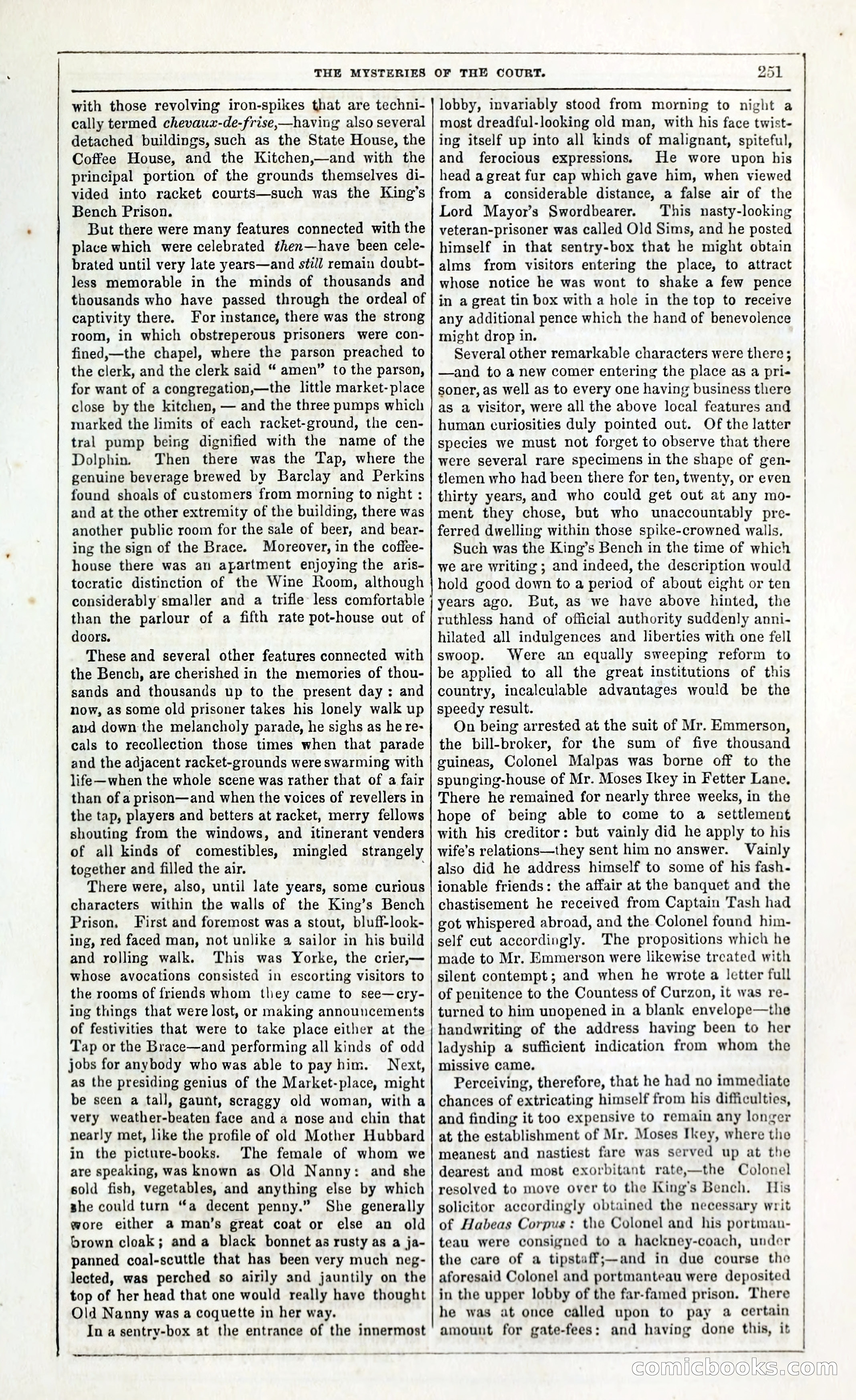
A restored page from Penny Dreadfuls, 1849. Page through the whole issue in the reader above.
📄 Transcribed text from this page (OCR, searchable)
Machine-transcribed from the original scan — historical spelling and the odd misread are preserved.
THE MYSTERIES OF THE COURT. rm en ee Se y Ast) with those revolving iron-spikes that are techni- cally termed chevaux-de-frise,—having also several detached buildings, such as the State House, the Coffee House, and the Kitchen,—and with the principal portion of the grounds themselves di- vided into racket courts—such was the King’s Bench Prison. But there were many features connected with the place which were celebrated then—have been cele- brated until very late years—and still remain doubt- less memorable in the minds of thousands and thousands who have passed through the ordeal of captivity there. For instance, there was the strong room, in which obstreperous prisoners were con- fined,—the chapel, where the parson preached to the clerk, and the clerk said “ amen” to the parson, for want of a congregation,—the little market- place close by the kitchen, — and the three pumps which marked the limits of each racket-ground, the cen- tral pump being dignified with the name of the Dolphin. Then there was the Tap, where the genuine beverage brewed by Barclay and Perkins found shoals of customers from morning to night : and at the other extremity of the building, there was another public room for the sale of beer, and bear- ing the sign of the Brace. Moreover, in the cofiee- house there was an apartment enjoying the aris- tocratic distinction of the Wine Room, although considerably smaller and a trifle less comfortable than the parlour of a fifth rate pot-house out of doors. These and several other features connected with the Bench, are cherished in the memories of thou- sands and thousands up to the present day: and now, as some old prisoner takes his lonely walk up avd down the melancholy parade, he sighs as he re- cals to recollection those times when that parade and the adjacent racket-grounds were swarming with life—when the whole scene was rather that of a fair than of a prison—and when the voices of revellers in the tap, players and betters at racket, merry fellows shouting from the windows, and itinerant venders of all kinds of comestibles, mingled strangely together and filled the air. There were, also, until late years, some curious characters within the walls of the King’s Bench Prison, First and foremost was a stout, bluff-look- ing, red faced man, not unlike a sailor in his build and rolling walk. This was Yorke, the crier,— whose avocations consisted in escorting visitors to the rooms of friends whom they came to see—ecry- ing things that were lost, or making announcements of festivities that were to take place either at the Tap or the Brace—and performing all kinds of odd jobs for anybody who was able to pay him. Next, as the presiding genius of the Market-place, might be seen a tall, gaunt, scraggy old woman, with a very weather-beaten face and a nose and chin that nearly met, like the profile of old Mother Hubbard in the picture-books. The female of whom we are speaking, was known as Old Nanny: and she sold fish, vegetables, and anything else by which she could turn “a decent penny.” She generally wore either a man’s great coat or else an old brown cloak; anda black bonnet as rusty as a ja- panned coal-scuttle that has been very much neg- lected, was perched so airily and jauntily on the top of her head that one would really have thought Old Nanny was a coquette in her way. In a sentry-box at the entrance of the innermost —-. —_—— ——- ———_—_— eS — —- ——- ee lobby, invariably stood from morning to night a most dreadful-looking old man, with his face twist- ing itself up into all kinds of malignant, spiteful, and ferocious expressions) He wore upon his head agreat fur cap which gave him, when viewed from a considerable distance, a false air of the Lord Mayor’s Swordbearer. This nasty-looking veteran-prisoner was called Old Sims, and he posted himself in that sentry-box that he might obtain alms from visitors entering the place, to attract whose notice he was wont to shake a few pence in a great tin box with a hole in the top to receive any additional pence which the hand of benevolence might drop in. Several other remarkable characters were there; —and to a new comer entering the place as a pri- soner, as well as to every one having business there as a visitor, were all the above local features and human curiosities duly pointed out. Of the latter species we must not forget to observe that there were several rare specimens in the shape of gen- tlemen who had been there for ten, twenty, or even thirty years, and who could get out at any mo- ment they chose, but who unaccountably pre- ferred dwelling within those spike-crowned walls, Such was the King’s Bench in the time of which we are writing ; and indeed, the description would hold good down to a period of about eight or ten years ago. But, as we have above hinted, the ruthless hand of official authority suddenly anni- hilated all indulgences and liberties with one fell swoop. Were an equally sweeping reform to be applied to all the great institutions of this country, incalculable advautages would be the speedy result. On being arrested at the suit of Mr. Emmerson, the bill-broker, for the sum of five thousand guineas, Colonel Malpas was borne off to the spunging-house of Mr. Moses Ikey in Fetter Lane, There he remained for nearly three weeks, in the hope of being able to come to a settlement with his creditor: but vainly did he apply to his wife’s relations—they sent him no answer. Vainly also did he address himself to some of his fash- ionable friends: the affair at the banquet and the chastisement he received from Captain Tash had got whispered abroad, and the Colonel found him- self cut accordingly. The propositions which he made to Mr. Emmerson were likewise treated with silent contempt; and when he wrote a letter full of penitence to the Countess of Curzon, it was re- turned to him unopened in a blank envelope—the handwriting of the address having been to her ladyship a sufficient indication from whom the missive came. Perceiving, therefore, that he had no immediate chances of extricating himself from his difficulties, and finding it too expensive to remain any longer at the establishment of Mr. Moses Ikey, where the meanest and nastiest fare was served up at the dearest and most exorbitant rate,—the Colonel resolved to move over to the King’s Bench. His solicitor accordingly obtained the necessary writ of Habeas Corpus: the Colonel and his portman- teau were consigned to a hackney- coach, under the care of a tipstaff;—and in due course the aforesaid Colonel and portmanteau were deposited in the upper lobby of the far-famed prison. There he was at once called upon to pay a certain amount for gate-fees: and having done this, it | OO Connie S (CO)