
Penny Dreadfuls, 1849 · page 261 of 394
The Mysteries of the Court of London — page 261: what you’re looking at
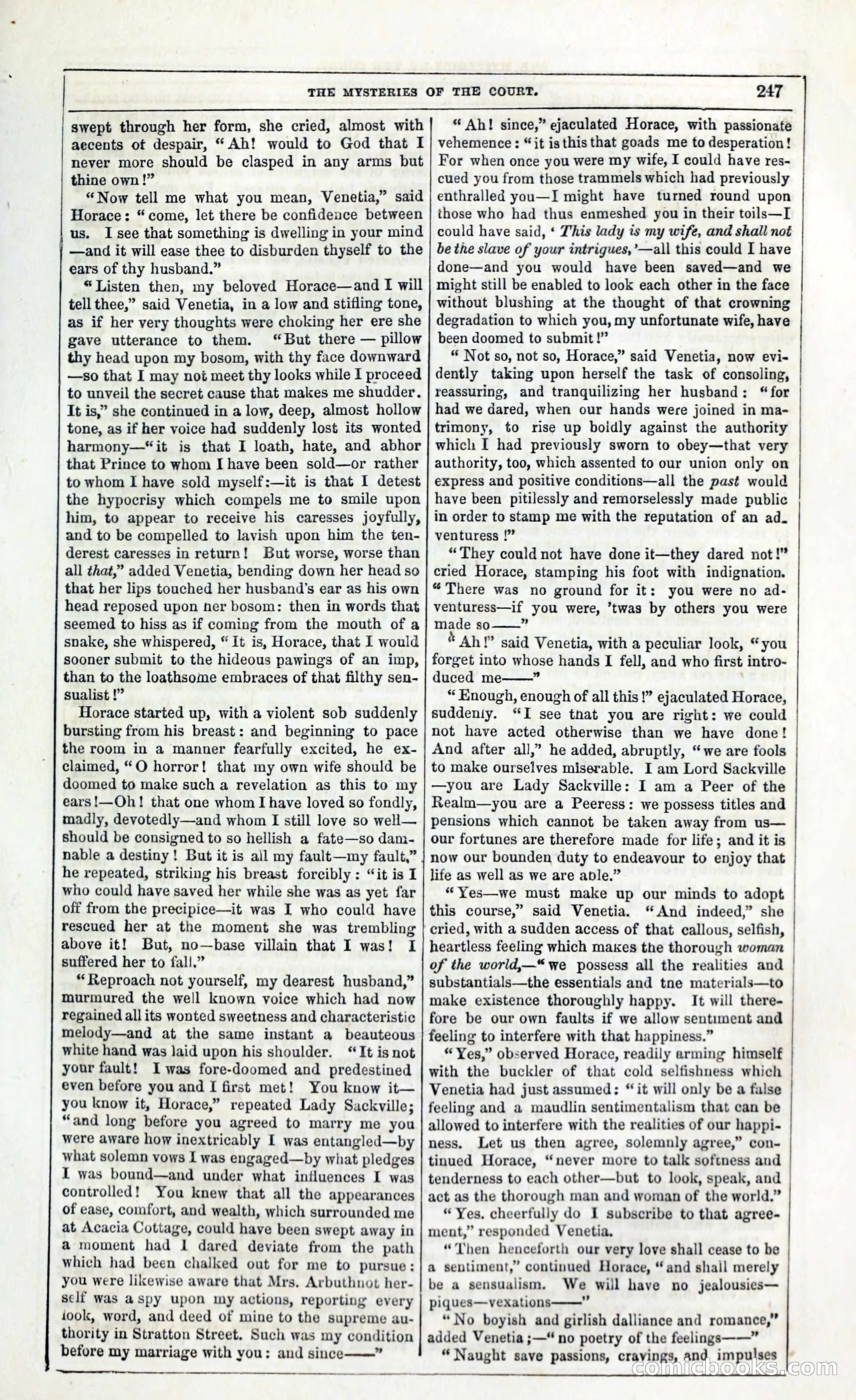
A restored page from Penny Dreadfuls, 1849. Page through the whole issue in the reader above.
📄 Transcribed text from this page (OCR, searchable)
Machine-transcribed from the original scan — historical spelling and the odd misread are preserved.
= SRR RE ee THE MYSTERIES OF THE COURT. 247 swept through her form, she cried, almost with aecents of despair, “ Ah! would to God that I never more should be clasped in any arms but thine own!” “Now tell me what you mean, Venetia,” said Horace: “ come, let there be confidence between us. I see that something is dwelling in your mind —and it will ease thee to disburden thyself to the ears of thy husband.” “Listen then, my beloved Horace—and I will tell thee,” said Venetia, in a low and stifling tone, as if her very thoughts were choking her ere she gave utterance to them. thy head upon my bosom, with thy face downward —so that I may not meet thy looks while I proceed to unveil the secret cause that makes me shudder. It is,” she continued in a low, deep, almost hollow tone, as if her voice had suddenly lost its wonted harmony—“it is that I loath, hate, and abhor that Prince to whom I have been sold—or rather to whom I have sold myself:—it is that I detest the hypocrisy which compels me to smile upon him, to appear to receive his caresses joyfully, and to be compelled to lavish upon him the ten- derest caresses in return! But worse, worse than all that,” added Venetia, bending down her head so that her lips touched her husband’s ear as his own head reposed upon her bosom: then in words that seemed to hiss as if coming from the mouth of a snake, she whispered, “ It is, Horace, that I would sooner submit to the hideous pawings of an imp, than to the loathsome embraces of that filthy sen- sualist !” Horace started up, with a violent sob suddenly bursting from his breast: and beginning to pace the room in a manner fearfully excited, he ex- claimed, “O horror! that my own wife should be doomed to make such a revelation as this to my ears!—Oh! that one whom I have loved so fondly, madly, devotedly—and whom I still love so well— should be consigned to so hellish a fate—so dam- nable a destiny! But it is all my fault—my fault,” he repeated, striking his breast forcibly: “it is I who could have saved her while she was as yet far off from the precipice—it was I who could have rescued her at the moment she was trembling above it! But, no—base villain that I was! I suffered her to fall.” * Reproach not yourself, my dearest husband,” murmured the well known voice which had now regained all its wonted sweetness and characteristic melody—and at the same instant a beauteous white hand was laid upon his shoulder. “It isnot your fault! Iwas fore-doomed and predestined even before you and I first met! You know it— you know it, Horace,” repeated Lady Sackville; “and long before you agreed to marry me you were aware how inextricably I was entangled—by what solemn vows I was engaged—by what pledges I was bound—and under what influences I was controlled! You knew that all the appearances of ease, comfort, and wealth, which surrounded me at Acacia Cottage, could have been swept away in a moment had 1 dared deviate from the path which had been chalked out for me to pursue: you were likewise aware that Mrs. Arbuthnot her- self was aspy upon my actions, reporting every jook, word, and deed of mine to the supreme au- thority in Stratton Street. Such was my condition before my marriage with you: and since——” — ——— “But there — pillow — ———— “ Ah! since,” ejaculated Horace, with passionate vehemence : “jt isthis that goads me to desperation! For when once you were my wife, I could have res- cued you from those trammels which had previously enthralled you—I might have turned round upon those who had thus enmeshed you in their toils—I could have said, ‘ This lady ts my wife, and shall not be the slave of your intrigues, ’—all this could I have done—and you would have been saved—and we might still be enabled to look each other in the face without blushing at the thought of that crowning degradation to which you, my unfortunate wife, have been doomed to submit !” * Not so, not so, Horace,” said Venetia, now evi- dently taking upon herself the task of consoling, reassuring, and tranquilizing her husband: “for had we dared, when our hands were joined in ma- trimony, to rise up boidly against the authority which I had previously sworn to obey—that very authority, too, which assented to our union only on express and positive conditions—all the past would have been pitilessly and remorselessly made public in order to stamp me with the reputation of an ad. venturess !” “They could not have done it—they dared not!” cried Horace, stamping his foot with indignation. “There was no ground for it: you were no ad- venturess—if you were, ’twas by others you were made so——” * Ah!” said Venetia, with a peculiar look, “you forget into whose hands I fell, and who first intro- duced me “ Knough, enough of all this!” ejaculated Horace, suddenly. “I see that you are right: we could not have acted otherwise than we have done! And after all,” he added, abruptly, “we are fools to make ourselves miserable. I am Lord Sackville —you are Lady Sackville: I am a Peer of the Realm—you are a Peeress: we possess titles and pensions which cannot be taken away from us— our fortunes are therefore made for life; and it is now our bounden duty to endeavour to enjoy that life as well as we are able.” “ Yes—we must make up our minds to adopt this course,” said Venetia. “And indeed,” she cried, with a sudden access of that callous, selfish, heartless feeling which makes the thorough woman of the world,—“ we possess all the realities and substantials—the essentials and tne materials—to make existence thoroughly happy. It will there- fore be our own faults if we allow sentiment and feeling to interfere with that happiness.” * Yes,” observed Horace, readily arming himself with the buckler of that cold selfishness which Venetia had just assumed: “it will only be a false feeling and a maudlin sentimentalism that can be allowed to interfere with the realities of our happi- ness. Let us then agree, solemnly agree,” con- tinued Horace, “never more to talk softness and tenderness to each other—but to look, speak, and act as the thorough man and woman of the world.” * Yes. cheerfully do I subscribe to that agree- ment,” responded Venetia, “Then henceforth our very love shall cease to be a sentiment,” continued Horace, “and shail merely be a sensualism. We will have no jealousies— piques—vexations——” “No boyish and girlish dalliance and romance,” added Venetia ;—* no poetry of the feelings——” sett ee — “ Naught save passions, cravings